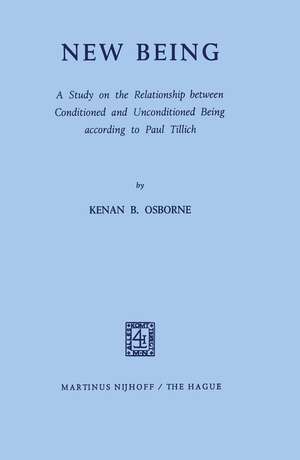
New Being: A Study on the Relationship between Conditioned and Unconditioned Being according to Paul Tillich
Autor Kenan B. Osborneen Limba Engleză Paperback – 1969
Preț: 370.62 lei
Puncte Express: 556
Carte tipărită la comandă
Livrare economică 30 noiembrie-14 decembrie
Livrare prin curier în România Termenul estimat este afișat lângă disponibilitate.
Transport gratuit de la 400.00 lei Plată online sau ramburs, în funcție de opțiunile comenzii.
Retur gratuit în 14 zile Comandă securizată și suport în română.
Specificații
ISBN-13: 9789401502610
ISBN-10: 9401502617
Pagini: 244
Ilustrații: XI, 228 p.
Dimensiuni: 155 x 235 x 13 mm
Greutate: 0.35 kg
Ediția:1969
Editura: SPRINGER NETHERLANDS
Colecția Springer
Locul publicării:Dordrecht, Netherlands
ISBN-10: 9401502617
Pagini: 244
Ilustrații: XI, 228 p.
Dimensiuni: 155 x 235 x 13 mm
Greutate: 0.35 kg
Ediția:1969
Editura: SPRINGER NETHERLANDS
Colecția Springer
Locul publicării:Dordrecht, Netherlands
V-ar putea interesa
-
 On What There Must BeRoss Harrison-33%Preț: 753.82 lei1122.63 lei
 -
 The Existence of Space and TimeIan Hinckfuss-28%Preț: 344.50 lei481.47 lei
 -
 Kant and the Transcendental Object: A Hermeneutic StudyJ. N. Findlay-32%Preț: 648.26 lei959.86 lei
 -
 -31%Preț: 891.56 lei1285.88 lei
 -
 The Self and Self-KnowledgeAnnalisa Coliva-31%Preț: 727.16 lei1054.57 lei
 -
 The Law-Governed UniverseJohn T. Roberts-21%Preț: 513.47 lei652.26 lei
 -
 Metaphysics: A Very Short IntroductionStephen Mumford-20%Preț: 56.19 lei70.53 lei
 -
 Oxford Studies in Metaphysics volume 7Karen Bennett-12%Preț: 320.90 lei364.83 lei
 -
 Perception, Causation, and ObjectivityJohannes Roessler-22%Preț: 351.90 lei450.94 lei
 -
 Rethinking ResponsibilityK. E. Boxer-29%Preț: 521.99 lei732.11 lei
 -
 -21%Preț: 444.32 lei561.28 lei
 -
 Without Hierarchies: The Scale Freedom of the UniverseMariam Thalos-31%Preț: 629.80 lei914.72 lei
 -
 -13%Preț: 262.56 lei300.32 lei
 -
 Your Magnetic HeartRuediger SchachePreț: 158.27 lei
 -
 MetaphysicsRobert C. KoonsPreț: 185.54 lei
 -
 Debates in the Metaphysics of TimeL. Nathan Oaklander-23%Preț: 259.16 lei336.50 lei
Public țintă
ResearchCuprins
I: The threefold basic towards understanding conditioned being’s quest for the unconditioned.- 1. Identification and evaluation of the theme.- 2. The problematic of Tillich’s “quest”.- 3. The axial concepts in this problematic of the “quest”.- II: Three fundamental approaches to resolve the problematic of Tillich’s “quest”.- 1. The first approach: Tillich’s so-called “answering theology”.- 2. The second approach: Tillich’s two formal criteria and his material norm for all systematic theology.- 3. The third approach: Tillich’s existentialism.- III: Idealistic components in Tillich’s interpretation of the God-man relationship.- 1. German idealism in general.- 2. Tillich’s interpretation of the God-man relationship and Kant’s analysis of finitude.- 3. Tillich’s interpretation of the God-man relationship and Fichte’s dynamic view of the subject-object structure.- 4. Tillich’s prius of ultimate concern and Schleiermacher’s prius of “Das schlecht- hinnige Abhängigkeitsgefühl.- 5. Tillich’s interpretation of the God-man relationship and Schelling’s explanation of the transition from essence to existence.- 6. Tillich’s interpretation of the God-man relationship and Hegel’s explanation of dialectic.- IV: Tillich’s interpretation of old being.- 1. Old being as reason and the quest for revelation.- 2. Old being as finite essence and the question of God.- 3. Old being as existence and the quest for the Christ.- 4. Old being as ambiguous life and the quest for unambiguous life.- 5. Old being as history and the quest for the kingdom of God.- 6. Conclusion concerning old being and the God-man relationship.- V: New Being in Jesus as the Christ.- 1. What does Tillich find in adequate or false in the chalcedonian formula?.- 2. Whatdoes Tillich mean by the incarnation?.- 3. What does Tillich mean by redemption?.- 4. What does Tillich mean by redemption applied to men?.- VI: General conclusions and evaluations regarding Tillich’s interpretation of the God-man relationship.- 1. General criticisms.- 2. Positive and valid aspects of Tillich’s interpretation of the God-man relationship.- Excursus: Tillich’s explanation of the two streams of philosophical thought since the renaissance.