
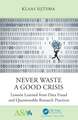
Never Waste a Good Crisis: Lessons Learned from Data Fraud and Questionable Research Practices: ASA-CRC Series on Statistical Reasoning in Science and Society
Autor Klaas Sijtsmaen Limba Engleză Hardback – 15 iun 2023
| Toate formatele și edițiile | Preț | Express |
|---|---|---|
| Paperback (1) | 268.07 lei 3-5 săpt. | +26.60 lei 4-10 zile |
| CRC Press – 15 iun 2023 | 268.07 lei 3-5 săpt. | +26.60 lei 4-10 zile |
| Hardback (1) | 615.27 lei 6-8 săpt. | |
| CRC Press – 15 iun 2023 | 615.27 lei 6-8 săpt. |

Preț: 615.27 lei
Preț vechi: 723.85 lei
-15%
108.77€ • 129.68$ • 94.34£
Carte tipărită la comandă
Livrare economică 17-31 martie
Specificații
ISBN-10: 1032189010
Pagini: 218
Ilustrații: 11 Tables, black and white; 9 Line drawings, black and white; 9 Illustrations, black and white
Dimensiuni: 138 x 216 x 19 mm
Greutate: 0.4 kg
Ediția:1
Editura: CRC Press
Colecția Chapman and Hall/CRC
Seria ASA-CRC Series on Statistical Reasoning in Science and Society
Public țintă
GeneralCuprins
1. Why this book? 2. Fraud and Questionable Research Practices 3. Learning from Data Fraud 4. Investigating Data Fabrication and Falsification 5. Confirmation and Exploration 6. Causes of Questionable Research Practices 7. Reducing Questionable Research Practices
Notă biografică
Klaas Sijtsma is an emeritus professor of methods and techniques of psychological research at Tilburg University. He is also a former dean of a school suffering from a huge data fraud affair by one of its eminent professors, which he had to cope with during his term. Being both an applied statistician and an experienced administrator having to deal with serious breaches of scientific integrity gave him a unique perspective on the problems discussed in this book. He gave many lectures on the topic and authored several publications. This book summarizes his views. In addition, he has published more than 200 papers and book chapters on statistical topics and coauthored three books on measurement of psychological attributes such as intelligence, personality traits, and attitudes. At present, he is co-chair of the Committee on Research Integrity of Erasmus University Rotterdam.
Recenzii
- Lex Bouter, Professor Emeritus of Methodology and Integrity, Vrije Universiteit Amsterdam
"Sijtsma’s book is of interest to anybody interested in open science and to all methodologists. He points out problems and then provides concrete solutions. As a member of the book’s target audience, I finished the book in a few sittings and highly recommend it."
- Eric-Jan Wagenmakers in Chance, October 2024
"[This book] is well written and readable, but it is also statistical rather than journalistic, despite being an inside view of a major news event. I wholeheartedly agree with the practical recommendations the author makes, on research transparency, on statistical approaches, and on the importance of statistical education."
- Catherine Saunders in Journal of the Royal Statistical Society Series A: Statistics in Society, August 2024
Descriere
This book covers statistical consequences of breaches of research integrity such as fabrication and falsification of data, and researcher glitches summarized as questionable research practices. It is unique in that it discusses how unwarranted data manipulation harms research results and that questionable research practices are often caused by researchers’ inadequate mastery of the statistical methods and procedures they use for their data analysis. The author’s solution to prevent problems concerning the trustworthiness of research results, no matter how they originated, is to publish data in publicly available repositories and encourage researchers not trained as statisticians not to overestimate their statistical skills and resort to professional support from statisticians or methodologists.
The author discusses some of his experiences concerning mutual trust, fear of repercussions, and the bystander effect as conditions limiting revelation of colleagues’ possible integrity breaches. He explains why people are unable to mimic real data and why data fabrication using statistical models stills falls short of credibility. Confirmatory and exploratory research and the usefulness of preregistration, and the counter-intuitivenature of statistics, are discussed.
The author questions the usefulness of statistical advice concerning frequentist hypothesis testing, Bayes-factor use, alternative statistics education, and reduction of situational disturbances like performance pressure, as stand-alone means to reduce questionable research practices when researchers lack experience with statistics.