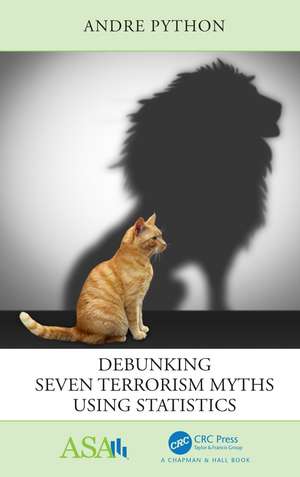
Debunking Seven Terrorism Myths Using Statistics: ASA-CRC Series on Statistical Reasoning in Science and Society
Autor Andre Pythonen Limba Engleză Paperback – 10 iul 2020
Debunking Seven Terrorism Myths Using Statistics communicates evidence-based research work on terrorism to a general audience. It describes key statistics that provide an overview of the extent and magnitude of terrorist events perpetrated by actors independent of state governments across the world. The books brings a coherent and rigorous methodological framework to address issues stemming from the statistical analysis of terrorism data and its interpretations.
Features
- Uses statistical reasoning to identify and address seven major misconceptions about terrorism.
- Discusses the implications of major issues about terrorism data on the interpretation of its statistical analysis.
- Gradually introduces the complexity of statistical methods to familiarize the non-statistician reader with important statistical concepts to analyze data.
- Use illustrated examples to help the reader develop a critical approach applied to the quantitative analysis of terrorism data.
- Includes chapters focusing on major aspects of terrorism: definitional issues, lethality, geography, temporal and spatial patterns, and the predictive ability of models.

Preț: 316.81 lei
Puncte Express: 475
Carte disponibilă
Livrare economică 09-23 noiembrie
Livrare express 24-30 octombrie pentru 27.76 lei
Livrare prin curier în România Termenul estimat este afișat lângă disponibilitate.
Transport gratuit de la 400.00 lei Plată online sau ramburs, în funcție de opțiunile comenzii.
Retur gratuit în 14 zile Comandă securizată și suport în română.
Specificații
ISBN-13: 9780367472245
ISBN-10: 0367472244
Pagini: 150
Dimensiuni: 138 x 216 x 13 mm
Greutate: 0.28 kg
Ediția:1
Editura: CRC Press
Colecția Chapman and Hall/CRC
Seria ASA-CRC Series on Statistical Reasoning in Science and Society
ISBN-10: 0367472244
Pagini: 150
Dimensiuni: 138 x 216 x 13 mm
Greutate: 0.28 kg
Ediția:1
Editura: CRC Press
Colecția Chapman and Hall/CRC
Seria ASA-CRC Series on Statistical Reasoning in Science and Society
Public țintă
General, Professional Practice & Development, and Undergraduate CoreCuprins
1. The Role of Statistics in Debunking Terrorism Myths. 2. Myth.1: We Know Terrorism When We See It. 3. Myth.2: Terrorism only aims at killing civilians. 4. Myth.3: The vulnerability of the West to terrorism. 5. Myth.4: A homogeneous increase of terrorism over time. 6. Myth.5: Terrorism Occurs Randomly. 7. Myth.6: Hotspots of Terrorism are Static. 8. Myth.7: Terrorism cannot be predicted. 9. Terrorism: Knowns, Unknowns, and Uncertainty.
Notă biografică
Andre Python is ZJU100 young professor of Statistics at Zhejiang University. His current research interests are in extending statistical models to address policy-relevant issues raised by the spread of phenomena threatening global security and health. In 2017, Andre completed a PhD in Statistics at the University of St Andrews, applying a Bayesian spatiotemporal model to capture fine-scale patterns of non-state terrorism across the world. As postdoctoral researcher at the University of Oxford, he has developed geostatistical models and actively contributed to the design and teaching of Bayesian statistics and R software courses for PhD students and University staff.
Recenzii
"The book presents incredibly fascinating research, and can be interesting and useful not only to specialists but to general public for understanding and making informed judgments on terrorism and its debunking with help of statistical data analysis and prediction to prevent future attacks…Each chapter suggests mathematical definitions, glossary, and additional reading sources. Besides those, the book supplies with bibliography of 153 most recent works and multiple links to the internet sites.."
~Technometrics
~Technometrics
Descriere
The book provides a brief introduction to seven aspects of terrorism. It starts with acknowledging the ambiguity of the concept of terrorism.