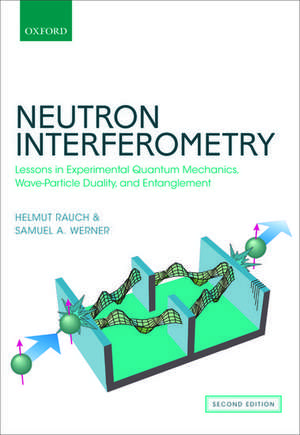
Neutron Interferometry: Lessons in Experimental Quantum Mechanics, Wave-Particle Duality, and Entanglement
Autor Helmut Rauch, Samuel A. Werneren Limba Engleză Hardback – 15 ian 2015
Preț: 908.27 lei
Preț vechi: 1313.70 lei
-31%
Puncte Express: 1362
Carte tipărită la comandă
Livrare economică 10-15 decembrie
Livrare prin curier în România Termenul estimat este afișat lângă disponibilitate.
Transport gratuit pentru acest produs Plată online sau ramburs, în funcție de opțiunile comenzii.
Retur gratuit în 14 zile Comandă securizată și suport în română.
Specificații
ISBN-13: 9780198712510
ISBN-10: 0198712510
Pagini: 460
Ilustrații: 215 b/w illustrations
Dimensiuni: 177 x 247 x 26 mm
Greutate: 1 kg
Ediția:Revised
Editura: OUP OXFORD
Colecția OUP Oxford
Locul publicării:Oxford, United Kingdom
ISBN-10: 0198712510
Pagini: 460
Ilustrații: 215 b/w illustrations
Dimensiuni: 177 x 247 x 26 mm
Greutate: 1 kg
Ediția:Revised
Editura: OUP OXFORD
Colecția OUP Oxford
Locul publicării:Oxford, United Kingdom
V-ar putea interesa
-
 Quantum Field Theory DemystifiedDavid McMahon-39%Preț: 178.29 lei294.51 lei
 -
 -25%Preț: 567.65 lei756.52 lei
 -
 -14%Preț: 246.75 lei285.61 lei
 -
 The Quantum Story: A history in 40 momentsJim Baggott-15%Preț: 101.48 lei119.68 lei
 -
 The Quantum Mechanics of Minds and WorldsJeffrey A. Barrett-27%Preț: 404.05 lei556.32 lei
 -
 Mathematical Theory of Quantum FieldsHuzihiro Araki-22%Preț: 476.99 lei607.91 lei
 -
 -27%Preț: 540.88 lei737.74 lei
 -
 Quantum Physics Workbook For DummiesSteven HolznerPreț: 114.50 lei
 -
 Quantum PhysicsStephen Gasiorowicz-27%Preț: 1506.43 lei2063.59 lei
 -
 Quantum Processes Systems, and InformationBenjamin Schumacher-8%Preț: 560.37 lei609.10 lei
 -
 Quantum Mechanics with Basic Field TheoryBipin R Desai-23%Preț: 856.65 lei1112.53 lei
 -
 Quantum Mechanics for Scientists and EngineersDavid A. B. Miller-23%Preț: 750.15 lei974.22 lei
Notă biografică
Helmut Rauch completed his PhD in 1965 and become full Professor in 1972. He spent one sabbatical year at KFA Juelich/Germany and worked regularly at the Institute Laue-Langevin in Grenoble/France. His scientific interests are: neutron physics, quantum optics, foundations of quantum mechanics, and reactor physics. He invented together with U. Bonse and W. Treimer the perfect crystal neutron interferometer, and has published more than 350 papers in refereed journals. He was Director of the Atomic Institute in Vienna, President of the Austrian Science Foundation and twice President of the Austrian Physical Society. He is member of the Austrian and German Physical Society, the Austrian Academy of Sciences, and the German Academy of Sciences "Leopoldina" in Halle. Honours include the Erwin Schrödinger Award of the Austrian Academy of Sciences, and the Ludwig Wittgenstein Award of the Austrian Research Association.Samuel Werner received his AB degree at Dartmouth College in 1959 and his PhD degree at the University of Michigan in 1965. He was a staff scientist in the Physics Department of the Scientific Laboratory of the Ford Motor Company for 10 years. He became Professor of Physics at the University of Missouri in 1975. Upon his retirement from Missouri in 2000 he moved to Gaithersburg, MD to become a guest researcher at NIST. His scientific interests are: neutron scattering, neutron physics, spin density waves (CDW) and charge density waves (SDW) in solids. He received the President's Award for Outstanding Research at the University of Missouri in 1980, the Outstanding Alumnus Award of the Nuclear Engineering Department at the University of Michigan in 1980, and an Exceptional Service Award of the Neutron Scattering Society of America in 2012. He was the first President of the NSSA. He is a Fellow of the NSSA, the American Physical Society, and the American Association for the Advancement of Science.