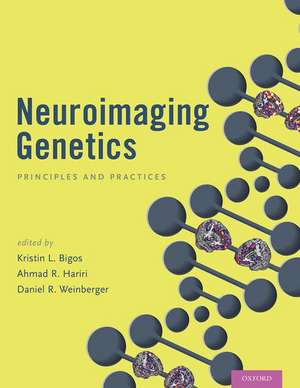
Neuroimaging Genetics: Principles and Practices
Editat de Kristin L. Bigos, Ahmad R. Hariri, Daniel R. Weinbergeren Limba Engleză Hardback – 7 apr 2016
Preț: 1331.21 lei
Preț vechi: 1973.60 lei
-33%
Puncte Express: 1997
Carte tipărită la comandă
Livrare economică 27 noiembrie-02 decembrie
Livrare prin curier în România Termenul estimat este afișat lângă disponibilitate.
Transport gratuit pentru acest produs Plată online sau ramburs, în funcție de opțiunile comenzii.
Retur gratuit în 14 zile Comandă securizată și suport în română.
Specificații
ISBN-13: 9780199920211
ISBN-10: 0199920214
Pagini: 432
Dimensiuni: 279 x 218 x 28 mm
Greutate: 1.64 kg
Editura: Oxford University Press
Colecția OUP USA
Locul publicării:New York, United States
ISBN-10: 0199920214
Pagini: 432
Dimensiuni: 279 x 218 x 28 mm
Greutate: 1.64 kg
Editura: Oxford University Press
Colecția OUP USA
Locul publicării:New York, United States
V-ar putea interesa
-
 -28%Preț: 508.54 lei707.92 lei
 -
 -20%Preț: 372.39 lei462.93 lei
 -
 Behavioral Methods in Consciousness ResearchMorten Overgaard-31%Preț: 528.62 lei765.89 lei
 -
 NeurogliaHelmut Kettenmann-32%Preț: 2182.35 lei3227.72 lei
 -
 Plants and the Human BrainDavid O. Kennedy-34%Preț: 681.03 lei1035.97 lei
 -
 Purkinje's Vision: The Dawning of NeuroscienceNicholas J. Wade-15%Preț: 456.89 lei537.52 lei
 -
 Looking Inside the Disordered BrainAhmad R. Hariri-27%Preț: 869.41 lei1190.97 lei
 -
 Beyond BoundariesMiguel NicolelisPreț: 142.24 lei
 -
 Principles of Neural CodingRodrigo Quian Quiroga-18%Preț: 1445.24 lei1762.49 lei
 -
 Complex Carbohydrates of Nervous TissueR U Margolis-15%Preț: 673.66 lei792.54 lei
 -
 N-AcetylaspartateJohn Moffett-18%Preț: 1232.79 lei1503.40 lei
 -
 Sciatic Nerve: Blocks, Injuries & RegenerationDavid J Fonseca-27%Preț: 1635.29 lei2228.62 lei
 -
 Glutamate: Functions, Regulation & DisordersGolda Chayat-27%Preț: 1219.58 lei1660.88 lei
 -
 Neurological Disorders: New ResearchChloe E Thomas-27%Preț: 1057.49 lei1440.09 lei
 -
 SELECT PAPERS OF DANIEL AMIT (1938-2007)Brunel Nicolas-23%Preț: 1170.83 lei1520.56 lei
Recenzii
Neuroimaging Genetics: Principles and Practice edited by Bigos, Hariri and Weinberger is the first volume in the field devoted to this burgeoning area of research. It brings together many of the pioneering investigators in the field who collectively summarize the history and current state of the art... [and] includes both chapters on specific neurochemically defined circuits including serotonin and dopamine, as well as those that are more disease specific, e.g schizophrenia, Williams syndrome, anxiety disorders and bipolar disorder. ... For the interdisciplinary investigator/student at the interface of genetics, neuroradiology, psychiatry, and neurology, this will be an enjoyable, informative read.
In the few years since this method was initially conceived, imaging genetics has emerged as a valuable tool to understand mechanisms of psychiatric disease, understanding how genes work on the level of brain, and to guide the search for new treatments. ... Scholarly and practical at the same time, this book will be an asset to the library of researchers in psychiatry, neuroscience, and genetics, as well as for practitioners curious where the research frontier now lies.
The book offers an impressive range of thematic fields, spanning from basic neuroscience to clinical implications...an important reference book for experienced researchers of the neuroimaging genetics community
In the few years since this method was initially conceived, imaging genetics has emerged as a valuable tool to understand mechanisms of psychiatric disease, understanding how genes work on the level of brain, and to guide the search for new treatments. ... Scholarly and practical at the same time, this book will be an asset to the library of researchers in psychiatry, neuroscience, and genetics, as well as for practitioners curious where the research frontier now lies.
The book offers an impressive range of thematic fields, spanning from basic neuroscience to clinical implications...an important reference book for experienced researchers of the neuroimaging genetics community
Notă biografică
Kristin L. Bigos is an Investigator in the Division of Clinical Pharmacology at the Lieber Institute for Brain Development; Ahmad R. Hariri is a Professor in the Departments of Psychology and Neuroscience at Duke University; Daniel R. Weinberger is Director and CEO of the Lieber Institute for Brain Development at Johns Hopkins Medical Campus