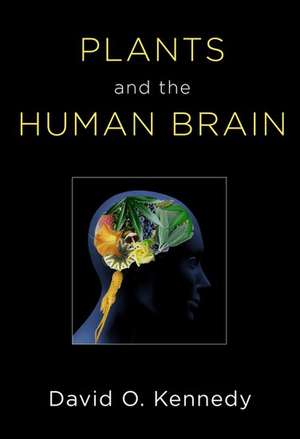
Plants and the Human Brain
Autor David O. Kennedyen Limba Engleză Hardback – 27 feb 2014
Adresăm acest volum studenților din domeniul biochimiei, cercetătorilor în psihofarmacologie și practicienilor în medicina naturistă care caută o fundamentare științifică riguroasă a interacțiunii dintre regnul vegetal și sistemul nervos central. Plants and the Human Brain depășește simpla descriere a efectelor drogurilor sau suplimentelor, propunând o investigație profundă asupra motivelor evolutive pentru care compușii produși de plante și fungi rezonează atât de precis cu biologia umană. Descoperim aici o teză fascinantă: substanțele care ne modifică starea de spirit sau cogniția sunt, la origine, arme de apărare împotriva insectelor sau semnale pentru polenizatori, funcționând pe căi de semnalizare intercelulară pe care le împărțim cu aceste taxoni de milioane de ani.
Structura lucrării este una academică și sistematică, fiind împărțită în funcție de clasele chimice majore. Analizăm alcaloizii — de la cafeină la compuși halucinogeni —, fenolii și terpenele, oferind o perspectivă integrată asupra modului în care dieta și mediul ne modelează funcția cerebrală. Cititorii familiarizați cu Lessons on Caffeine, Cannabis & Co de Angelika Böttger vor aprecia în acest volum contextul ecologic extins; în timp ce Böttger se concentrează pe biosinteză și acțiune moleculară, David O. Kennedy plasează aceste procese într-un cadru evolutiv mai larg, explicând „de ce”-ul din spatele afinității noastre biologice pentru fitochimicale. Reținem un ton echilibrat și precis, care transformă o temă adesea tratată senzaționalist într-un studiu de referință publicat de Oxford University Press.
Preț: 648.44 lei
Preț vechi: 976.13 lei
-34%
Carte tipărită la comandă
Livrare economică 11-16 iunie
Specificații
ISBN-10: 019991401X
Pagini: 396
Ilustrații: 15 b/w
Dimensiuni: 155 x 236 x 25 mm
Greutate: 0.68 kg
Editura: Oxford University Press
Colecția OUP USA
Locul publicării:New York, United States
V-ar putea interesa
-
 -32%Preț: 632.41 lei929.03 lei
 -
 Calcium Ions in Nerve Cell FunctionPlaton G. Kostyuk-37%Preț: 555.46 lei883.34 lei
 -
 The Autisms: Molecules to Model SystemsCraig M. Powell-34%Preț: 1236.57 lei1885.07 lei
 -
 -14%Preț: 652.47 lei758.69 lei
 -
 NeurogliaHelmut Kettenmann-37%Preț: 1987.24 lei3139.36 lei
 -
 Brain Imaging: What it Can (and Cannot) Tell Us About ConsciousnessRobert G. Shulman-34%Preț: 518.13 lei785.10 lei
 -
 Brain Aromatase, Estrogens, and BehaviorJacques Balthazart-35%Preț: 863.11 lei1322.65 lei
 -
 Brain, Mind, and the Structure of RealityPaul L. Nunez-18%Preț: 338.21 lei412.50 lei
 -
 Primate NeuroethologyMichael L. Platt-34%Preț: 837.56 lei1260.50 lei
 -
 Incomplete NatureTerrence W. DeaconPreț: 272.73 lei
 -
 -15%Preț: 446.02 lei524.73 lei
 -
 Language and Action in Cognitive NeuroscienceYann Coello-18%Preț: 1074.40 lei1310.24 lei
De ce să citești această carte
Recomandăm această carte pentru rigoarea cu care conectează botanica, entomologia și neuroștiințele. Cititorul câștigă o înțelegere sistemică asupra motivului pentru care creierul uman răspunde la compuși vegetali, depășind nivelul de simplă curiozitate farmacologică. Este o resursă esențială pentru a înțelege originea biologică a multor medicamente și substanțe psihoactive utilizate astăzi, oferind o perspectivă evolutivă rară în literatura de specialitate.
Despre autor
David O. Kennedy este un cercetător recunoscut în domeniul psihofarmacologiei, ocupând poziția de director al Centrului de Cercetare pentru Creier, Performanță și Nutriție de la Universitatea Northumbria. Expertiza sa se concentrează pe efectele compușilor naturali și ale suplimentelor alimentare asupra funcției cognitive umane. Prin lucrarea de față, publicată la Oxford University Press, Kennedy sintetizează ani de cercetare interdisciplinară, aducând laolaltă date din biologie evolutivă și neurochimie pentru a explica relația complexă dintre plante și mintea umană.
Descriere
Recenzii
This book is a scholarly masterpiece of David O. Kennedy. If you want to understand the pharmacological mode of action of the psychoactive natural products and their role in human history, Plants and the Human Brain, is fascinating read.
For plant biology collections, this book is a jewel. Highly recommended.
I enjoyed reading this book and learnt much from it. It deserves to be read widely as there must be few people who have the breadth of knowledge themselves which is found in it and for such it will enhance their application of this fascinating topic.
The book is extremely well referenced; therefore, not only is the text a treasure of amazing scientific discourses, but it is also an excellent factual resource that enables the reader to go beyond the book's scope. The exciting debate about the link between plants and humans continutes, and Kennedy has provided a fascinating new synthesis and exciting new insights based on a critical assesment of biochemical, pharmacological, and phytochemical evidence.
[A] landmark contribution to psychopharmacology and human health ... Students, teachers, and researchers of herbal medicine, biochemistry and phytochemistry, nutrition, psychopharmacology, ecology, and entomology should all avail themselves of the opportunity and pleasure to read this beautifully written book.