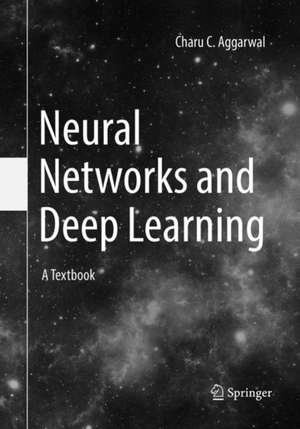
Neural Networks and Deep Learning: A Textbook
Autor Charu C. Aggarwalen Limba Engleză Paperback – 31 ian 2019
În cadrul acestei a doua ediții a volumului Neural Networks and Deep Learning, descoperim o structură riguros compartimentată, menită să ghideze cititorul de la mecanismele elementare la cele mai complexe arhitecturi contemporane. Organizarea materialului urmează o progresie logică în trei etape: primele capitole stabilesc legătura matematică dintre învățarea automată clasică și rețelele neuronale, partea centrală se concentrează pe fundamentele antrenării și regularizării, în timp ce secțiunile finale explorează frontierele actuale ale domeniului. Reținem efortul autorului de a demistifica succesul rețelelor adânci, oferind răspunsuri argumentate la întrebări esențiale despre utilitatea adâncimii rețelelor și dificultățile inerente procesului de antrenare.
Considerăm că această ediție aduce o valoare adăugată semnificativă prin capitolele noi despre rețelele neuronale pe grafuri și prin extinderea secțiunilor dedicate modelelor de limbaj bazate pe transformatoare. Această abordare completează perspectiva oferită de Understanding Deep Learning de Simon J. D. Prince; în timp ce Prince pune accent pe o intuiție digestibilă și curatată, Charu C. Aggarwal preferă o tratare algoritmică exhaustivă, ancorată în teoria matematică solidă. De asemenea, lucrarea se distinge de Introduction to Deep Learning de Sandro Skansi prin profunzimea detaliilor tehnice, fiind adresată cu precădere studenților la nivel masteral sau cercetătorilor.
Poziționăm acest titlu ca un pilon central în opera autorului, făcând trecerea de la lucrările sale axate pe baze de date spre inteligența artificială modernă. Cartea rafinează conceptele prezentate în Linear Algebra and Optimization for Machine Learning, aplicând acele fundamente teoretice direct în designul arhitectural al rețelelor neuronale. Prin includerea unor teme precum învățarea prin întărire (reinforcement learning) și rețelele generative adversariale, Aggarwal oferă un instrumentar complet pentru înțelegerea peisajului tehnologic actual.
Preț: 352.35 lei
Preț vechi: 440.44 lei
-20%
Carte disponibilă
Livrare economică 26 octombrie-09 noiembrie
Specificații
ISBN-10: 3030068560
Pagini: 497
Ilustrații: XXIII, 497 p. 139 illus., 11 illus. in color.
Dimensiuni: 178 x 254 x 32 mm
Greutate: 0.9 kg
Ediția:Softcover reprint of the original 1st ed. 2018
Editura: Springer International Publishing
Colecția Springer
Locul publicării:Cham, Switzerland
V-ar putea interesa
-
 Deep Learning IllustratedAglae Bassens-20%Preț: 328.25 lei410.31 lei
 -
 Learning Deep LearningMagnus Ekman-20%Preț: 414.01 lei517.52 lei
 -
 Deep LearningIan Goodfellow-20%Preț: 619.58 lei774.48 lei
 -
 Introduction to Machine LearningEthem Alpaydin-26%Preț: 570.66 lei768.15 lei
 -
 Probabilistic Machine LearningKevin P. Murphy-22%Preț: 834.21 lei1065.72 lei
 -
 Understanding Deep LearningSimon J. D. Prince-29%Preț: 614.07 lei865.97 lei
 -
 Deep LearningJohn D. Kelleher-20%Preț: 89.58 lei111.98 lei
 -
 -20%Preț: 655.10 lei818.88 lei
 -
 -39%Preț: 385.64 lei636.10 lei
 -
 -31%Preț: 607.05 lei885.58 lei
 -
 Programming Neural Networks with PythonJoachim Steinwendner-20%Preț: 301.14 lei376.42 lei
 -
 Math and Architectures of Deep LearningKrishnendu Chaudhury-20%Preț: 396.76 lei495.95 lei
 -
 Inside Deep Learning: Math, Algorithms, ModelsEdward Raff-20%Preț: 398.09 lei497.61 lei
 -
 -20%Preț: 243.40 lei304.25 lei
 -
 Deep Learning Crash CourseGiovanni Volpe-35%Preț: 284.12 lei439.78 lei
 -
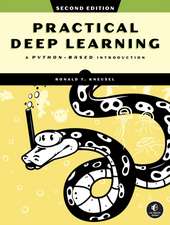 Practical Deep Learning, 2nd Edition: A Python-Based IntroductionRonald T. Kneusel-36%Preț: 331.28 lei514.93 lei
 -
 Deep Learning ArchitecturesOvidiu Calin-15%Preț: 498.66 lei586.66 lei
 -
 Machine Learning for Computer Scientists and Data AnalystsSetareh Rafatirad-15%Preț: 498.22 lei586.15 lei
 -
 Materials Data ScienceStefan Sandfeld-15%Preț: 591.20 lei695.53 lei
 -
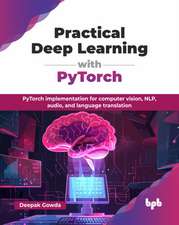 Practical Deep Learning with PyTorchDeepak Gowda-20%Preț: 225.42 lei281.77 lei
De ce să citești această carte
Recomandăm această carte oricărui student la informatică sau inginerie care dorește să înțeleagă nu doar cum să folosească modelele de deep learning, ci mai ales de ce funcționează acestea. Cititorul câștigă o viziune unitară asupra domeniului, învățând să proiecteze arhitecturi specifice pentru text, imagini sau grafuri. Este resursa ideală pentru a trece de la utilizarea unor biblioteci software la înțelegerea algoritmilor de bază care stau la temelia inteligenței artificiale.
Despre autor
Charu C. Aggarwal este un cercetător de renume mondial, ocupând poziția de Research Staff Member la IBM Research. Cu un parcurs academic de excepție, fiind licențiat la IIT Kanpur și doctor al MIT, Aggarwal a publicat peste 90 de lucrări științifice și deține zeci de brevete de invenție, fiind desemnat „Master Inventor” de către IBM. Experiența sa vastă în data mining și baze de date se reflectă în precizia matematică a textelor sale. În contextul actualei lucrări, autorul folosește rigoarea dobândită în cercetarea industrială pentru a oferi o perspectivă pragmatică, dar profund teoretică asupra rețelelor neuronale.
Descriere scurtă
The basics of neural networks: Many traditional machine learning models can be understood as special cases of neural networks. An emphasis is placed in the first two chapters on understanding the relationship between traditional machine learning and neural networks. Support vector machines, linear/logistic regression, singular value decomposition, matrix factorization, and recommender systems are shown to be special cases of neural networks. These methods are studied together with recent feature engineering methods like word2vec.
Fundamentals of neural networks: A detailed discussion of training and regularization is provided in Chapters 3 and 4. Chapters 5 and 6 present radial-basis function (RBF) networks and restricted Boltzmann machines.
Advanced topics in neural networks: Chapters 7 and 8 discuss recurrent neural networks and convolutional neural networks. Several advanced topics like deep reinforcement learning, neural Turing machines, Kohonen self-organizing maps, and generative adversarial networks are introduced in Chapters 9 and 10.
The book is written for graduate students, researchers, and practitioners. Numerous exercises are available along with a solution manual to aid in classroom teaching. Where possible, an application-centric view is highlighted in order to provide an understanding of the practical uses of each class of techniques.