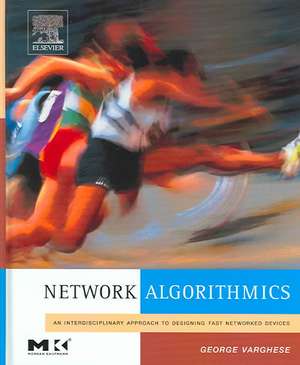
Network Algorithmics: An Interdisciplinary Approach to Designing Fast Networked Devices
Autor George Vargheseen Limba Engleză Hardback – 31 dec 2004
Prin parcurgerea lucrării Network Algorithmics, cititorul va reuși să implementeze dispozitive de rețea de mare viteză, optimizând algoritmi esențiali pentru rutere, firewall-uri și servere performante. Ne-a atras atenția abordarea interdisciplinară a autorului George Varghese, care nu se limitează doar la teorie, ci oferă o metodologie coerentă pentru eliminarea blocajelor de performanță ce apar inevitabil la intersecția dintre software și hardware.
Observăm că textul este construit pe o structură riguroasă, debutând cu identificarea obstacolelor la nivel de OS și hardware, urmată de prezentarea a 15 principii de implementare. Suntem de părere că valoarea practică a cărții rezidă în capitolele dedicate funcțiilor specifice: de la mecanisme de „Exact Match Lookups” și „Packet Classification”, până la gestionarea eficientă a timerelor și a procesării de protocol. Pe linia practică a volumului High-Speed Networking de James P G Sterbenz, dar cu un focus mult mai pronunțat pe algoritmii de optimizare a dispozitivelor (Network Algorithmics), această lucrare devine un instrument de lucru pentru inginerii de la companii precum Cisco sau Intel.
Fiecare secțiune este susținută de aproximativ 200 de ilustrații care clarifică fluxurile de date și deciziile de arhitectură. Spre deosebire de alte titluri care tratează rețelele din perspectivă pur matematică, Network Algorithmics este un ghid de inginerie aplicată, oferind soluții concrete pentru probleme de latență și throughput în sisteme distribuite complexe.
Preț: 417.17 lei
Preț vechi: 587.03 lei
-29%
Carte tipărită la comandă
Livrare economică 20 noiembrie-04 decembrie
Specificații
ISBN-10: 0120884771
Pagini: 496
Ilustrații: Approx. 200 illustrations
Dimensiuni: 191 x 235 x 34 mm
Greutate: 1.18 kg
Ediția:New.
Editura: ELSEVIER SCIENCE
V-ar putea interesa
-
 Computer Networks: A Systems ApproachLarry L. Peterson-41%Preț: 558.53 lei941.05 lei
 -
 Introduction to Networks Companion Guide (Ccnav7)Cisco Networking Academy-19%Preț: 576.69 lei711.97 lei
 -
 Designing Real-World Multi-domain NetworksDhrumil Prajapati-20%Preț: 348.92 lei436.14 lei
 -
 Networking Essentials Companion Guide v3Cisco Networking Academy-20%Preț: 589.99 lei737.48 lei
 -
 TCP/IP IllustratedKevin Fall-20%Preț: 403.13 lei503.92 lei
 -
 Computer Architecture: A Quantitative ApproachJohn L. Hennessy-39%Preț: 534.37 lei882.55 lei
 -
 The Real Internet ArchitecturePamela Zave-20%Preț: 222.38 lei277.98 lei
 -
 -20%Preț: 529.14 lei661.42 lei
 -
 Data and Computer CommunicationsWilliam Stallings-11%Preț: 638.48 lei717.39 lei
 -
 Computer Networks, Global EditionAndrew Tanenbaum-20%Preț: 601.07 lei751.33 lei
 -
![Computer Networking [Global Edition]](https://i1.books-express.ro/bt/9781292405469/computer-networking-global-edition.jpg) Computer Networking [Global Edition]James Kurose-20%Preț: 566.68 lei708.35 lei
Computer Networking [Global Edition]James Kurose-20%Preț: 566.68 lei708.35 lei -
 Networking All-In-One for DummiesDoug Lowe-20%Preț: 258.11 lei322.63 lei
 -
 -20%Preț: 432.49 lei540.61 lei
 -
 The Book of PF, 4th Edition: A No-Nonsense Guide to the OpenBSD FirewallPeter N.M. Hansteen-36%Preț: 279.74 lei437.64 lei
 -
 Networking and ComputationThomas G. RobertazziPreț: 462.45 lei
 -
 Networked SystemsSalem Lahlou-20%Preț: 996.76 lei1245.95 lei
 -
 Packet Tracer for Young Beginning AdminsDamian Strojek-20%Preț: 260.34 lei325.42 lei
 -
 Computer Networks in Packet Tracer for BeginnersDamian Strojek-20%Preț: 260.25 lei325.32 lei
 -
 Computer Networks in Packet Tracer for Intermediate UsersDamian Strojek-20%Preț: 265.31 lei331.65 lei
Public țintă
Network protocol implementers, from server vendors (i.e., Sun, IBM, Microsoft) to router vendors (i.e., Cisco, Juniper, PMC Sierra, Redback, Alcatel, Intel Networks). Also appeals to designers of efficient Intrusion Detection Systems (IDS) and firewalls which includes implementers at companies such as Cisco, ISS, Raptor, Symantec, Checkpoint, Network Associates, as well as companies and startups in security, storage and networking.De ce să citești această carte
Recomandăm această carte inginerilor și dezvoltatorilor care proiectează hardware și software de rețea. Cititorul câștigă o înțelegere profundă a celor 15 principii care guvernează viteza rețelelor moderne, învățând cum să elimine blocajele din protocoale și sisteme de operare. Este resursa ideală pentru cei care vor să construiască rutere, sisteme IDS sau servere web capabile să gestioneze volume masive de date fără pierderi de performanță.
Descriere scurtă
Author George Varghese begins by laying out the implementation bottlenecks that are most often encountered at four disparate levels of implementation: protocol, OS, hardware, and architecture. He then derives 15 solid principles—ranging from the commonly recognized to the groundbreaking—that are key to breaking these bottlenecks.
The rest of the book is devoted to a systematic application of these principles to bottlenecks found specifically in endnodes, interconnect devices, and specialty functions such as security and measurement that can be located anywhere along the network. This immensely practical, clearly presented information will benefit anyone involved with network implementation, as well as students who have made this work their goal.
FOR INSTRUCTORS: To obtain access to the solutions manual for this title simply register on our textbook website (textbooks.elsevier.com)and request access to the Computer Science subject area. Once approved (usually within one business day) you will be able to access all of the instructor-only materials through the "Instructor Manual" link on this book's academic web page at textbooks.elsevier.com.
- Addresses the bottlenecks found in all kinds of network devices, (data copying, control transfer, demultiplexing, timers, and more) and offers ways to break them
- Presents techniques suitable specifically for endnodes, including Web servers
- Presents techniques suitable specifically for interconnect devices, including routers, bridges, and gateways
- Written as a practical guide for implementers but full of valuable insights for students, teachers, and researchers
- Includes end-of-chapter summaries and exercises
Cuprins
2 Network Implementation Models
3 Fifteen Implementation Principles
4 Principles in Action
5 Copying Data
6 Transfering Control
7 Maintaining Timers
8 Demultiplexing
9 Protocol Processing
10 Exact Match Lookups
11 Prefix Match Lookups
12 Packet Classification
13 Switching
14 Scheduling Packets
15 Routers as Distributed Systems
16 Measuring Network Traffic
17 Network Security
18 Conclusions
Appendix A Detailed Models
Recenzii
"This book nicely describes implementation tricks for building fast networking stacks, particularly in routers. This is a much needed book, I don't know of any other that covers this sort of implementation advice. George Varghese has invented several techniques to help speed up the Internet and in his book he provides interesting insight into this, and much more." --Radia Perlman, Distinguished Engineer, Sun Microsystems