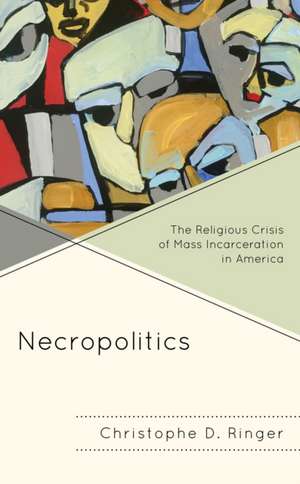
Necropolitics: The Religious Crisis of Mass Incarceration in America: Religion and Race
Autor Christophe D. Ringeren Limba Engleză Paperback – 20 mai 2022







Preț: 254.33 lei
Preț vechi: 349.29 lei
-27%
Puncte Express: 381
Carte tipărită la comandă
Livrare economică 01-15 decembrie
Livrare prin curier în România Termenul estimat este afișat lângă disponibilitate.
Transport gratuit de la 400.00 lei Plată online sau ramburs, în funcție de opțiunile comenzii.
Retur gratuit în 14 zile Comandă securizată și suport în română.
Specificații
ISBN-13: 9781793626813
ISBN-10: 1793626812
Pagini: 162
Dimensiuni: 154 x 220 x 12 mm
Greutate: 0.25 kg
Editura: Bloomsbury Publishing
Colecția Lexington Books
Seria Religion and Race
Locul publicării:New York, United States
ISBN-10: 1793626812
Pagini: 162
Dimensiuni: 154 x 220 x 12 mm
Greutate: 0.25 kg
Editura: Bloomsbury Publishing
Colecția Lexington Books
Seria Religion and Race
Locul publicării:New York, United States
Cuprins
Acknowledgments
Introduction
Chapter 1: The Politics of Death in the Arche of the American Experience
Chapter 2: The Necropolitics of Social Death and Statecraft
Chapter 3: Beyond the Death-Bound-Subject
Chapter 4: Necropolitics and Juridical Power
Chapter 5: The Eschatological Production of Mass Incarceration
Conclusion
References
Index
About the Author
Introduction
Chapter 1: The Politics of Death in the Arche of the American Experience
Chapter 2: The Necropolitics of Social Death and Statecraft
Chapter 3: Beyond the Death-Bound-Subject
Chapter 4: Necropolitics and Juridical Power
Chapter 5: The Eschatological Production of Mass Incarceration
Conclusion
References
Index
About the Author
Recenzii
Necropolitics is an engaging work that explores the role and impact of religious thought and positionality on views of mass incarceration in the US.... Throughout, Ringer contends that the crisis of mass incarceration is predicated on the legitimized social death of Black Americans who are alternately characterized as animalistic, and are criminalized and restrained to foster a good society.... This is a very interesting contribution to the broader exploration of mass incarceration, as it ties religion-a fundamental American concept-to mass incarceration-a contested social and economic reality-through theoretical analysis. [I]t is excellent for those with grounding in religious theory, political theory, political economy, and mass incarceration. Highly recommended.
Necropolitics: The Religious Crisis of Mass Incarceration is a theoretically astute and methodologically sophisticated examination of the political and religious dimensions of the American carceral state. The crisis of mass incarceration is not merely a failure of public policy. Rather, it is a symptom of a foundational compromise that governs and orders American democracy itself. Christophe Ringer justly challenges us to confront the necropolitical nightmare of mass incarceration in moving beyond a politics of sacrifice to a politics of justice.
This innovative account of necropolitics focuses on the religious narratives and theological imagination that undergird the animalizing and criminalizing black people. The practical outcome of this antiblack outlook and habit-formation, which displaces the imago dei with the fearsome image of the animalistic super predator, is the hyper- and mass incarceration of black people. As socially dead subjects, blacks are the living dead, simultaneously objects of biopolitics and necropolitics. This antiblack theopolitics of life and death is the arche of the American project.
Christophe Ringer's fine book is an essential contribution. The book challenges scholars to explore the complex religious roots of the racialized police violence and mass incarceration in today's neoliberal order. It is the great gift of this book that Ringer weaves artful personal reflection with some of the best of critical theory and theology, provoking readers to view mass incarceration as a politics of death, a 'necropolitics' that for the United States is its 'ordeal of the world' (Mbembe). In so doing, Ringer's discerning critique exposes U.S. citizens' and residents' vulnerability and finitude amid the U.S. carceral state that services white and corporate interests. Still, Ringer illumines paths to a future that is 'otherwise.'
Christophe Ringer's Necropolitics: The Religious Crisis in Mass Incarceration is a compelling examination of the carceral industry in the United States from the colonial period to the twenty-first century. Interweaving theology, critical social and political theory, and philosophy, Ringer illuminates how mass incarceration and the political anchors undergirding it have wrought suffering and death upon Blacks. He explains how the 'City on the Hill'-an imagined political community championed by conservatives and neoliberals-criminalized and animalized Blacks through the advancement of zero-tolerance and neoliberal policies. Necropolitics also sheds light on the dynamism and tactical innovation of the carceral state's central actors such as their use of execution sermons, coerced confessions, constructs such as superpredators, narrations of dystopian cities, and retrenchment of social welfare programs. Altogether, Ringer's fascinating book reveals that mass incarceration is wedded to a public theology that encourages Black death and situates racial hierarchy as a foundational principle of the U.S. nation-state.
Necropolitics is a theological-religious interrogation of mass incarceration and the social agreements upon which it is based. Those who want to better understand the purpose and function of a criminal penal system built on and sustained by a capitalistic system of human labor exploitation, that disproportionately views Black life as expendable, will learn much by reading this book.
Necropolitics: The Religious Crisis of Mass Incarceration is a theoretically astute and methodologically sophisticated examination of the political and religious dimensions of the American carceral state. The crisis of mass incarceration is not merely a failure of public policy. Rather, it is a symptom of a foundational compromise that governs and orders American democracy itself. Christophe Ringer justly challenges us to confront the necropolitical nightmare of mass incarceration in moving beyond a politics of sacrifice to a politics of justice.
This innovative account of necropolitics focuses on the religious narratives and theological imagination that undergird the animalizing and criminalizing black people. The practical outcome of this antiblack outlook and habit-formation, which displaces the imago dei with the fearsome image of the animalistic super predator, is the hyper- and mass incarceration of black people. As socially dead subjects, blacks are the living dead, simultaneously objects of biopolitics and necropolitics. This antiblack theopolitics of life and death is the arche of the American project.
Christophe Ringer's fine book is an essential contribution. The book challenges scholars to explore the complex religious roots of the racialized police violence and mass incarceration in today's neoliberal order. It is the great gift of this book that Ringer weaves artful personal reflection with some of the best of critical theory and theology, provoking readers to view mass incarceration as a politics of death, a 'necropolitics' that for the United States is its 'ordeal of the world' (Mbembe). In so doing, Ringer's discerning critique exposes U.S. citizens' and residents' vulnerability and finitude amid the U.S. carceral state that services white and corporate interests. Still, Ringer illumines paths to a future that is 'otherwise.'
Christophe Ringer's Necropolitics: The Religious Crisis in Mass Incarceration is a compelling examination of the carceral industry in the United States from the colonial period to the twenty-first century. Interweaving theology, critical social and political theory, and philosophy, Ringer illuminates how mass incarceration and the political anchors undergirding it have wrought suffering and death upon Blacks. He explains how the 'City on the Hill'-an imagined political community championed by conservatives and neoliberals-criminalized and animalized Blacks through the advancement of zero-tolerance and neoliberal policies. Necropolitics also sheds light on the dynamism and tactical innovation of the carceral state's central actors such as their use of execution sermons, coerced confessions, constructs such as superpredators, narrations of dystopian cities, and retrenchment of social welfare programs. Altogether, Ringer's fascinating book reveals that mass incarceration is wedded to a public theology that encourages Black death and situates racial hierarchy as a foundational principle of the U.S. nation-state.
Necropolitics is a theological-religious interrogation of mass incarceration and the social agreements upon which it is based. Those who want to better understand the purpose and function of a criminal penal system built on and sustained by a capitalistic system of human labor exploitation, that disproportionately views Black life as expendable, will learn much by reading this book.