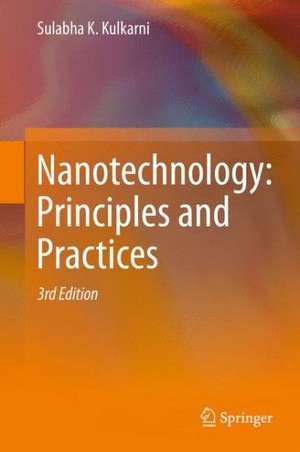
Nanotechnology: Principles and Practices
Autor Sulabha K. Kulkarnien Limba Engleză Hardback – 17 noi 2014
The book goes on to illustrate the various applications of nanomaterials in electronics, optoelectronics, cosmetics, energy, textiles and the medical field and discusses the environmental impact of these technologies. Many new areas, materials and effects are then introduced, including spintronics, soft lithography, metamaterials, the lotus effect, the Gecko effect and graphene. The book also explains the functional principles of essential techniques, such as scanning tunneling microscopy (STM), atomic force microscopy (AFM), scanning near field optical microscopy (SNOM), Raman spectroscopy and photoelectron microscopy. In closing, Chapter 14, ‘Practicals’, provides a helpful guide to setting up and conducting inexpensive nanotechnology experiments in teaching laboratories.
Preț: 618.28 lei
Preț vechi: 727.39 lei
-15%
Puncte Express: 927
Carte tipărită la comandă
Livrare economică 28 noiembrie-12 decembrie
Livrare prin curier în România Termenul estimat este afișat lângă disponibilitate.
Transport gratuit pentru acest produs Plată online sau ramburs, în funcție de opțiunile comenzii.
Retur gratuit în 14 zile Comandă securizată și suport în română.
Specificații
ISBN-13: 9783319091709
ISBN-10: 3319091700
Pagini: 428
Ilustrații: XXIV, 403 p. 341 illus., 13 illus. in color.
Dimensiuni: 160 x 241 x 29 mm
Greutate: 0.75 kg
Ediția:3rd edition 2015
Editura: Springer
Locul publicării:Cham, Switzerland
ISBN-10: 3319091700
Pagini: 428
Ilustrații: XXIV, 403 p. 341 illus., 13 illus. in color.
Dimensiuni: 160 x 241 x 29 mm
Greutate: 0.75 kg
Ediția:3rd edition 2015
Editura: Springer
Locul publicării:Cham, Switzerland
V-ar putea interesa
-
 -13%Preț: 299.36 lei345.47 lei
 -
 -32%Preț: 995.13 lei1458.74 lei
 -
 -8%Preț: 447.39 lei486.29 lei
 -
 -23%Preț: 1262.27 lei1639.31 lei
 -
 Nanotechnology: Principles, Applications and Ethical ConsiderationsDr Paresh Chandra Ray-27%Preț: 1273.94 lei1736.18 lei
 -
 Advances in Nanotechnology: Volume 7Zacharie Bartul-26%Preț: 780.52 lei1060.24 lei
 -
 Materials Science: Future AspectsKalpana Awasthi-27%Preț: 1082.09 lei1473.82 lei
 -
 -30%Preț: 97.81 lei139.80 lei
 -
 -27%Preț: 5006.50 lei6858.22 lei
 -
 -44%Preț: 122.28 lei217.77 lei
 -
 NanochemistryGeoffrey A Ozin-14%Preț: 388.63 lei453.06 lei
 -
 Nanotoxicology and Nanoecotoxicology Vol. 1Vineet Kumar-24%Preț: 944.31 lei1242.51 lei
 -
 Biogenic Wastes-Enabled Nanomaterial SynthesisAbhishek Kumar Bhardwaj-18%Preț: 993.21 lei1211.22 lei
 -
 Nanomaterials in Daily LifeZhypargul Abdullaeva-15%Preț: 660.76 lei777.37 lei
 -
 Chemical Principles of NanoengineeringAndrea R. Tao-8%Preț: 496.49 lei539.67 lei
 -
 -14%Preț: 829.86 lei964.95 lei
 -
 Principles of Nanoscience and Molecular EngineeringRené M. Overney-23%Preț: 708.17 lei919.70 lei
 -
 Sustainable NanomaterialsImran Uddin-18%Preț: 1502.53 lei1832.35 lei
Public țintă
Upper undergraduateCuprins
Introduction to Quantum Mechanics.- Chapter 1: Structure and Bonding.- Chapter 2: Synthesis of Nanomaterials—I (Physical Methods).- Chapter 3: Synthesis of Nanomaterials—II (Chemical Methods).- Chapter 4: Synthesis of Nanomaterials—III (Biological Methods).- Chapter 5: Self Assembly.- Chapter 6:Analysis Techniques.- Chapter 7: Types of Nanomaterials and Their Properties.- Chapter 8: Nanolithography.- Chapter 9: Nanoelectronics.- Chapter 10: Some Special Nanomaterials.- Chapter 11: Applications.- Chapter 12: Nanotechnology and Environment.- Chapter 13: Practicals
Recenzii
Notă biografică
The author, Dr. Mrs. Sulabha K. Kulkarni has been in the field of research and teaching for more than 50 years. She is a Fellow of Indian National Science Academy (FNA), Indian Academy of Science (FASc), Indian National Academy of Sciences (FNASc), Maharashtra Academy of Science (FMASc) and Academician Asia Pacific Academy of Materials (APAM-Academician). Her specializations besides Nanotechnology include Condensed Matter Physics, Surface Science and Material Science. She was a Faculty member and then University Grants Commission (UGC) India Scientist at University of Pune, now SPPU, Pune, Indian Institute of Science Education and Research (IISER) Pune. She was a Pro-Vice Chancellor at Banasthali University, Rajasthan, a visiting scientist at IISER, Pune and INSA Senior Scientist and INSA Honorary Scientist at Centre of Materials and Electronics Technologies (CMET), Pune.
Textul de pe ultima copertă
Given the rapid advances in the field, this book offers an up-to-date introduction to nanomaterials and nanotechnology. Though condensed into a relatively small volume, it spans the whole range of multidisciplinary topics related to nanotechnology. Starting with the basic concepts of quantum mechanics and solid state physics, it presents both physical and chemical synthetic methods, as well as analytical techniques for studying nanostructures. The size-specific properties of nanomaterials, such as their thermal, mechanical, optical and magnetic characteristics, are discussed in detail. The book goes on to illustrate the various applications of nanomaterials in electronics, optoelectronics, cosmetics, energy, textiles and the medical field, and discusses the environmental impact of these technologies. Many new areas, materials and effects are then introduced, including spintronics, soft lithography, metamaterials, the lotus effect, the Gecko effect, and graphene. The book also explains the functional principles of essential techniques, such as scanning tunneling microscopy (STM), atomic force microscopy (AFM), scanning near field optical microscopy (SNOM), Raman spectroscopy and photoelectron microscopy. In closing, Chapter 14, ‘Practicals’, provides a helpful guide to setting up and conducting inexpensive nanotechnology experiments in teaching laboratories.
Caracteristici
A comprehensive and up-to-date textbook on nanomaterials and nanotechnologies Strikes the right balance in presenting syntheses, materials, analytical techniques and applications Covers the physical, chemical and biological properties of nanomaterials Introduces novel materials, including graphene and metamaterials Enriched with many useful illustrations Includes six useful appendices Includes supplementary material: sn.pub/extras