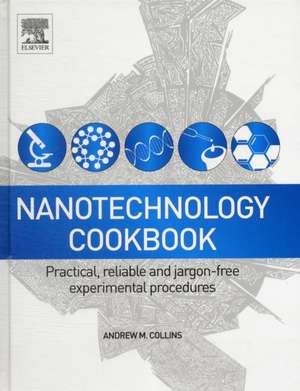
Nanotechnology Cookbook: Practical, Reliable and Jargon-free Experimental Procedures
Autor Andrew Collinsen Limba Engleză Hardback – 26 iun 2012
Recomandăm Nanotechnology Cookbook cercetătorilor aflați la început de drum, de la nivel de masterat la post-doctorat, precum și profesioniștilor din start-up-uri care au nevoie de rezultate imediate în laborator. Cartea presupune cunoștințe de bază în științele exacte, dar este concepută special pentru a depăși barierele interdisciplinare: un chimist va găsi instrucțiuni clare pentru culturi celulare, în timp ce un fizician va învăța cum să prepare coloizii de aur necesari calibrării echipamentelor. Reținem că acest volum nu este un tratat teoretic, ci un ghid procedural care elimină frustrarea căutării prin zeci de lucrări științifice pentru detalii de preparare elementare.
Abordarea diferă de A Laboratory Course in Nanoscience and Nanotechnology prin caracterul său de manual de referință rapidă — este mai puțin un curs academic structurat și mai mult un instrument aplicabil direct la masa de lucru. În timp ce Introduction to Nanoscience se concentrează pe fundamentele teoretice și impactul societal, lucrarea lui Andrew Collins prioritizează execuția corectă a celor peste 100 de „rețete” de sinteză.
Structura volumului reflectă o progresie logică și practică. După o introducere necesară și un capitol riguros dedicat siguranței, textul trece la tehnici analitice comune, urmate de secțiuni dedicate metodelor chimice, fizice și, în final, nanotehnologiei biologice. Cele 120 de ilustrații, majoritatea color, joacă un rol critic, oferind un punct de reper vizual pentru cum ar trebui să arate preparatele în diverse stadii, un detaliu adesea omis în articolele de specialitate.
Preț: 553.62 lei
Preț vechi: 732.52 lei
-24%
Carte tipărită la comandă
Livrare economică 01-15 decembrie
Specificații
ISBN-10: 0080971725
Pagini: 324
Ilustrații: 120 illustrations (100 in full color)
Dimensiuni: 152 x 229 x 20 mm
Greutate: 1.16 kg
Editura: ELSEVIER SCIENCE
V-ar putea interesa
-
 HealthyishEmma PetersenPreț: 149.38 lei
 -
 The Kitchen Science CookbookMichelle Dickinson-15%Preț: 138.45 lei163.15 lei
 -
 -18%Preț: 35.40 lei43.07 lei
 -
 -11%Preț: 103.35 lei116.52 leiRecomandat
 -
 Sam Holland's Kitchen KickstartSam HollandPreț: 164.47 lei
 -
 Preț: 130.55 lei
 -
 Justine Cooks: A CookbookJustine DoironPreț: 238.63 lei
 -
 XAFS for EveryoneScott Calvin-9%Preț: 829.58 lei911.63 lei
 -
 -8%Preț: 394.89 lei429.24 lei
 -
 Organic NanochemistryYuming Zhao-19%Preț: 595.89 lei735.67 lei
 -
 Good ThingsSamin Nosrat-14%Preț: 209.27 lei242.02 lei
 -
 The Essential Guide to Doing Your Research ProjectZina O'LearyPreț: 310.17 lei
 -
 -36%Preț: 284.35 lei440.95 lei
 -
 My Bohemian KitchenEvangeline HarburyPreț: 147.89 lei
 -
 NanochemistryGeoffrey A Ozin-14%Preț: 388.63 lei453.06 lei
 -
 Practical Professional CookeryH. Cracknell-14%Preț: 379.18 lei438.66 lei
 -
 Practical Organic Chemistry WorkbookDevanshi MagooPreț: 388.28 lei
 -
 Principles of Nanoscience and Molecular EngineeringRené M. Overney-23%Preț: 708.17 lei919.70 lei
 -
 Think Like a Chef, 25th Anniversary EditionTom ColicchioPreț: 255.53 lei
Public țintă
Nanoscientists working on a range of interdisciplinary experiments in academic research settings, from graduate through PhD and post-doctoral researcher. Interdisciplinary nanotechnology professionals and small to mid-size start-up companies interested in nanotech experimentation would also be highly interested.De ce să citești această carte
Această carte este esențială pentru oricine lucrează într-un laborator de nanotehnologie și dorește să economisească timp. Câștigați acces la proceduri de sinteză verificate, explicate fără jargon, care vă permit să treceți direct la faza experimentală. Este instrumentul ideal pentru a naviga între discipline fără a fi expert în toate, oferind claritate vizuală și pași de execuție siguri pentru materiale nanostructurate complexe.
Despre autor
Andrew Collins este un cercetător multidisciplinar, cunoscut pentru capacitatea sa de a investiga teme complexe și de a le prezenta într-un format accesibil. Deși o parte semnificativă a operei sale, precum Gobekli Tepe: Genesis of the Gods sau The Cygnus Key, explorează originile civilizației și tehnologiile arhaice, expertiza sa în documentare și sinteză de date se traduce în Nanotechnology Cookbook printr-o rigoare procedurală deosebită. Autorul aplică aceeași curiozitate analitică pentru a demistifica procesele tehnologice moderne, oferind comunității științifice un instrument practic de lucru.
Descriere scurtă
Nanoscience research is also characterized by rapid movement within disciplines. The amount of time it takes wading through papers and chasing down academics is frustrating and wasteful and our reviewers seem to suggest this work would give an excellent starting point for their work. The current source of published data is either in journal articles, which requires highly advanced knowledge of background information, or books on the subject, which can skim over the essential details of preparations. Having a cookbook to hand to flick through and from which you may select a preparation acts as a good source of contact both to researchers and those who supervise them alike.
This book therefore supports fundamental nanoscience experimentation. It is by intention much more user-friendly than traditional published works, which too-frequently assumes state of the art knowledge. Moreover you can pick up this book and find a synthesis to suit your needs without digging through specialist papers or tracking someone down who eventually may or may not be able to help. Once you have used the recipe the book would then act as a reference guide for how to analyze these materials and what to look out for.
- 100+ detailed recipes for synthesis of basic nanostructured materials, enables readers to pick up the book and get started on a preparation immediately
- High fidelity images show how preparations should look rather than vague schematics or verbal descriptions
- Sequential and user-friendly by design, so the reader won't get lost in overly detailed theory or miss out a step from ignorance
- A cookbook, by design and structure the work is easy to use, familiar and compact
Cuprins
2. Safety
3. Common Analytical Techniques for Nanoscale Material
4. Chemical techniques
5. Physical techniques
6. Biological Nanotechnology