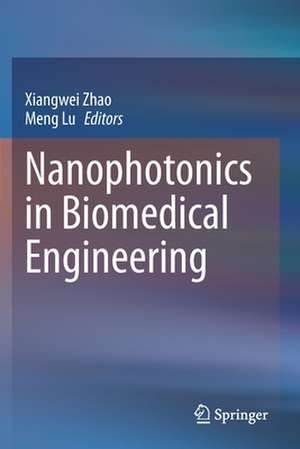
Nanophotonics in Biomedical Engineering
Editat de Xiangwei Zhao, Meng Luen Limba Engleză Paperback – 25 oct 2021
Preț: 618.88 lei
Preț vechi: 728.09 lei
-15%
Puncte Express: 928
Carte tipărită la comandă
Livrare economică 04-18 decembrie
Livrare prin curier în România Termenul estimat este afișat lângă disponibilitate.
Transport gratuit pentru acest produs Plată online sau ramburs, în funcție de opțiunile comenzii.
Retur gratuit în 14 zile Comandă securizată și suport în română.
Specificații
ISBN-13: 9789811561399
ISBN-10: 9811561397
Pagini: 288
Ilustrații: V, 282 p. 160 illus., 126 illus. in color.
Dimensiuni: 155 x 235 x 16 mm
Greutate: 0.44 kg
Ediția:1st ed. 2021
Editura: Springer
Locul publicării:Singapore, Singapore
ISBN-10: 9811561397
Pagini: 288
Ilustrații: V, 282 p. 160 illus., 126 illus. in color.
Dimensiuni: 155 x 235 x 16 mm
Greutate: 0.44 kg
Ediția:1st ed. 2021
Editura: Springer
Locul publicării:Singapore, Singapore
V-ar putea interesa
-
 Biomaterials Science: An Introduction to Materials in MedicineWilliam R Wagner-28%Preț: 950.47 lei1311.52 lei
 -
 Introduction to NanophotonicsHenri Benisty-8%Preț: 373.74 lei406.24 lei
 -
 Physics in Biology and MedicinePaul Davidovits-32%Preț: 508.24 lei747.60 lei
 -
 Lasers and Current Optical Techniques in BiologyGiuseppe Palumbo-14%Preț: 1418.91 lei1649.90 lei
 -
 Fundamentals of NanomedicineJames F Leary-5%Preț: 702.81 lei739.79 lei
 -
 Fundamentals of Photonics, Third Edition, 2V SetBahaa E. A. Saleh-23%Preț: 1219.19 lei1583.36 lei
 -
 Cellulose NanocrystalsWadood Y Hamad-23%Preț: 780.46 lei1013.59 lei
 -
 -26%Preț: 891.64 lei1212.39 lei
 -
 -14%Preț: 1328.41 lei1544.66 lei
 -
 Progress in Nanophotonics 7Takashi Yatsui-18%Preț: 779.45 lei950.55 lei
 -
 Biomedical Photonic TechnologiesZ Zhang-14%Preț: 759.42 lei883.05 lei
 -
 -14%Preț: 925.04 lei1075.63 lei
 -
 -14%Preț: 825.88 lei960.33 lei
 -
 Nanotechnology for BioapplicationsBong-Hyun Jun-24%Preț: 972.69 lei1279.86 lei
 -
 -18%Preț: 1154.11 lei1407.45 lei
 -
 Advances in Photonics Integrated Circuits, LASER and ApplicationsVarun Raghunathan-18%Preț: 1601.51 lei1953.06 lei
 -
 Nanoimaging - Future of Precision MedicineSikandar Shaikh-5%Preț: 1157.23 lei1218.14 lei
Cuprins
Photonic crystals for biomolecule sensing applications.- Recent advances in Surface Plasmon Resonance for biosensing applications and future prospects.- Surface-enhanced Raman Scattering for biology and medicine.- Nanophotonic techniques for single cell analysis.- Biointerface Characterization by Nonlinear Optical Spectroscopy.- Chemiluminescence and its biomedical applications.- Luminescent Conjugated Polymer Dots for Biomedical Applications.- Dark-Field Hyperspectral Imaging (DF-HSI) Modalities for Characterization of Single Molecule and Cellular Processes.- Additive Manufacturing Technologies based on Photopolymerization.
Notă biografică
Dr. Xiangwei Zhao is a Professor at the School of Biological Science and Medical Engineering, Southeast University, Nanjing, China.
Dr. Meng Lu is an Assistant Professor at the Department of Electrical and Computer Engineering, Iowa State University, USA.
Dr. Meng Lu is an Assistant Professor at the Department of Electrical and Computer Engineering, Iowa State University, USA.
Textul de pe ultima copertă
This book summarizes the latest advances in nanophotonics for biomedical applications, including biomolecular sensing and imaging, additive fabrications, and biophotonics. The engineering of nanophotonics will have significant impacts on the life sciences and medicine alike. Given its scope, the book offers a valuable asset for researchers, scientists, engineers, and graduate students in the fields of biomedical engineering, electrical engineering, materials sciences, optics, biology, and medicine.
Caracteristici
Summarizes the most recent advances of nanophotonics in biomedical applications Includes biomolecular sensing and imaging, optical manipulations and fabrications Covers not only nanophotonics but also biophotonics