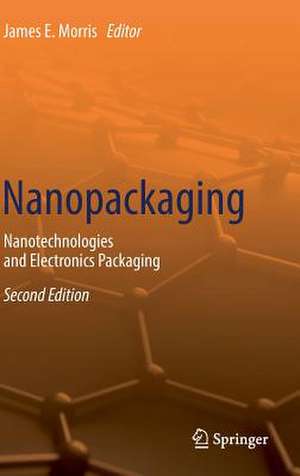
Nanopackaging
Editat de James E. Morrisen Limba Engleză Hardback – 2 oct 2018
Now in a widely extended second edition, Nanopackaging is an important reference for industrial and academic researchers, as well as practicing engineers seeking information about latest techniques. Twelve new chapters address carbon nanotubes and nanowires, fabrication and properties of graphene, graphene for thermal cooling of microelectronics and for electrical interconnections, packaging of post-CMOS nanoelectronics, environmental and health effects of nanopackaging technologies, and more. This book is an ideal reference for researchers, practicing engineers, and graduate students who are either entering the field for the first time, or are already conducting research and want to expand their knowledge in the field of nanopackaging.
Preț: 1305.78 lei
Preț vechi: 1592.42 lei
-18%
Puncte Express: 1959
Carte tipărită la comandă
Livrare economică 07-21 decembrie
Livrare prin curier în România Termenul estimat este afișat lângă disponibilitate.
Transport gratuit pentru acest produs Plată online sau ramburs, în funcție de opțiunile comenzii.
Retur gratuit în 14 zile Comandă securizată și suport în română.
Specificații
ISBN-13: 9783319903613
ISBN-10: 3319903616
Pagini: 1024
Ilustrații: XXVIII, 996 p. 635 illus., 419 illus. in color.
Dimensiuni: 160 x 241 x 60 mm
Greutate: 1.63 kg
Ediția:Second Edition 2018
Editura: Springer
Locul publicării:Cham, Switzerland
ISBN-10: 3319903616
Pagini: 1024
Ilustrații: XXVIII, 996 p. 635 illus., 419 illus. in color.
Dimensiuni: 160 x 241 x 60 mm
Greutate: 1.63 kg
Ediția:Second Edition 2018
Editura: Springer
Locul publicării:Cham, Switzerland
V-ar putea interesa
-
 Introduction to Microfabrication 2eSami Franssila-19%Preț: 493.30 lei609.01 lei
 -
 Advanced Computational NanomechanicsNuno Silvestre-23%Preț: 760.29 lei987.39 lei
 -
 -23%Preț: 1262.27 lei1639.31 lei
 -
 Advances in Microelectronics & PhotonicsSatyabrata Jit-26%Preț: 1557.95 lei2116.25 lei
 -
 Advanced Nanotube & Nanofiber MaterialsA K Haghi-26%Preț: 503.70 lei676.91 lei
 -
 -26%Preț: 503.19 lei676.58 lei
 -
 -30%Preț: 97.81 lei139.80 lei
 -
 Nano-Bio- Electronic, Photonic and MEMS PackagingC. P. (Ching-Ping) Wong-18%Preț: 1111.31 lei1355.25 lei
 -
 Organic-Based Nanomaterials in Food PackagingKaiser Younis-24%Preț: 1290.35 lei1697.83 lei
 -
 -18%Preț: 1453.61 lei1772.69 lei
 -
 Preț: 411.30 lei
 -
 Chemical Physics of Polymer NanocompositesVera V. Myasoedova-23%Preț: 2386.87 lei3099.83 lei
 -
 -14%Preț: 883.53 lei1027.36 lei
 -
 Fundamental and Applied Nano-ElectromagneticsAntonio Maffucci-24%Preț: 882.41 lei1161.06 lei
 -
 -18%Preț: 1272.55 lei1551.89 lei
 -
 Handbook of Emerging Materials for Semiconductor IndustryYoung Suh Song-18%Preț: 5149.36 lei6279.70 lei
Cuprins
Nanopackaging: Nanotechnologies and Electronics Packaging.- Modelling Technologies and Applications.- Advances in Delamination Modeling: Continuum Aspects.- Advances in Delamination Modeling: Atomistic Aspects.- Soft Mold Nano-imprint: Modeling and Simulation.- Nanoparticle Properties.- Nanoparticle Fabrication.- Nanoparticle-based High-k Dielectric Composites for Embedded Capacitors.- Nanostructured Materials for Embedded Resistors.- Nanogranular Magnetic Core Inductors: Design, Fabrication and Packaging.- Nanoparticles in Isotropic Conductive Adhesives.- Nano materials in Anisotropic Conductive Adhesives (ACAs).- Nanoparticles in Microvias.- Silver Nanoparticles for Inkjet Printed Conductive Structures in Electronic Packaging.- A Study of Nano Particles in SnAg-Based Lead Free Solders.- Nano-Underfills for Fine Pitch Electronics.- Carbon Nanotubes: Synthesis and Characterization.- Characteristics of Carbon Nanotubes for Nanoelectronic Device Applications.- High Electromagnetic Shielding of Plastic Transceiver Packaging Using Dispersed Multiwall Carbon Nanotubes.- Properties of 63Sn-37Pb and Sn-3.8Ag-0.7Cu Solders Reinforced with Single-Wall Carbon Nanotubes.- Carbon Nanotubes for Thermal Management of Microsystems.- Nanowires in Electronics Packaging.- Nanowire ACF for Ultrafine pitch Flip-Chip Interconnection.- Synthesis and Optical Characterization of CVD Graphene.- Characterization of electronic, electrical, optical and mechanical properties of grapheme.- Graphene for Thermal Cooling of Microelectronics.- Carbon Interconnects.- Design and Development of Stress-Engineered Compliant Interconnect for Microelectronic Packaging.- Nanosensors for Electronics Package Reliability.- Applications of Bio-Nanotechnology to Electronics Packaging.- Flip Chip Packaging for Nanoscale Silicon Logic Devices: Challenges and Opportunities.- Nanotechnology Health, Safety, Environment Overview.
Notă biografică
James E. Morris is Professor of Electrical & Computer Engineering at Portland State University, Oregon. He has edited or co-authored five books on electronic packaging, and has more on the way.
Textul de pe ultima copertă
This book presents a comprehensive overview of nanoscale electronics and systems packaging, and covers nanoscale structures, nanoelectronics packaging, applications of nanoparticles, graphene, carbon nanotubes and nanowires in packaging, and offers a roadmap for future trends. Composite materials are studied for high-k dielectrics, resistors and inductors, electrically conductive adhesives, conductive “inks,” underfill fillers, and solder enhancement.
Now in a second edition, Nanopackaging is an important reference for industrial and academic researchers, as well as practicing engineers seeking information about latest techniques. 12 new chapters address carbon nanotubes and nanowires, fabrication and properties of graphene, graphene for thermal cooling of microelectronics and for electrical interconnections, packaging of post-CMOS nanoelectronics, environmental and health effects of nanopackaging technologies, and more. This book is an ideal reference for researchers, practicing engineers, and graduate students who are either entering the field for the first time, or are already conducting research and want to expand their knowledge in the field of nanopackaging.
Now in a second edition, Nanopackaging is an important reference for industrial and academic researchers, as well as practicing engineers seeking information about latest techniques. 12 new chapters address carbon nanotubes and nanowires, fabrication and properties of graphene, graphene for thermal cooling of microelectronics and for electrical interconnections, packaging of post-CMOS nanoelectronics, environmental and health effects of nanopackaging technologies, and more. This book is an ideal reference for researchers, practicing engineers, and graduate students who are either entering the field for the first time, or are already conducting research and want to expand their knowledge in the field of nanopackaging.
Caracteristici
Discusses the importance of computer modeling in nanopackaging and offers suggestions for implementation Contains 12 new chapters from internationally recognized contributors, as well as updates in all existing chapters Brings together a comprehensive overview of nanoscale electronics and systems and covers structures, nanoelectronics packaging and interconnects, and offers a roadmap for future trends
Descriere
Descriere de la o altă ediție sau format:
Nanotechnologies are being applied to microelectronics packaging, primarily in the applications of nanoparticle nanocomposites, or in the exploitation of the superior mechanical, electrical, or thermal properties of carbon nanotubes. Composite materials are studied for high-k dielectrics, resistors and inductors, electrically conductive adhesives, conductive “inks,” underfill fillers, and solder enhancement. “Nanopackaging” is intended for industrial and academic researchers, industrial electronics packaging engineers who need to keep abreast of their field, and others with interests in nanotechnology. It will survey the application of nanotechnologies to electronics packaging, as represented by current research across the field.
Nanotechnologies are being applied to microelectronics packaging, primarily in the applications of nanoparticle nanocomposites, or in the exploitation of the superior mechanical, electrical, or thermal properties of carbon nanotubes. Composite materials are studied for high-k dielectrics, resistors and inductors, electrically conductive adhesives, conductive “inks,” underfill fillers, and solder enhancement. “Nanopackaging” is intended for industrial and academic researchers, industrial electronics packaging engineers who need to keep abreast of their field, and others with interests in nanotechnology. It will survey the application of nanotechnologies to electronics packaging, as represented by current research across the field.
Recenzii
From
the
reviews:“This
is
an
impressive
work
that
provides
a
substantial
and
relatively
in
depth
coverage
of
a
wide
range
of
electronics
packaging
and
assembly
related
applications
for
nanotechnology.
Each
chapter
concludes
with
a
list
of
references
that
can
be
used
by
the
reader
to
further
investigate
a
particular
subject
and
the
book
is
well
produced
with
good
quality
figures
and
illustrations.
…
I
am
pleased
to
be
able
to
conclude
this
…
Nanopackaging:
Nanotechnologies
and
Electronics
Packaging
as
‘highly
recommended’.”
(Martin
Goosey,
Microelectronics
International,
Vol.
26
(3),
2009)