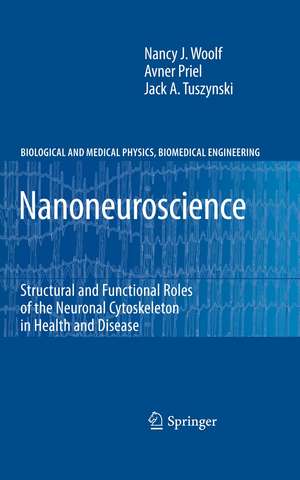
Nanoneuroscience
Autor Nancy J. Woolf, Avner Prielen Limba Engleză Paperback – 14 mar 2012
Preț: 918.13 lei
Preț vechi: 1119.67 lei
-18%
Puncte Express: 1377
Carte tipărită la comandă
Livrare economică 02-16 decembrie
Livrare prin curier în România Termenul estimat este afișat lângă disponibilitate.
Transport gratuit pentru acest produs Plată online sau ramburs, în funcție de opțiunile comenzii.
Retur gratuit în 14 zile Comandă securizată și suport în română.
Specificații
ISBN-13: 9783642261978
ISBN-10: 3642261973
Pagini: 292
Ilustrații: XII, 280 p. 12 illus. in color.
Dimensiuni: 155 x 235 x 16 mm
Greutate: 0.45 kg
Ediția:2010
Editura: Springer
Locul publicării:Berlin, Heidelberg, Germany
ISBN-10: 3642261973
Pagini: 292
Ilustrații: XII, 280 p. 12 illus. in color.
Dimensiuni: 155 x 235 x 16 mm
Greutate: 0.45 kg
Ediția:2010
Editura: Springer
Locul publicării:Berlin, Heidelberg, Germany
V-ar putea interesa
-
 The Brain: A Very Short IntroductionMichael O'Shea-32%Preț: 48.58 lei71.12 lei
 -
 Natural NeuroscienceNachum Ulanovsky-14%Preț: 447.91 lei520.82 lei
 -
 Theoretical NeuroscienceLaurence F. Abbott-16%Preț: 546.97 lei651.46 lei
 -
 Netter's Atlas of NeuroscienceDavid L. Felten-27%Preț: 402.26 lei552.00 lei
 -
 Netter's Neuroscience Coloring BookDavid L. Felten-5%Preț: 166.49 lei175.25 lei
 -
 Principles of NeurobiologyLiqun Luo-5%Preț: 679.44 lei715.21 lei
 -
 Principles of Cognitive NeuroscienceDale Purves-27%Preț: 1436.98 lei1968.47 lei
 -
 Theoretical Neuroscience: Understanding CognitionXiao-Jing Wang-9%Preț: 809.37 lei889.42 lei
 -
 Neuroscience: Exploring the BrainMark Bear-5%Preț: 988.01 lei1040.01 lei
 -
 -24%Preț: 72.29 lei94.69 lei
 -
 50 Human Brain Ideas You Really Need to KnowMoheb Costandi-28%Preț: 50.65 lei70.19 lei
 -
 The Brain at RestJoseph JebelliPreț: 75.26 lei
 -
 Sensor Technology in NeuroscienceMichael Thompson-14%Preț: 1119.65 lei1301.91 lei
 -
 Bio-Inspired Information PathwaysMartin ZieglerPreț: 359.44 lei
 -
 The NeuronomiconGrayson W. Hooper-5%Preț: 453.16 lei477.01 lei
 -
 Neurosciences - From Molecule to Behavior: a university textbookC. Giovanni Galizia-15%Preț: 723.68 lei851.38 lei
 -
 Neuromorphic Circuits for Nanoscale DevicesPinaki Mazumder-5%Preț: 737.16 lei775.96 lei
 -
 Spintronics-Based Neuromorphic ComputingDebanjan Bhowmik-20%Preț: 785.58 lei981.97 lei
Public țintă
Professional/practitionerCuprins
Introducing Nanoneuroscience as a Distinct Discipline.- Nanoscale Components of Neurons: From Biomolecules to Nanodevices.- The Cytoskeleton as a Nanoscale Information Processor: Electrical Properties and an Actin-Microtubule Network Model.- Nanocarriers and Intracellular Transport: Moving Along the Cytoskeletal Matrix.- Nanotechnology, Nanostructure, and Nervous System Disorders.- Novel Modes of Neural Computation: From Nanowires to Mind.
Notă biografică
Nancy J. Woolf teaches behavioral neuroscience and neuropharmacology at the University of California, Los Angeles. She received her Ph.D. in Neuroscience at UCLA School of Medicine in 1983. Her areas of research include the organization of acetylcholine systems, neural plasticity and memory, neural degeneration and Alzheimer’s disease, and consciousness and cognition. She is specifically interested in microtubules in cognition and disease.
Avner Priel is a physicist trained at Bar-Ilan University and Weizmann Institute of Science in Israel. His theoretical and experimental work focuses on the electromagnetic properties of cytoskeletal macromolecules and their interactions with membrane structures, in particular in dendrites. Through the use of patch clamp technique, he has shown that microtubules support ionic waves propagation and amplify electric signals, thereby behaving as bio-transistors.
Jack A. Tuszynski is Allard Research Chair in Oncology at the Cross Cancer Institute and Professor in the Department of Physics at the University of Alberta, Edmonton, Canada. As an international expert in biomolecular theory, Tuszynski has served as project leader of the MITACS Center of Excellence: "Mathematical Modelling in Pharmaceutical Development" and built an international and interdisciplinary team of scientists working on computer simulations of cells, organs and physiological processes.
Avner Priel is a physicist trained at Bar-Ilan University and Weizmann Institute of Science in Israel. His theoretical and experimental work focuses on the electromagnetic properties of cytoskeletal macromolecules and their interactions with membrane structures, in particular in dendrites. Through the use of patch clamp technique, he has shown that microtubules support ionic waves propagation and amplify electric signals, thereby behaving as bio-transistors.
Jack A. Tuszynski is Allard Research Chair in Oncology at the Cross Cancer Institute and Professor in the Department of Physics at the University of Alberta, Edmonton, Canada. As an international expert in biomolecular theory, Tuszynski has served as project leader of the MITACS Center of Excellence: "Mathematical Modelling in Pharmaceutical Development" and built an international and interdisciplinary team of scientists working on computer simulations of cells, organs and physiological processes.
Textul de pe ultima copertă
Nanoneuroscience is the study of computationally relevant biomolecules found inside neurons. Because of recent technological advances at the nanometer scale, scientists have at their disposal increasingly better ways to study the brain and the biophysics of its molecules. This book describes how biomolecules contribute to the operations of synapses and perform other computationally relevant functions inside dendrites. These biomolecular operations considerably expand the brain-computer analogy - endowing each neuron with the processing power of a silicon-based multiprocessor. Amazingly, the brain contains hundreds of billions of neurons.
Caracteristici
Presents new ideas that address puzzling open questions Offers new insights into disorders of mind Uses computer simulation to understand neural processing Includes supplementary material: sn.pub/extras