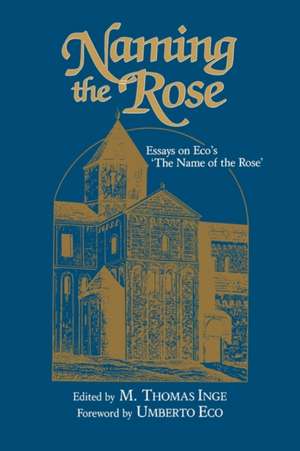
Naming the Rose
Editat de M. Thomas Ingeen Limba Engleză Paperback – 12 ian 2011
Destinat studenților în filologie, cercetătorilor în semiotică și practicienilor din domeniul criticii literare, acest volum colectiv oferă instrumentele analitice necesare pentru a decoda complexitatea unui fenomen literar global. Considerăm că valoarea principală a lucrării Naming the Rose rezidă în capacitatea sa de a explica cum un roman polițist plasat într-o mănăstire medievală reușește să integreze teme de teologie, istorie și politică fără a pierde interesul publicului larg. Descoperim aici o structură riguroasă, unde eseuri semnate de specialiști din diverse discipline lingvistice explorează tradițiile care au alimentat scriitura lui Umberto Eco: de la teoriile comediei și apocalipsei, până la semiotica aplicată. Un element distinctiv, rar întâlnit în culegerile de critică, este prefața semnată chiar de Umberto Eco. Autorul acceptă ipotezele criticilor săi și le oferă un răspuns direct, transformând volumul într-un dialog intelectual viu. Ritmul textelor este unul academic, dar accesibil, oferind o perspectivă profundă asupra modului în care ficțiunea populară poate aborda idei filosofice complexe. Lucrarea acoperă aceeași arie ca The Key to The Name of the Rose de Adele J. Haft, dar cu o abordare mult mai teoretică și interdisciplinară. În timp ce volumul lui Haft se concentrează pe traducerea și explicarea referințelor latine și istorice pentru a facilita lectura, Naming the Rose investighează contextul cultural și critic, fiind mai apropiat de rigoarea academică din New Essays on Umberto Eco. Este o resursă esențială pentru oricine dorește să înțeleagă nu doar „ce” se întâmplă în roman, ci și „cum” este construit acesta din punct de vedere structural.
Preț: 230.15 lei
Carte tipărită la comandă
Livrare economică 18 noiembrie-02 decembrie
Specificații
ISBN-10: 1617030341
Pagini: 224
Dimensiuni: 152 x 229 x 13 mm
Greutate: 0.37 kg
Editura: University Press of Mississippi
V-ar putea interesa
-
 Five Moral PiecesUmberto Eco-43%Preț: 55.21 lei97.18 lei
 -
 The Trojan Women and Other PlaysEuripides-20%Preț: 62.69 lei78.24 lei
 -
 Complete LettersPliny the Younger-19%Preț: 69.73 lei85.85 lei
 -
 Selected EssaysDavid Hume-18%Preț: 71.02 lei86.90 lei
 -
 Tales of the Elders of IrelandAnn DooleyPreț: 69.35 lei
 -
 Heracles and Other PlaysEuripidesPreț: 62.08 lei
 -
 EssaysLydia DavisPreț: 98.88 lei
 -
 Listening to Radio, 1920-1950Ray Barfield-30%Preț: 473.98 lei675.27 lei
 -
 Huck Finn Among the Critics: A Centennial SelectionM. Thomas Inge-21%Preț: 257.89 lei326.71 lei
 -
 People, Places, Things - Essays by Elizabeth BowenElizabeth Bowen-17%Preț: 233.64 lei280.24 lei
 -
 Faith in FakesUmberto Eco-19%Preț: 63.54 lei78.45 lei
 -
 Augustus Baldwin LongstreetJohn Donald WadePreț: 287.07 lei
 -
 Comics as CultureM. Thomas IngePreț: 280.65 lei
 -
 -18%Preț: 85.35 lei104.60 lei
 -
 NotebooksA M KleinPreț: 286.95 lei
 -
 Conversations with William FaulknerM Thomas IngePreț: 240.20 lei
 -
 Self-Reliance, and Other Essays (Series One) (Aziloth Books)Ralph Waldo EmersonPreț: 62.38 lei
 -
 August Rodin - Einer Jungen Bildhauerin: Benno TschischwitzRainer Maria RilkePreț: 103.72 lei
De ce să citești această carte
Această carte este indispensabilă pentru cei care doresc să depășească nivelul de suprafață al lecturii și să înțeleagă arhitectura intelectuală a operei lui Eco. Cititorul câștigă acces la o bibliografie critică valoroasă și la comentariile directe ale autorului asupra propriei creații. Este motivul concret pentru care orice pasionat de literatură postmodernă ar trebui să consulte acest volum: oferă cheia de boltă a unei capodopere a secolului XX.