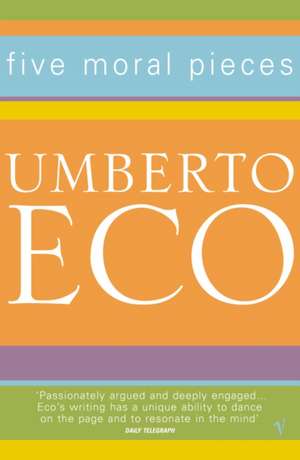
Five Moral Pieces
Autor Umberto Ecoen Limba Engleză Paperback – 5 dec 2002
What good, he asks in a talk delivered during the Gulf War, does war do in a world where the flow of goods, services, and information is unstoppable, and the enemy is always behind the lines? What makes news today, who decides how it will be presented and how does the way it is disseminated contribute to the widespread disillusionment with politics in general? In one of the most personal of the essays, Eco recalls experiencing liberation from fascism in Italy as a boy, and examines the various historical forms of fascism, always with an eye toward such ugly manifestations today. And finally, in an intensely personal open letter to an Italian Cardinal, Eco reflects on a question underlying all the reflections in the book - what does it mean to be moral or ethical when one doesn't believe in God?
As thoughtful and subtle as they are pragmatic and relevant, these essays present one of the world's most important thinkers at the height of his critical powers.
Preț: 55.21 lei
Preț vechi: 97.18 lei
-43%
Puncte Express: 83
Carte disponibilă
Livrare economică 06-18 noiembrie
Livrare express 23-29 octombrie pentru 56.99 lei
Livrare prin curier în România Termenul estimat este afișat lângă disponibilitate.
Transport gratuit de la 400.00 lei Plată online sau ramburs, în funcție de opțiunile comenzii.
Retur gratuit în 14 zile Comandă securizată și suport în română.
Specificații
ISBN-13: 9780099276968
ISBN-10: 0099276968
Pagini: 128
Dimensiuni: 129 x 198 x 9 mm
Greutate: 0.11 kg
Editura: Vintage Publishing
Locul publicării:United Kingdom
ISBN-10: 0099276968
Pagini: 128
Dimensiuni: 129 x 198 x 9 mm
Greutate: 0.11 kg
Editura: Vintage Publishing
Locul publicării:United Kingdom
V-ar putea interesa
-
 The Role of the ReaderUmberto EcoPreț: 155.49 lei
 -
 Semiotics and the Philosophy of LanguageUmberto EcoPreț: 159.03 lei
 -
 The Sign of Three – Dupin, Holmes, PeirceUmberto EcoPreț: 147.11 lei
 -
 Preț: 165.82 lei
 -
 The Limits of InterpretationUmberto EcoPreț: 277.51 lei
 -
 River's EdgeOwen BullockPreț: 67.50 lei
 -
 Gallery of Antique ArtPaul HetheringtonPreț: 69.16 lei
 -
 Desiring HerRed Gibson (Rosemarie Gibson)Preț: 42.74 lei
 -
 Preț: 82.95 lei
 -
 SelfieThe InspectorPreț: 37.21 lei
 -
 Mix PagesT. Lee-PoetPreț: 90.52 lei
 -
 Race & PoliticsTherone ShellmanPreț: 102.51 lei
 -
 George Herbert's 82Nathan H. NelsonPreț: 88.59 lei
 -
 Paper HeartJennifer LeBlancPreț: 73.55 lei
 -
 Spirit EyesMaurice WhelanPreț: 83.24 lei
 -
 Chem TrailsQuinten CollierPreț: 107.18 lei
 -
 STEPWELLAzura TyabjiPreț: 76.86 lei
 -
 Cries in the WildernessMorris Kuol YollPreț: 126.72 lei
 -
 Gravitas: Volume 18 Issue 2Andrew LaflechePreț: 42.49 lei
 -
 Invisible InsaneAfric McglincheyPreț: 50.36 lei
 -
 Words in PassingE. M. Schorb.Preț: 94.69 lei
 -
 Words in PassingE. M. SchorbPreț: 132.19 lei
 -
 Preț: 148.83 lei
Descriere
Recalls experiencing liberation from fascism in Italy as a boy, and examines the various historical forms of fascism, always with an eye toward ugly manifestations. The author reflects on a question underlying the reflections in this book - what does it mean to be moral or ethical when one doesn't believe in God?
What makes news today, who decides how it will be disseminated contribute to the widespread disillusionment with politics in general? In the most personal of the essays, Eco recalls experiencing liberation from fascism in Italy as a boy, and examines the various historical forms of fascism, always with an eye toward such ugly manifestations today. And finally, in an intensely personal open letter to an Italian Cardinal, Eco reflects on a question underlying all the reflections in the book - what does it mean to be moral or ethical when one doesn't believe in God? As thoughtful and subtle as they are pragmatic and relevant, these essays present one of the world's most important thinkers at the height of his critical powers.Recenzii
PRAISE FOR UMBERTO ECO
"Instead of that tone of constipated envy we associate with criticism,
Eco's essays read like letters from a friend, trying to share something he loves
with someone he likes."--San Francisco Review of Books
"One of the most influential thinkers of our time."--Los Angeles Times
—
"Instead of that tone of constipated envy we associate with criticism,
Eco's essays read like letters from a friend, trying to share something he loves
with someone he likes."--San Francisco Review of Books
"One of the most influential thinkers of our time."--Los Angeles Times
—