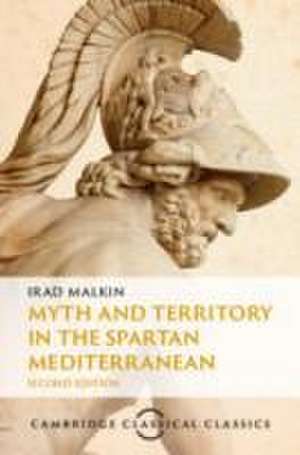
Myth and Territory in the Spartan Mediterranean: Cambridge Classical Classics
Autor Irad Malkinen Limba Engleză Paperback – 13 iun 2024
| Toate formatele și edițiile | Preț | Express |
|---|---|---|
| Paperback (1) | 168.62 lei 3-5 săpt. | +20.18 lei 7-13 zile |
| Cambridge University Press – 13 iun 2024 | 168.62 lei 3-5 săpt. | +20.18 lei 7-13 zile |
| Hardback (2) | 574.16 lei 6-8 săpt. | |
| Cambridge University Press – 14 sep 1994 | 574.16 lei 6-8 săpt. | |
| Cambridge University Press – 13 mai 2024 | 617.06 lei 6-8 săpt. |
Preț: 168.62 lei
Nou
Puncte Express: 253
Preț estimativ în valută:
29.84€ • 34.99$ • 26.20£
29.84€ • 34.99$ • 26.20£
Carte disponibilă
Livrare economică 10-24 ianuarie 26
Livrare express 27 decembrie 25 - 02 ianuarie 26 pentru 30.17 lei
Preluare comenzi: 021 569.72.76
Specificații
ISBN-13: 9781009466066
ISBN-10: 1009466062
Pagini: 334
Dimensiuni: 152 x 229 x 18 mm
Greutate: 0.49 kg
Ediția:2nd edition
Editura: Cambridge University Press
Seria Cambridge Classical Classics
ISBN-10: 1009466062
Pagini: 334
Dimensiuni: 152 x 229 x 18 mm
Greutate: 0.49 kg
Ediția:2nd edition
Editura: Cambridge University Press
Seria Cambridge Classical Classics
Cuprins
Introduction; 1. The 'colony of the Dorians' and the Return of the Herakleidai; 2. The Homeric king of Sparta: Menelaos in a Spartan Mediterranean; 3. Spartan colonisation in the Aegean and the Peloponnese; 4. Taras: native hostility, territorial possession, and a new-ancient past; 5. Foundation and territory: the cults of Apollo Karneios and Zeus Ammon; 6. Myth and colonial territory: Libya; 7. Promises unfulfilled: Dorieus between North Africa and Sicily; 8. Myth and decolonization: Sparta's colony at Herakleia Trachinia.
Recenzii
"...this book provides a densely detailed and richly annotated gazetteer of every myth concerning Sparta." Pericles Georges, American Historical Review