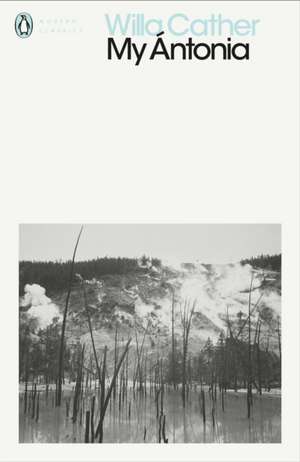
My Ántonia
Autor Willa Catheren Limba Engleză Paperback – 4 oct 2018
Găsim în My Ántonia un exemplu magistral de ficțiune istorică și regionalistă care subversează convențiile epopeii clasice de frontieră. În loc să se concentreze pe cucerirea violentă a pământului, Willa Cather alege să exploreze cucerirea spiritului și reziliența în fața izolării. Recomandăm acest volum nu doar ca pe o cronică a migrației, ci ca pe o meditație profundă asupra memoriei și a modului în care peisajul modelează identitatea umană. Textul este construit dintr-o perspectivă nostalgică, fiind narat de Jim Burden, care își amintește copilăria petrecută în Nebraska alături de Ántonia Shimerda, o imigrantă boemă a cărei forță vitală devine simbolul pionieratului american. Cititorul care a apreciat determinarea și independența personajului Alexandra Bergson din O Pioneers! va găsi aici o vibrație similară a spiritului feminin — însă My Ántonia oferă un context mult mai intim și o structură narativă mai nuanțată, axată pe maturizarea psihologică. Structura acestei ediții este remarcabilă prin bogăția contextului oferit. Dincolo de narațiunea principală, cuprinsul ne dezvăluie o secțiune amplă de anexe (Appendix A-F), care includ cronologii, interviuri și recenzii contemporane din 1918. Acestea permit o înțelegere profundă a modului în care opera a fost recepționată și a evoluției viziunii lui Cather. Față de The Song of the Lark, unde accentul cade pe dezvoltarea artistică, aici accentul este pus pe comuniunea cu pământul și pe legăturile umane indestructibile formate în condiții de privațiune. Este, fără îndoială, cea mai personală lucrare a autoarei, transformând experiența brută a preriei într-o proză de o frumusețe lirică rară.
Preț: 56.99 lei
Preț vechi: 70.73 lei
-19%
Carte disponibilă
Livrare economică 18-29 septembrie
Livrare express 01-05 septembrie pentru 32.62 lei
Specificații
ISBN-10: 0241338328
Pagini: 256
Dimensiuni: 128 x 198 x 25 mm
Greutate: 0.19 kg
Editura: Penguin
Locul publicării:London, United Kingdom
V-ar putea interesa
-
 Selected DiariesVirginia Woolf-18%Preț: 77.36 lei93.91 lei
 -
 The Fire Next TimeJames Baldwin-29%Preț: 49.30 lei69.18 lei
 -
 Nobody Knows My NameJames Baldwin-20%Preț: 61.61 lei77.01 lei
 -
 VilletteCharlotte Brontë-22%Preț: 62.70 lei80.82 lei
 -
 The Collected Dorothy ParkerDorothy Parker-18%Preț: 77.56 lei94.02 lei
 -
 Memoirs of a Dutiful DaughterSimone de Beauvoir-30%Preț: 64.02 lei92.10 lei
 -
 The Autobiography of Alice B. ToklasGertrude Stein-26%Preț: 57.08 lei77.46 lei
 -
 Giovanni's RoomJames Baldwin-27%Preț: 55.79 lei76.71 lei
 -
 An AnthologySimone WeilPreț: 91.74 lei
 -
 A Day in the Life of a Smiling WomanMargaret DrabblePreț: 77.57 lei
 -
 Best Minds of My GenerationAllen Ginsberg-24%Preț: 70.70 lei93.07 lei
 -
 Selected WritingsAnna Freud-21%Preț: 84.13 lei105.94 lei
 -
 A Gift of LoveMartin Luther King Jr.-20%Preț: 56.07 lei70.41 lei
 -
 Selected LettersCharlotte Brontë-19%Preț: 63.24 lei78.13 lei
 -
 The Pumpkin EaterPenelope MortimerPreț: 76.71 lei
 -
 The SuffragettesTbd-39%Preț: 17.03 lei27.96 lei
 -
 Pedagogy of the OppressedPaulo Freire-27%Preț: 55.53 lei76.55 lei
 -
 Notes of a Native SonJames Baldwin-27%Preț: 56.38 lei77.05 lei
 -
 Tell Me How Long the Train's Been GoneJames Baldwin-25%Preț: 58.82 lei78.51 lei
 -
 Why We Can't WaitMartin Luther King Jr.-21%Preț: 55.56 lei70.30 lei
 -
 A WomanSibilla Aleramo-27%Preț: 56.69 lei77.24 lei
 -
 Lady Sings the BluesBillie Holiday-27%Preț: 55.94 lei76.79 lei
 -
 Great ExpectationsKathy Acker-21%Preț: 55.31 lei69.59 lei
 -
 Black Skin, White MasksFrantz Fanon-27%Preț: 56.41 lei77.08 lei
 -
 Women, Race & ClassAngela Y. Davis-26%Preț: 57.11 lei77.49 lei
 -
 Sister OutsiderAudre Lorde-27%Preț: 56.31 lei77.01 lei
 -
 Story Of OPauline Reage-20%Preț: 56.57 lei70.91 lei
 -
 The WavesVirginia WoolfPreț: 35.66 lei
 -
 ShirleyCharlotte BrontëPreț: 38.24 lei
 -
 ProfessorCharlotte BrontëPreț: 36.06 lei
De ce să citești această carte
Această carte se adresează cititorului care caută o literatură clasică densă, cu un puternic simț al locului. Câștigați o perspectivă autentică asupra vieții imigranților europeni în America secolului al XIX-lea, surprinsă fără exagerări sau distorsiuni. Este o lectură obligatorie pentru a înțelege spiritul american, oferind o experiență contemplativă despre trecerea timpului și valoarea prieteniei care supraviețuiește deceniilor.
Despre autor
Willa Sibert Cather (1873–1947) a fost o figură centrală a literaturii americane, recompensată cu Premiul Pulitzer în 1923 pentru romanul 'One of Ours'. Mutată în Nebraska la vârsta de nouă ani, Cather a transformat peisajul preriei și viețile imigranților europeni în nucleul operei sale. Recunoscută pentru trilogia 'Great Plains', ea a scris cu o sensibilitate aparte despre nostalgie, exil și lupta settlers-ilor de a găsi o comunitate într-un spațiu geografic vast și adesea ostil. Opera sa rămâne un etalon pentru modul în care mediul fizic interacționează cu psihologia umană.
Notă biografică
Recenzii
No romantic novel ever written in America, by man or woman, is one half so beautiful as My Ántonia
Cather was the first great American novelist to make the West - the real West, not the stuff of pulp fiction - her theme. She makes you see, smell, and feel the prairie
Descriere scurtă
Jim and Ántonia meets as children in the wide open plains of Nebraska at the end of the nineteenth century. Jim leaves for college and a career in the east, while Ántonia stays at home, dedicating herself to her farm and family. As the years roll by, Jim will come to view Ántonia as the embodiment of the prairie itself - tough, spirited and enduring, despite the hardness and loneliness of pioneer life. Willa Cather's beautiful novel is a celebration of the Nebraskan prairie she loved she much, and a powerful depiction of a pivotal era in the making of America.
Descriere
Willa Cather’s My Ántonia is considered one of the most significant American novels of the twentieth century. Set during the great migration west to settle the plains of the North American continent, the narrative follows Ántonia Shimerda, a pioneer who comes to Nebraska as a child and grows with the country, inspiring a childhood friend, Jim Burden, to write her life story. The novel is important both for its literary aesthetic and as a portrayal of important aspects of American social ideals and history, particularly the centrality of migration to American culture.
The Broadview edition includes a rich selection of primary source materials: the revised introduction for the 1926 edition; Cather’s “Mesa Verde Wonderland is Easy to Reach…,” “Nebraska: The End of the First Cycle,” “Peter”, and her comments on the novel; contemporary reviews and photographs.
Extras
We went all the way in day-coaches, becoming more sticky and grimy with each stage of the journey. Jake bought everything the newsboys offered him: candy, oranges, brass collar buttons, a watch-charm, and for me a Life of Jesse James, which I remember as one of the most satisfactory books I have ever read. Beyond Chicago we were under the protection of a friendly passenger conductor, who knew all about the country to which we were going and gave us a great deal of advice in exchange for our confidence. He seemed to us an experienced and worldly man who had been almost everywhere; in his conversation he threw out lightly the names of distant states and cities. He wore the rings and pins and badges of different fraternal orders to which he belonged. Even his cuff-buttons were engraved with hieroglyphics, and he was more inscribed than an Egyptian obelisk.
Once when he sat down to chat, he told us that in the immigrant car ahead there was a family from ' across the water' whose destination was the sameas ours.
'They can't any of them speak English, except one little girl, and all she can say is "We go Black Hawk, Nebraska." She's not much older than you, twelve or thirteen, maybe, and she's as bright as a new dollar. Don't you want to go ahead and see her, Jimmy? She's got the pretty brown eyes, too!'
This last remark made me bashful, and I shook my head and settled down to 'Jesse James.' Jake nodded at me approvingly and said you were likely to get diseases from foreigners.
I do not remember crossing the Missouri River, or anything about the long day's journey through Nebraska. Probably by that time I had crossed so many rivers that I was dull to them. The only thing very noticeable about Nebraska was that it was still, all day long, Nebraska.
I had been sleeping, curled up in a red plush seat, for a long while when we reached Black Hawk. Jake roused me and took me by the hand. We stumbled down from the train to a wooden siding, where men were running about with lanterns. I couldn't see any town, or even distant lights; we were surrounded by utter darkness. The engine was panting heavily after its long run. In the red glow from the fire-box, a group of people stood huddled together on the platform) encumbered by bundles and boxes. I knew this must be the immigrant family the conductor had told us about. The woman wore a fringed shawl tied over her head, and she carried a little tin trunk in her arms, hugging it as if it were a baby. There was an old man, tall and stooped. Two half-grown boys and a girl stood holding oilcloth bundles, and a little girl clung to her mother's skirts. Presently a man with a lantern approached them and began to talk, shouting and exclaiming. I pricked up my ears, for it was positively the first time I had ever heard a foreign tongue.
Another lantern came along. A bantering voice called out: 'Hello, are you Mr. Burden's folks? If you are, it's me you're looking for. I'm Otto Fuchs. I'm Mr. Burden's hired man, and I'm to drive you out. Hello, Jimmy, ain'tyou scared to come so far west?'
I looked up with interest at the new face in the lantern-light. He might have stepped out of the pages of Jesse James. He wore a sombrero hat, with a wide leather band and a bright buckle, and the ends of his moustache were twisted up stiffly, like little horns. He looked lively and ferocious, I thought, and as if he had a history. A long scar ran across one cheek and drew the corner of his mouth up in a sinister curl. The top of his left ear was gone, and his skin was brown as an Indian's. Surely this was the face of a desperado. As he walked about the platform in his highheeled boots, looking for our trunks, I saw that he was a rather slight man, quick and wiry, and light on his feet. He told us we had a long night drive ahead of us, and had better be on the hike. He led us to a hitching-bar where two farm-wagons were tied, and 1 saw the foreign family crowding into one of them. The other was for us. Jake got on the front seat with Otto Fuchs, and I rode on the straw in the bottom of the wagon-box, covered up with a buffalo hide. The immigrants rumbled off into the empty darkness, and we followed them.
I tried to go to sleep, but the jolting made me bite my tongue, and I soon began to ache all over. When the straw settled down, I had a hard bed. Cautiously I slipped from under the buffalo hide, got up on my knees and peered over the side of the wagon.
Cuprins
Introduction
Willa Cather: A Brief Chronology
A Note on the Text
My Ántonia
Appendix A: Cather’s Revised Introduction to the 1926 Edition of My Ántonia
Appendix B: Cather’s “Mesa Verde Wonderland is Easy to Reach”
Appendix C: Cather’s “Nebraska:The End of the First Cycle”
Appendix D: Cather’s “Peter”
Appendix E: Interviews and Commentary by Cather on My Ántonia
- Latrobe Carroll, “Willa Sibert Cather,” Bookman, 3 May 1921
- “A Talk with Miss Cather,” Webster County Argus, 29 September 1921
- Eleanor Hinman, “Willa Cather,” Lincoln Sunday Star, 6 November 1921
- Rose C. Field, “Restlessness Such as Ours Does Not Make for Beauty,” New York Times Book Review, 21 December 1924
- Randolph Bourne, The Dial, 14 December 1918
- H.W. Boynton, Bookman, December 1918
- C.L.H., New York Call, 13 November 1918
- A.L.A. Booklist, 1918
- Book Review Digest, 1918
- Independent, 25 January 1919
- New York Times, 6 October 1918
- Nation, 2 November 1918
- The Globe and Commercial Advertiser, 11 January 1919
- H.L. Mencken, The Smart Set, 17 February 1919
- Primitive Dugout
- Sod House
- Threshing Scene
- The Pavelka Farm
- Anna Sadilek
- Blind Boone
- The University of Nebraska
- Nebraska Land Company, Czech Language Immigration Poster
- Welcome to the Land of Freedom
- Emigrants Coming to the “Land of Promise”
- Crossing the Great American Desert in Nebraska
- “Oh, Promise Me”
- “O Bury Me Not on the Lone Prairie”