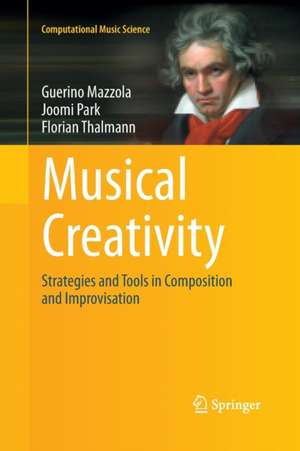
Musical Creativity: Computational Music Science
Autor Guerino Mazzola, Joomi Park, Florian Thalmannen Limba Engleză Paperback – 23 aug 2016
Ne-a atras atenția modul în care Musical Creativity reușește să transforme procesul abstract al creației într-o disciplină riguroasă, ancorată în matematică și informatică. Observăm că această lucrare reprezintă o actualizare metodologică a teoriilor fundamentale enunțate de Guerino Mazzola în lucrarea sa de referință, The Topos of Music III: Gestures. Spre deosebire de abordarea pur fenomenologică a gestului muzical din volumele anterioare, titlul de față integrează semiotica și teoria toposurilor într-un flux de lucru aplicat, destinat atât studenților, cât și cercetătorilor. Subliniem structura progresivă a volumului, care ghidează cititorul de la o ontologie a muzicii („Oniontology”) către aspecte tehnice specifice: ritm, armonie, contrapunct și structuri dodecafonice. Partea practică este susținută de tutoriale ce utilizează software-ul muzical Rubato, oferind o punte tehnologică între teorie și execuție. Complementar volumului Composing with Constraints, care se concentrează pe exerciții logice pas cu pas, Musical Creativity acoperă zona fundamentală a arhitecturilor de concepte și a modelelor computaționale, oferind o bază matematică pentru intuiția artistică. În contextul operei autorului, această carte face legătura între Functorial Semiotics for Creativity in Music and Mathematics și practica interpretativă explorată în Musical Performance. Studiile de caz sunt deosebit de relevante, oferind o analiză tehnică a variațiunilor lui Beethoven din op. 109 și o demonstrație de recompoziție a structurilor lui Boulez prin modulul software BigBang. Este un parcurs dens, dar extrem de bine organizat, care redefinește compoziția ca pe un sistem complex de obiecte predicative și transformări matematice.
Din seria Computational Music Science
- 24%
 Preț: 1037.84 lei
 - 20%
 Preț: 573.63 lei
 - 20%
 Preț: 573.49 lei
 -
 Preț: 399.89 lei
 - 15%
 Preț: 667.74 lei
 -
 Preț: 350.08 lei
 -
 Preț: 401.71 lei
 -
 Preț: 404.83 lei
 -
 Preț: 325.86 lei
 - 15%
 Preț: 672.24 lei
 - 15%
 Preț: 517.16 lei
 - 15%
 Preț: 516.31 lei
 - 18%
 Preț: 928.77 lei
 - 24%
 Preț: 861.07 lei
 - 24%
 Preț: 753.70 lei
 - 20%
 Preț: 553.63 lei
 - 15%
 Preț: 547.93 lei
 - 18%
 Preț: 729.35 lei
 - 15%
 Preț: 582.81 lei
 -
 Preț: 447.97 lei
 - 24%
 Preț: 995.60 lei
 - 18%
 Preț: 702.55 lei
 - 24%
 Preț: 896.41 lei
 - 19%
 Preț: 469.55 lei
Preț: 533.18 lei
Preț vechi: 627.27 lei
-15%
Carte tipărită la comandă
Livrare economică 07-21 decembrie
Specificații
ISBN-10: 3662508648
Pagini: 352
Ilustrații: XIV, 337 p. 129 illus., 97 illus. in color.
Dimensiuni: 155 x 235 x 20 mm
Greutate: 0.53 kg
Ediția:Softcover reprint of the original 1st edition 2011
Editura: Springer
Colecția Computational Music Science
Seria Computational Music Science
Locul publicării:Berlin, Heidelberg, Germany
V-ar putea interesa
-
 -15%Preț: 178.09 lei209.90 lei
 -
 Constructing Music: Musical Explorations in Creative CodingTeresa M. Nakra-16%Preț: 188.03 lei224.71 lei
 -
 -5%Preț: 124.42 lei130.97 lei
 -
 Composing Music: A New ApproachWilliam RussoPreț: 256.80 lei
 -
 Music Lessons: The Collège de France LecturesPierre BoulezPreț: 213.54 lei
 -
 Music's OdysseyRobin HollowayPreț: 358.94 lei
 -
 Principles of OrchestrationNikolai Rimsky-KorsakovPreț: 181.58 lei
 -
 Structural Functions of HarmonyArnold SchoenbergPreț: 107.97 lei
 -
 Fundamentals of Musical CompositionArnold SchoenbergPreț: 121.98 lei
 -
 A Perfect HarmonyDavid DarlingPreț: 66.26 lei
 -
 The Piano Improvisation HandbookCarl Humphries-13%Preț: 260.03 lei299.24 lei
 -
 Preț: 126.02 lei
 -
 The Madman's OrchestraEdward Brooke-HitchingPreț: 197.06 leiRecomandat
 -
 Preț: 174.89 lei
 -
 Preț: 106.29 lei
 -
 AS Music Composition WorkbookAlan CharltonPreț: 209.75 lei
 -
 Musical PerformanceGuerino Mazzola-20%Preț: 573.49 lei716.86 lei
 -
 Preț: 162.25 lei
De ce să citești această carte
Recomandăm această carte studenților de la compoziție și cercetătorilor în tehnologie muzicală care doresc să depășească limitele intuiției tradiționale. Cititorul câștigă o înțelegere profundă a fundamentelor matematice ale creativității, beneficiind de un set de instrumente software și strategii concrete pentru a structura procesul de improvizație și compoziție într-un mod inovator și riguros.
Despre autor
Guerino Mazzola este un matematician, muzicolog și pianist de jazz recunoscut la nivel internațional pentru pionieratul său în teoria matematică a muzicii. Alături de Joomi Park și Florian Thalmann, acesta explorează intersecția dintre topologie, semiotică și informatică. Mazzola este autorul unor lucrări monumentale publicate de Springer, precum „The Topos of Music”, și a dezvoltat software-ul Rubato, un instrument esențial pentru analiza muzicală computațională. Activitatea sa academică și artistică se concentrează pe modelarea creativității prin intermediul structurilor matematice complexe, fiind un punct de referință în seria Computational Music Science.
Descriere scurtă
After a thorough introduction, the book offers a first practical part with a detailed tutorial for students in composition and improvisation, using musical instruments and music software. The second, theoretical part deals with historical, actual, and new principles of creative processes in music, based on the results and methods developed in the first author’s book Topos of Music and referring to semiotics, predicative objects, topos theory, and object-oriented concept architectures. The third part of the book details four case studies in musical creativity, including an analysis of the six variations of Beethoven's sonata op. 109, a discussion of the creative process in a CD coproduced in 2011 by the first and second authors, a recomposition of Boulez’s "Structures pour deux pianos" using the Rubato software module BigBang developed by the third author, and the Escher theorem from mathematical gesture theory in music.
This is both a textbook addressed to undergraduate and graduate students of music composition and improvisation, and also a state-of-the-art survey addressed to researchers in creativity studies and music technology. The book contains summaries and end-of-chapter questions, and the authors have used the book as the main reference to teach an undergraduate creativity studies program and also to teach composition. The text is supported throughout with musical score examples.