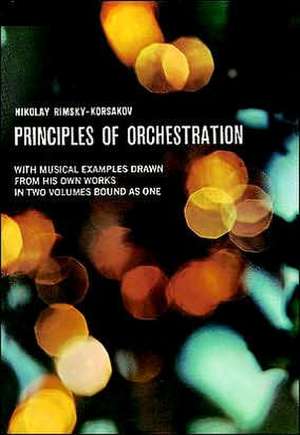
Principles of Orchestration
Autor Nikolai Rimsky-Korsakoven Limba Engleză Paperback – iun 1964
Contextul apariției acestui volum reeditat de Dover Publications este marcat de dorința de a conserva moștenirea didactică a unuia dintre cei mai mari maeștri ai culorii orchestrale. Notăm cu interes faptul că Principles of Orchestration nu este doar un manual tehnic, ci un testament artistic în care Nikolay Rimsky-Korsakov distilează decenii de experiență componistică. Considerăm că forța acestui tratat rezidă în onestitatea premisei sale: deși invenția nu poate fi predată, tehnica reprezintă fundamentul necesar pentru orice spirit creator. Experiența de studiu este una profund senzorială, cititorul fiind ghidat prin analiza texturilor sonore și a rezonanței tonale. Primele capitole oferă o examinare minuțioasă a grupurilor de coarde, suflători și alămuri, culminând cu strategii complexe despre cum se poate detașa o melodie de cadrul său armonic sau cum se obține un acord echilibrat în diverse combinații instrumentale. Ceea ce diferențiază această ediție este integrarea organică a celor 330 de pagini de partituri. Aceste exemple, extrase din capodopere precum Sheherazade sau Capriccio Espagnol, transformă conceptele abstracte în experiențe auditive vizualizate, permițând studierea modului în care sclipirea orchestrală este construită notă cu notă. Colecționarii și studenții care au apreciat rigoarea din Orchestration de Walter Piston vor găsi aici aceeași calitate a reproducerii și o profunzime similară a analizei. Totuși, spre deosebire de manualele academice contemporane, volumul lui Rimsky-Korsakov oferă perspectiva rară a creatorului care își explică propria metodă de lucru, transformând lectura într-o lecție privată de compoziție clasică.
Preț: 168.85 lei
Carte disponibilă
Livrare economică 18 mai-01 iunie
Specificații
ISBN-10: 0486212661
Pagini: 512
Dimensiuni: 163 x 232 x 25 mm
Greutate: 0.73 kg
Ediția:Revised edition
Editura: Dover Publications
V-ar putea interesa
-
 Carols for Choirs 1Reginald Jacques-21%Preț: 138.81 lei175.68 lei
 -
 The Guide to MIDI Orchestration 4ePaul Gilreath-9%Preț: 986.93 lei1084.55 lei
 -
 OrchestrationWalter PistonPreț: 387.70 lei
 -
 The Study of OrchestrationSamuel Adler-18%Preț: 952.47 lei1161.55 lei
 -
 Music, Physics and EngineeringHarry F. OlsonPreț: 95.19 lei
 -
 Treatise on InstrumentationHector BerliozPreț: 293.78 lei
 -
 On the Sensations of ToneHerman HelmoholtzPreț: 146.38 lei
 -
 Structural Functions of HarmonyArnold SchoenbergPreț: 102.85 lei
 -
 Essential Dictionary Of OrchestraDave BlackPreț: 98.00 lei
 -
 Music Theory Note by NoteMichael MillerPreț: 139.18 lei
 -
 The Craft of Musical Composition, Book I: TheoryPaul HindemithPreț: 143.43 lei
 -
 Preț: 117.18 lei
 -
 Orchestration in Musical TheatrePaul R. Laird-18%Preț: 74.77 lei91.52 lei
 -
 The Madman's OrchestraEdward Brooke-Hitching-16%Preț: 189.47 lei224.44 leiRecomandat
 -
 The Evolution of Modern OrchestrationLouis Adolphe CoernePreț: 168.13 lei
 -
 Sound TracksGraeme LawsonPreț: 89.77 lei
 -
 Preț: 95.52 lei
 -
 I Can Play: The NutcrackerFrances Lincoln Children'S Books-20%Preț: 94.33 lei117.32 lei
 -
 The Story Orchestra: I Can Play: Swan LakeJessica Courtney-Tickle-20%Preț: 94.42 lei117.36 lei
De ce să citești această carte
Această carte este indispensabilă oricărui compozitor sau orchestrator care dorește să stăpânească arta culorii sonore. Cititorul câștigă acces direct la secretele tehnice ale unui maestru rus, învățând cum să echilibreze un ansamblu mare și cum să utilizeze vocea umană în context simfonic. Este o investiție în tehnică, oferind exemple muzicale vaste care nu se regăsesc în alte tratate standard.
Descriere scurtă
In it, the composer aims to provide the reader with the fundamental principles of modern orchestration from the standpoint of brilliance and imagination, and he devotes considerable space to the study of tonal resonance and orchestral combination. In his course, he demonstrates such things as how to produce a good-sounding chord of certain tone-quality, uniformly distributed; how to detach a melody from its harmonic setting; correct progression of parts; and other similar problems.
The first chapter is a general review of orchestral groups, with an instrument-by-instrument breakdown and material on such technical questions as fingering, range, emission of sound, etc. There follows two chapters on melody and harmony in strings, winds, brasses, and combined groups. Chapter IV, Composition of the Orchestra, covers different ways of orchestrating the same music; effects that can be achieved with full tutti; tutti in winds, tutti pizzicato, soli in the strings, etc.; chords; progressions; and so on. The last two chapters deal with opera and include discussion of solo and choral accompaniment, instruments on stage or in the wings, technical terms, soloists (range, register, vocalization, vowels, etc.), voices in combination, and choral singing.
Immediately following this text are some 330 pages of musical examples drawn from "Sheherazade," the "Antar Symphony," "Capriccio Espagnol," "Sadko," "Ivan the Terrible," "Le Coq d'Or," "Mlada," "The Tsar's Bride," and others of Rimsky-Korsakov's works. These excerpts are all referred to in the text itself, where they illustrate, far better than words, particular points of theory and actual musical practice. They are largely responsible for making this book the very special (and very useful) publication it is.
This single-volume edition also includes a brief preface by the editor and extracts from Rimsky-Korsakov's 1891 draft and final versions of his own preface, as well as an appendixed chart of single tutti chords in the composer's works.