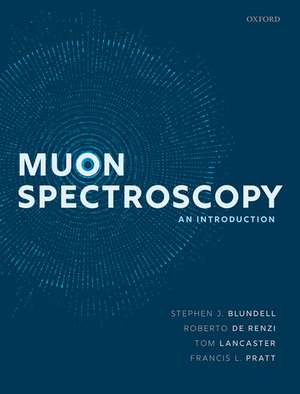
Muon Spectroscopy: An Introduction
Editat de Stephen J. Blundell, Roberto De Renzi, Tom Lancaster, Francis L. Pratten Limba Engleză Paperback – 10 noi 2021
Muons, radioactive particles produced in accelerators, have emerged as an important tool to study problems in condensed matter physics and chemistry. Beams of muons with all their spins polarized can be used to investigate a variety of static and dynamic effects and hence to deduce properties concerning magnetism, superconductivity, molecular or chemical dynamics and a large number of other phenomena. The technique was originally the preserve of a few specialistslocated in particle physics laboratories.
Today it is used by scientists from a very wide range of scientific backgrounds and interests. This modern, pedagogic introduction to muon spectroscopy is written with the beginner in the field in mind, but also aims to serve as a reference for more experienced researchers. The key principles are illustrated by numerous practical examples of the application of the technique to different areas of science and there are many worked examples and problems provided to test understanding.
The book vividly demonstrates the power of the technique to extract important information in manydifferent scientific contexts, all stemming, ultimately, from the exquisite magnetic sensitivity of the implanted muon spin.
Preț: 317.56 lei
Preț vechi: 435.66 lei
-27%
Carte tipărită la comandă
Livrare economică 10-16 decembrie
Specificații
ISBN-10: 0198858965
Pagini: 432
Ilustrații: 304 line illustrations and photographs
Dimensiuni: 190 x 247 x 21 mm
Greutate: 0.95 kg
Editura: OUP OXFORD
Colecția OUP Oxford
Locul publicării:Oxford, United Kingdom
V-ar putea interesa
-
 Magnetism in Condensed MatterStephen Blundell-10%Preț: 342.83 lei379.48 lei
 -
 -19%Preț: 521.50 lei644.17 lei
 -
 -23%Preț: 762.00 lei989.62 lei
 -
 Principles of Neutron Scattering from Condensed MatterAndrew T. Boothroyd-23%Preț: 539.16 lei701.29 lei
 -
 The Current Status and Future Direction of High-Magnetic-Field Science and Technology in the United StatesNational Academies of Sciences Engineering and MedicinePreț: 196.75 lei
 -
 Optically Stimulated LuminescenceEduardo G Yukihara-23%Preț: 820.69 lei1065.83 lei
 -
 Nuclear Physics - Principles & ApplicationsJohn LilleyPreț: 400.16 lei
 -
 XAFS for EveryoneScott Calvin-9%Preț: 829.58 lei911.63 lei
 -
 The Physics of Polarized TargetsTapio O Niinikoski-14%Preț: 1328.83 lei1545.14 lei
 -
 Experimental Techniques in Magnetism and Magnetic MaterialsSindhunil Barman Roy-14%Preț: 820.79 lei954.41 lei
 -
 Magnets: Types, Uses & SafetyTakashiro Akitsu-26%Preț: 892.84 lei1213.19 lei
 -
 Introduction to Muon Spin SpectroscopyAlex Amato-15%Preț: 560.54 lei659.45 lei
 -
 A Concise Introduction to Polymer PhysicsReinhard Hentschke-15%Preț: 489.27 lei575.61 lei
 -
 -11%Preț: 524.67 lei589.52 lei
 -
 -14%Preț: 883.38 lei1027.18 lei
 -
 Fundamentals of ¿¿Fe Mössbauer SpectrometryR. Justin Joseyphus-18%Preț: 998.45 lei1217.61 lei
Recenzii
Such an introductory text is completely lacking at the moment, and I think that this team is the ideal choice for bringing an edited volume together.
Notă biografică
Cuprins
- 1: The Basics of µSR
- Part I: Elements of Muon Spectroscopy
- 2: Introduction
- 3: Muon Charge and Spin States
- 4: The Quantum Muon
- 5: Polarization Functions
- Part II: Science with µSR
- 6: Magnetism
- 7: Dynamic Effects in Magnetism
- 8: Measuring Dynamic Processes
- 9: Superconductors
- 10: Semiconductors and Dielectrics
- 11: Ionic Motion
- 12: Chemistry
- Part III: Practicalities of Muon Spectroscopy
- 13: Making Muons
- 14: Instrumentation
- 15: Doing the Experiment
- Part IV: Further Topics in Muon Spectroscopy
- 16: Calculating Muon Sites
- 17: Numerical Modelling
- 18: Low Energy µSR
- 19: Stimulation Methods
- 20: High Magnetic Fields
- 21: Muons under Pressure
- 22: Negative Muon Techniques
- Part V: Complementary Techniques
- 23: µSR versus Other Resonance and Bulk Techniques
- 24: X-rays, Neutrons, and µSR
- Free