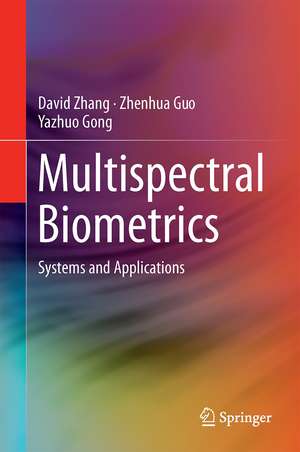
Multispectral Biometrics
Autor David Zhang, Zhenhua Guo, Yazhuo Gongen Limba Engleză Hardback – 23 sep 2015
Preț: 666.74 lei
Preț vechi: 784.40 lei
-15%
Puncte Express: 1000
Carte tipărită la comandă
Livrare economică 03-17 decembrie
Livrare prin curier în România Termenul estimat este afișat lângă disponibilitate.
Transport gratuit pentru acest produs Plată online sau ramburs, în funcție de opțiunile comenzii.
Retur gratuit în 14 zile Comandă securizată și suport în română.
Specificații
ISBN-13: 9783319224848
ISBN-10: 3319224840
Pagini: 244
Ilustrații: XI, 229 p. 129 illus.
Dimensiuni: 160 x 241 x 19 mm
Greutate: 0.48 kg
Ediția:1st edition 2015
Editura: Springer
Locul publicării:Cham, Switzerland
ISBN-10: 3319224840
Pagini: 244
Ilustrații: XI, 229 p. 129 illus.
Dimensiuni: 160 x 241 x 19 mm
Greutate: 0.48 kg
Ediția:1st edition 2015
Editura: Springer
Locul publicării:Cham, Switzerland
V-ar putea interesa
-
 Computing PROSODYYoshinori Sagisaka-15%Preț: 707.59 lei832.47 lei
-
 Proceedings of the Paralinguistic Information and its Integration in Spoken Dialogue Systems WorkshopRamón López-Cózar Delgado-18%Preț: 1273.46 lei1553.00 lei
-
 -15%Preț: 660.37 lei776.91 lei
-
 Privacy-Preserving Machine Learning for Speech ProcessingManas A. Pathak-15%Preț: 662.13 lei778.98 lei
-
 3D BiometricsDavid Zhang-20%Preț: 675.35 lei844.18 lei
-
 Principles of Magnetic Resonance ImagingYi Wang Phd-19%Preț: 575.75 lei710.80 lei
-
 Preț: 74.85 lei
-
 Camera RecognitionNistPreț: 87.42 lei
-
 Preț: 75.44 lei
-
 Preț: 95.45 lei
-
 Irex IIIP. GrotherPreț: 113.97 lei
-
 Artificial Intelligence ApplicationsColumbus CieslaPreț: 154.15 lei
-
 Preț: 54.49 lei
-
 -18%Preț: 1268.80 lei1547.32 lei
-
 Biometric RecognitionZhenan Sun-20%Preț: 492.29 lei615.36 lei
-
 Biometric RecognitionJie Zhou-20%Preț: 361.88 lei452.36 lei
-
 Biometric RecognitionJie Zhou-20%Preț: 346.13 lei432.67 lei
-
 Digitale Signalverarbeitung 1Hans W. Schüßler-15%Preț: 511.93 lei602.27 lei
-
 Morphological Image AnalysisPierre Soille-24%Preț: 1139.90 lei1499.88 lei
-
 Ethics and Policy of BiometricsAjay Kumar-20%Preț: 316.23 lei395.28 lei
-
 New Developments in Sensing Technology for Structural Health MonitoringSubhas Chandra Mukhopadhyay-18%Preț: 913.32 lei1113.81 lei
-
 -18%Preț: 1094.13 lei1334.30 lei
-
 Preț: 375.08 lei
-
 Optical Signal ProcessingPankaj K. DasPreț: 403.65 lei
-
 Digitale BildverarbeitungMartin WernerPreț: 304.56 lei
-
 Discriminative Learning in BiometricsDavid Zhang-20%Preț: 674.03 lei842.53 lei
-
 Tongue Image AnalysisDavid Zhang-20%Preț: 1032.26 lei1290.32 lei
-
 Breath Analysis for Medical ApplicationsDavid Zhang-5%Preț: 747.03 lei786.35 lei
-
 FACIAL MULTI-CHARACTERISTICS AND APPLICATIONSQijun Zhao & David Zhang Bob Zhang-20%Preț: 916.12 lei1145.14 lei
Public țintă
ResearchCuprins
Multimodal Fusion for Robust Identity Authentication: Role of Liveness Checks.- Multimodal Biometric Person Recognition System Based on Multi-Spectral Palmprint Features Using Fusion of Wavelet Representations.- Audio-Visual Biometrics and Forgery.- Face and ECG Based Multi-Modal Biometric Authentication.- Biometrical Fusion – Input Statistical Distribution.- Normalization of Infrared Facial Images under Variant Ambient Temperatures.- Use of Spectral Biometrics for Aliveness Detection.- A Contactless Biometric System Using Palm Print and Palm Vein Features.- Liveness Detection in Biometrics.- Fingerprint Recognition.- A Gender Detection Approach.- Improving Iris Recognition Performance Using Quality Measures.- Application of LCS Algorithm to Authenticate Users within Their Mobile Phone Through In-Air Signatures.- Performance Comparison of Principal Component Analysis-Based Face Recognition in Color Space.- Block Coding Schemes Designed for Biometric Authentication.- Perceived Age Estimation from Face Images.- Cell Biometrics Based on Bio-Impedance Measurements.- Hand Biometrics in Mobile Dices.
Notă biografică
David Zhang graduated in Computer Science from Peking University. He received his MSc in 1982 and his PhD in 1985 in Computer Science from the Harbin Institute of Technology (HIT), respectively. From 1986 to 1988 he was a Postdoctoral Fellow at Tsinghua University and then an Associate Professor at the Academia Sinica, Beijing. In 1994 he received his second PhD in Electrical and Computer Engineering from the University of Waterloo, Ontario, Canada. He is a Chair Professor since 2005 at the Hong Kong Polytechnic University where he is the Founding Director of the Biometrics Research Centre (UGC/CRC) supported by the Hong Kong SAR Government in 1998. He is Founder and Editor-in-Chief, International Journal of Image and Graphics (IJIG); Founder and Series Editor, Springer International Series on Biometrics (KISB); Organizer, the 1st International Conference on Biometrics Authentication (ICBA); Associate Editor of more than ten international journals including IEEE Transactions and so on. He was selected as a Highly Cited Researcher in Engineering by Thomson Reuters in 2014, 2015 and 2016, respectively. Professor Zhang is a Croucher Senior Research Fellow, Distinguished Speaker of the IEEE Computer Society, and a Fellow of both IEEE and IAPR.
Dongmin Guo received her B.S. and M.S. degrees at School of Automation, Northwestern Polytechnical University Xi'an, China in 2003 and 2006, respectively and received her Ph.D. degree at the Hong Kong Polytechnic University, Hong Kong, in 2011. She is currently working as a research associate in Radiology Department, Wake Forest University Health Sciences. Her research interests include bioinformatics and machine learning.
Ke Yan received his B.S. and Ph.D. degrees both from the Department of Electronic Engineering, Tsinghua University, Beijing, China. He was the winner of the 2016 Tsinghua University Excellent Doctoral Dissertation Award. He iscurrently a postdoctoral fellow in the Lab of Diagnostic Radiology Research, National Institutes of Health, USA. He is studying deep learning methods to analyze medical images. His research interests include computer vision, machine learning, and their biomedical applications.
Textul de pe ultima copertă
Describing several new biometric technologies, such as high-resolution fingerprint, finger-knuckle-print, multi-spectral backhand, 3D fingerprint, tongueprint, 3D ear, and multi-spectral iris recognition technologies, this book analyzes a number of efficient feature extraction, matching and fusion algorithms and how potential systems have been developed. Focusing on how to develop new biometric technologies based on the requirements of applications, and how to design efficient algorithms to deliver better performance, the work is based on the author’s research with experimental results under different challenging conditions described in the text. The book offers a valuable resource for researchers, professionals and postgraduate students working in the fields of computer vision, pattern recognition, biometrics, and security applications, amongst others.
Caracteristici
Maximizes reader insights into new biometric technologies such as high- resolution fingerprint, finger-knuckle-print and multi-spectral iris recognition technologies Analyzes how these technologies have been implemented in different biometric systems Highlights experimental results gleaned under challenging conditions Includes supplementary material: sn.pub/extras