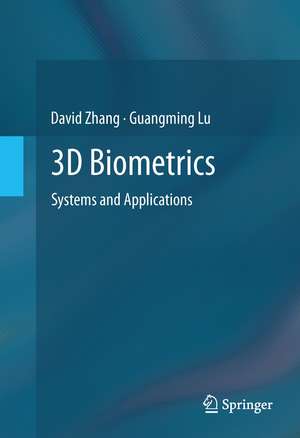
3D Biometrics
Autor David Zhang, Guangming Luen Limba Engleză Hardback – iun 2013
Preț: 675.35 lei
Preț vechi: 844.18 lei
-20%
Puncte Express: 1013
Carte tipărită la comandă
Livrare economică 28 noiembrie-12 decembrie
Livrare prin curier în România Termenul estimat este afișat lângă disponibilitate.
Transport gratuit pentru acest produs Plată online sau ramburs, în funcție de opțiunile comenzii.
Retur gratuit în 14 zile Comandă securizată și suport în română.
Specificații
ISBN-13: 9781461473992
ISBN-10: 1461473993
Pagini: 304
Ilustrații: XII, 290 p.
Dimensiuni: 160 x 241 x 20 mm
Greutate: 0.57 kg
Ediția:2013
Editura: Springer
Locul publicării:New York, NY, United States
ISBN-10: 1461473993
Pagini: 304
Ilustrații: XII, 290 p.
Dimensiuni: 160 x 241 x 20 mm
Greutate: 0.57 kg
Ediția:2013
Editura: Springer
Locul publicării:New York, NY, United States
V-ar putea interesa
-
 Pattern Recognition and Machine LearningChristopher M Bishop-20%Preț: 646.10 lei807.62 lei
 -
 Iris BiometricsChristian Rathgeb-20%Preț: 856.69 lei1070.86 lei
 -
 Digital FingerprintingCliff Wang-20%Preț: 722.41 lei903.01 lei
 -
 -18%Preț: 1268.80 lei1547.32 lei
 -
 Computer Models for Facial Beauty AnalysisDavid Zhang-20%Preț: 674.25 lei842.81 lei
 -
 -20%Preț: 257.61 lei322.01 lei
 -
 Belief Functions: Theory and ApplicationsJi¿ina Vejnarová-20%Preț: 343.01 lei428.76 lei
 -
 String Processing and Information RetrievalShunsuke Inenaga-20%Preț: 334.59 lei418.24 lei
 -
 Machine Learning and Knowledge Discovery in DatabasesPaolo Frasconi-20%Preț: 678.57 lei848.21 lei
 -
 Artificial Neural Networks in Pattern RecognitionFriedhelm Schwenker-20%Preț: 461.76 lei577.20 lei
 -
 Algorithmic Learning TheoryRonald Ortner-20%Preț: 339.95 lei424.94 lei
 -
 Nature of Computation and CommunicationPhan Cong Vinh-20%Preț: 329.48 lei411.85 lei
 -
 Patch-Based Techniques in Medical ImagingGuorong Wu-20%Preț: 327.16 lei408.95 lei
 -
 -20%Preț: 324.22 lei405.27 lei
 -
 Latent Variable Analysis and Signal SeparationPetr Tichavský-20%Preț: 361.01 lei451.26 lei
 -
 Pattern Recognition and Information ProcessingViktor V. Krasnoproshin-20%Preț: 320.58 lei400.72 lei
 -
 Reproducible Research in Pattern RecognitionBertrand Kerautret-20%Preț: 316.62 lei395.77 lei
 -
 Guide to Convolutional Neural NetworksHamed Habibi Aghdam-20%Preț: 519.95 lei649.94 lei
 -
 -20%Preț: 309.93 lei387.41 lei
 -
 -20%Preț: 328.16 lei410.20 lei
 -
 Discriminative Learning in BiometricsDavid Zhang-20%Preț: 674.03 lei842.53 lei
 -
 Tongue Image AnalysisDavid Zhang-20%Preț: 1032.26 lei1290.32 lei
Public țintă
Professional/practitionerCuprins
Overview.- 3D Biometrics Technologies and Systems.- 3D Ear Acquisition System.- Two Significant Characteristics in 3D Ear.- 3D Ear Feature Extraction and Recognition.- 3D Palmprint Capturing System.- 3D Information in Palmprint.- 3D Palmprint Classification by Global Features.- Joint Line and Orientation Features in 3D Palmprint.- 3D Fingerprint Acquisition Device.- 3D Fingerprint Reconstruction.- 3D Fingerprint Identification System.- The Principle of 3D Camera Imaging.- 3D Face Verification System.- Book Review and Future Work.
Recenzii
From the reviews:
“The authors start with an overview of biometrics, covering the basics and exploring why biometrics is becoming part of our daily lives. … I found this to be a very good, extensive discussion on implementation details, and would recommend to anyone implementing a biometric system in their work.” (Mariam Kiran, Computing Reviews, November, 2013)
“The authors start with an overview of biometrics, covering the basics and exploring why biometrics is becoming part of our daily lives. … I found this to be a very good, extensive discussion on implementation details, and would recommend to anyone implementing a biometric system in their work.” (Mariam Kiran, Computing Reviews, November, 2013)
Caracteristici
Includes discussions on popular 3D imaging technologies, combines them with biometric applications, and then presents real 3D biometric systems Introduces many efficient 3D feature extraction, matching, and fusion algorithms Techniques presented have been supported by experimental results using various 3D biometric classifications
Notă biografică
David Zhang graduated in Computer Science from Peking University. He received his MSc in 1982 and his PhD in 1985 in Computer Science from the Harbin Institute of Technology (HIT), respectively. From 1986 to 1988 he was a Postdoctoral Fellow at Tsinghua University and then an Associate Professor at the Academia Sinica, Beijing. In 1994 he received his second PhD in Electrical and Computer Engineering from the University of Waterloo, Ontario, Canada. He is a Chair Professor since 2005 at the Hong Kong Polytechnic University where he is the Founding Director of the Biometrics Research Centre (UGC/CRC) supported by the Hong Kong SAR Government in 1998. He is Founder and Editor-in-Chief, International Journal of Image and Graphics (IJIG); Founder and Series Editor, Springer International Series on Biometrics (KISB); Organizer, the 1st International Conference on Biometrics Authentication (ICBA); Associate Editor of more than ten international journals including IEEE Transactions and so on. He was selected as a Highly Cited Researcher in Engineering by Thomson Reuters in 2014, 2015 and 2016, respectively. Professor Zhang is a Croucher Senior Research Fellow, Distinguished Speaker of the IEEE Computer Society, and a Fellow of both IEEE and IAPR.
Dongmin Guo received her B.S. and M.S. degrees at School of Automation, Northwestern Polytechnical University Xi'an, China in 2003 and 2006, respectively and received her Ph.D. degree at the Hong Kong Polytechnic University, Hong Kong, in 2011. She is currently working as a research associate in Radiology Department, Wake Forest University Health Sciences. Her research interests include bioinformatics and machine learning.
Ke Yan received his B.S. and Ph.D. degrees both from the Department of Electronic Engineering, Tsinghua University, Beijing, China. He was the winner of the 2016 Tsinghua University Excellent Doctoral Dissertation Award. He iscurrently a postdoctoral fellow in the Lab of Diagnostic Radiology Research, National Institutes of Health, USA. He is studying deep learning methods to analyze medical images. His research interests include computer vision, machine learning, and their biomedical applications.