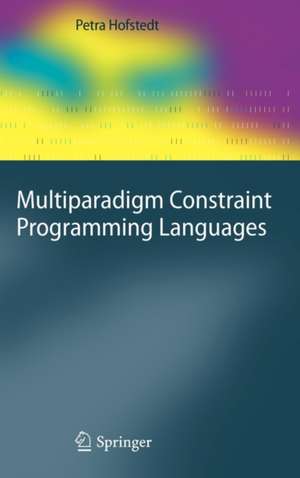
Multiparadigm Constraint Programming Languages: Cognitive Technologies
Autor Petra Hofstedten Limba Engleză Hardback – 17 iun 2011
This book deals with the theory and practice of multiparadigm constraint programming languages. The author first elaborates on programming paradigms and languages, constraints, and the merging of programming concepts which yields multiparadigm (constraint) programming languages. In the second part the author inspects two concrete approaches on multiparadigm constraint programming – the concurrent constraint functional language CCFL, which combines the functional and the constraint-based paradigms and allows the description of concurrent processes; and a general framework for multiparadigm constraint programming and its implementation, Meta-S.
The book is appropriate for researchers and graduate students in the areas of programming and artificial intelligence.
Din seria Cognitive Technologies
- 20%
 Preț: 999.31 lei
 - 20%
 Preț: 1304.33 lei
 - 15%
 Preț: 671.79 lei
 - 20%
 Preț: 1514.31 lei
 - 20%
 Preț: 666.51 lei
 - 20%
 Preț: 279.65 lei
 - 20%
 Preț: 342.57 lei
 - 20%
 Preț: 335.91 lei
 -
 Preț: 403.03 lei
 - 15%
 Preț: 638.15 lei
 - 20%
 Preț: 998.70 lei
 -
 Preț: 409.71 lei
 - 20%
 Preț: 1038.33 lei
 - 20%
 Preț: 618.34 lei
 - 20%
 Preț: 347.10 lei
 - 63%
 Preț: 310.47 lei
 - 20%
 Preț: 695.26 lei
 - 20%
 Preț: 552.07 lei
 - 20%
 Preț: 1008.89 lei
 - 20%
 Preț: 670.53 lei
 - 20%
 Preț: 992.32 lei
 - 20%
 Preț: 675.12 lei
 - 20%
 Preț: 671.84 lei
 - 20%
 Preț: 530.42 lei
 - 20%
 Preț: 356.18 lei
 - 44%
 Preț: 785.81 lei
 - 20%
 Preț: 695.48 lei
 - 46%
 Preț: 533.80 lei
 - 44%
 Preț: 558.89 lei
 - 20%
 Preț: 671.21 lei
Preț: 668.99 lei
Preț vechi: 836.23 lei
-20%
Puncte Express: 1003
Carte tipărită la comandă
Livrare economică 26 noiembrie-10 decembrie
Livrare prin curier în România Termenul estimat este afișat lângă disponibilitate.
Transport gratuit pentru acest produs Plată online sau ramburs, în funcție de opțiunile comenzii.
Retur gratuit în 14 zile Comandă securizată și suport în română.
Specificații
ISBN-13: 9783642173295
ISBN-10: 3642173292
Pagini: 192
Ilustrații: XII, 180 p.
Dimensiuni: 160 x 241 x 16 mm
Greutate: 0.41 kg
Ediția:2011
Editura: Springer
Colecția Cognitive Technologies
Seria Cognitive Technologies
Locul publicării:Berlin, Heidelberg, Germany
ISBN-10: 3642173292
Pagini: 192
Ilustrații: XII, 180 p.
Dimensiuni: 160 x 241 x 16 mm
Greutate: 0.41 kg
Ediția:2011
Editura: Springer
Colecția Cognitive Technologies
Seria Cognitive Technologies
Locul publicării:Berlin, Heidelberg, Germany
V-ar putea interesa
-
 -20%Preț: 89.95 lei112.23 lei
 -
 Bayesian Modeling of Uncertainty in Low-Level VisionRichard Szeliski-20%Preț: 650.05 lei812.56 lei
 -
 Computer VisionSimon J. D. Prince-20%Preț: 574.23 lei717.78 lei
 -
 Machine LearningPeter Flach-20%Preț: 386.84 lei483.55 lei
 -
 Multi-Agent Machine LearningSchwartz-20%Preț: 658.33 lei822.91 lei
 -
 Wavelet Neural NetworksAntonis K Alexandridis-20%Preț: 615.48 lei769.35 lei
 -
 Practical Introduction to CompDawson-Howe-20%Preț: 518.21 lei647.76 lei
 -
 Machine Learning: An Algorithmic Perspective, Second EditionStephen Marsland-20%Preț: 624.35 lei780.44 lei
 -
 -9%Preț: 987.33 lei1084.98 lei
 -
 -20%Preț: 304.47 lei380.60 lei
 -
 Einführung in die Constraint-ProgrammierungPetra Hofstedt-20%Preț: 221.97 lei277.46 lei
 -
 Information Security and Digital ForensicsDasun Weerasinghe-20%Preț: 329.48 lei411.85 lei
 -
 -20%Preț: 314.67 lei393.34 lei
 -
 Arts and TechnologyFay Huang-20%Preț: 335.46 lei419.34 lei
 -
 Computer Vision, Imaging and Computer Graphics: Theory and ApplicationsAlpeshkumar Ranchordas-20%Preț: 332.50 lei415.63 lei
 -
 -20%Preț: 947.87 lei1184.84 lei
 -
 -20%Preț: 321.03 lei401.30 lei
 -
 Believable BotsPhilip Hingston-20%Preț: 676.70 lei845.88 lei
Public țintă
ResearchCuprins
Basic Notions.- Programming Languages and Paradigms.- Constraints.- Multiparadigm Constraint Programming Languages.- Concurrent Constraint Functional Programming with CCFL.- A Generic Framework for Multiparadigm Constraint Programming.- Outlook.- References.- Index.
Recenzii
From the reviews:
“The book describes elementary and advanced constraint programming concepts. … This book is a useful textbook for related courses at the undergraduate or graduate level, but requires a background in general programming concepts, mathematical logic, and programming language theory. … The book would also be a good starting reference for researchers studying constraints.” (Maulik A. Dave, ACM Computing Reviews, July, 2012)
“The book describes elementary and advanced constraint programming concepts. … This book is a useful textbook for related courses at the undergraduate or graduate level, but requires a background in general programming concepts, mathematical logic, and programming language theory. … The book would also be a good starting reference for researchers studying constraints.” (Maulik A. Dave, ACM Computing Reviews, July, 2012)
Notă biografică
Petra Hofstedt:
Studium der Informatik an der Technischen Universität Dresden, 1995 Abschluss zur Diplom-Informatikerin.- Von 1995 bis 1999 wissenschaftliche Mitarbeiterin an der TU Dresden mit den Forschungs- und Arbeitsschwerpunkten (Deklarative) Programmiersprachen, parallele Programmierung und theoretische Informatik.- 1997 Forschungsaufenthalt an der Rheinisch-Westfälischen Technischen Hochschule Aachen.- Von 1999 bis 2001 wissenschaftliche Mitarbeiterin und seit 2002 wissenschaftliche Assistentin im Fachbereich Informatik der Technischen Universität Berlin (Fachgebiet Übersetzerbau und Programmiersprachen), Forschungs- und Arbeitsgebiete: Constraint-Programmierung, Programmiersprachen und Compilerbau.- 2001 Promotion zum Thema "Cooperation and Coordination of Constraint Solvers".
Armin Wolf:
Studium der Informatik an der Universität Karslruhe, 1991 Abschluss zum Diplom-Informatiker.- Von 1992 bis 1994 wissenschaftlicher Mitarbeiter an der Technischen Hochschule Berlin. Arbeitsschwerpunkte: formale Spezifikationen und deklarative Programmierung.- Seit 1994 wissenschaftlicher Mitarbeiter und Projektleiter am Fraunhofer Institut für Rechnerarchitektur und Softwaretechnik (FIRST) in Berlin. Arbeitsschwerpunkte: Methoden, Verfahren und Anwendungen der Constraint-Programmierung, insbesondere in der Planung.- Oktober 1998 bis Oktober 2003 Forschungskoordinator am Institut FIRST. Unterstützung der Institutsleitung bei der Neustrukturierung des Instituts, dessen wissenschaftliche Ausrichtung sowie dessen Überleitung in die Fraunhofer Gesellschaft. Präsentation des Instituts nach innen und außen.- Seit Januar 1999 stellvertretender Leiter des Bereichs "Planungstechnik" am Institut FIRST.- 1999 Promotion mit Auszeichnung zur adaptiven regelbasierten Constraint-Programmierung.
Textul de pe ultima copertă
Programming languages are often classified according to their paradigms, e.g. imperative, functional, logic, constraint-based, object-oriented, or aspect-oriented. A paradigm characterizes the style, concepts, and methods of the language for describing situations and processes and for solving problems, and each paradigm serves best for programming in particular application areas. Real-world problems, however, are often best implemented by a combination of concepts from different paradigms, because they comprise aspects from several realms, and this combination is more comfortably realized using multiparadigm programming languages.
This book deals with the theory and practice of multiparadigm constraint programming languages. The author first elaborates on programming paradigms and languages, constraints, and the merging of programming concepts which yields multiparadigm (constraint) programming languages. In the second part the author inspects two concrete approaches on multiparadigm constraint programming – the concurrent constraint functional language CCFL, which combines the functional and the constraint-based paradigms and allows the description of concurrent processes; and a general framework for multiparadigm constraint programming and its implementation, Meta-S.
The book is appropriate for researchers and graduate students in the areas of programming and artificial intelligence.
This book deals with the theory and practice of multiparadigm constraint programming languages. The author first elaborates on programming paradigms and languages, constraints, and the merging of programming concepts which yields multiparadigm (constraint) programming languages. In the second part the author inspects two concrete approaches on multiparadigm constraint programming – the concurrent constraint functional language CCFL, which combines the functional and the constraint-based paradigms and allows the description of concurrent processes; and a general framework for multiparadigm constraint programming and its implementation, Meta-S.
The book is appropriate for researchers and graduate students in the areas of programming and artificial intelligence.
Caracteristici
Suitable for researchers and graduate students working in the areas of programming and constraints Introduces new approaches Demonstrates results on real-world problems Includes supplementary material: sn.pub/extras