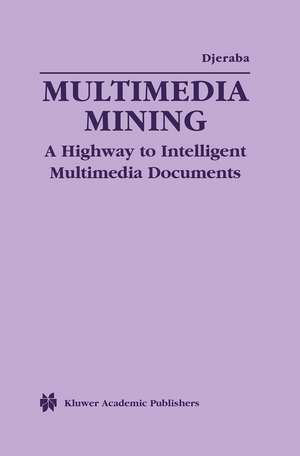
Multimedia Mining
Editat de Chabane Djerabaen Limba Engleză Hardback – 30 noi 2002
Multimedia documents are ubiquitous and often required, if not essential, in many applications today. This phenomenon has made multimedia documents widespread and extremely large. There are tools for managing and searching within these collections, but the need for tools to extract hidden useful knowledge embedded within multimedia objects is becoming pressing and central for many decision-making applications. The tools needed today are tools for discovering relationships between objects or segments within multimedia document components, such as classifying images based on their content, extracting patterns in sound, categorizing speech and music, and recognizing and tracking objects in video streams.
Preț: 652.62 lei
Preț vechi: 815.78 lei
-20%
Puncte Express: 979
Carte tipărită la comandă
Livrare economică 30 noiembrie-14 decembrie
Livrare prin curier în România Termenul estimat este afișat lângă disponibilitate.
Transport gratuit pentru acest produs Plată online sau ramburs, în funcție de opțiunile comenzii.
Retur gratuit în 14 zile Comandă securizată și suport în română.
Specificații
ISBN-13: 9781402072475
ISBN-10: 1402072473
Pagini: 231
Ilustrații: XIV, 231 p.
Dimensiuni: 162 x 243 x 20 mm
Greutate: 0.54 kg
Ediția:2003 edition
Editura: Springer Us
Locul publicării:New York, NY, United States
ISBN-10: 1402072473
Pagini: 231
Ilustrații: XIV, 231 p.
Dimensiuni: 162 x 243 x 20 mm
Greutate: 0.54 kg
Ediția:2003 edition
Editura: Springer Us
Locul publicării:New York, NY, United States
V-ar putea interesa
-
 Computer VisionSimon J. D. Prince-20%Preț: 582.72 lei728.39 lei
 -
 Practical Introduction to CompDawson-Howe-20%Preț: 518.21 lei647.76 lei
 -
 Mathematical Tools for Data MiningDan A. Simovici-20%Preț: 931.35 lei1164.18 lei
 -
 Image Analysis and Processing IIV. Cantoni-20%Preț: 334.49 lei418.11 lei
 -
 3D Synthetic Environment ReconstructionMahdi Abdelguerfi-20%Preț: 942.95 lei1178.68 lei
 -
 Statistical Image Processing Techniques for Noisy ImagesPhillipe Réfrégier-20%Preț: 320.97 lei401.21 lei
 -
 A Pyramid Framework for Early VisionJean-Michel Jolion-20%Preț: 319.81 lei399.77 lei
 -
 Mathematical Nonlinear Image ProcessingEdward R. Dougherty-20%Preț: 1277.13 lei1596.41 lei
 -
 Intelligent Unmanned Ground VehiclesMartial H. Hebert-20%Preț: 1224.74 lei1530.92 lei
 -
 Multi-Modal User Interactions in Controlled EnvironmentsChaabane Djeraba-20%Preț: 944.85 lei1181.07 lei
 -
 Beginning Design for 3D PrintingJoe Micallef-20%Preț: 351.09 lei438.87 lei
 -
 -20%Preț: 1261.24 lei1576.54 lei
 -
 The NexStar Evolution and SkyPortal User's GuideJames L. ChenPreț: 308.59 lei
 -
 Augmented Reality, Virtual Reality, and Computer GraphicsLucio Tommaso De Paolis-20%Preț: 328.49 lei410.62 lei
 -
 Immersive Learning Research NetworkColin AllisonPreț: 383.82 lei
 -
 Computer Vision and GraphicsLeszek J. Chmielewski-20%Preț: 341.19 lei426.48 lei
 -
 -20%Preț: 656.86 lei821.08 lei
 -
 Hybrid Soft Computing for Image SegmentationSiddhartha Bhattacharyya-20%Preț: 677.34 lei846.67 lei
 -
 -20%Preț: 668.76 lei835.95 lei
 -
 Mining Multimedia and Complex DataOsmar R. Zaïane-20%Preț: 322.16 lei402.70 lei
 -
 Digital Imaging and Communications in Medicine (DICOM)Oleg S. Pianykh-5%Preț: 913.64 lei961.73 lei
 -
 -20%Preț: 505.34 lei631.67 lei
 -
 COMPUTER VISION IN ROBOTICS AND INDUSTRIAL APPLICATIONSSankowski Dominik-20%Preț: 1281.12 lei1601.40 lei
Public țintă
ResearchCuprins
Featured Chapters.- 1. Met: Image Mining for Typhoon Analysis.- 1.1. Introduction.- 1.2. Typhoon from an Informatics Perspective.- 1.3. Representation of the Typhoon.- 1.4. Image Mining.- 1.5. Image Mining Environment for Typhoon Analysis and Prediction.- 1.6. Conclusion.- 1.7. Acknowledgment.- 1.8. References.- 2. Discovering Patterns with and within Images.- 2.1. Introduction.- 2.2. Image Mining Techniques.- 2.3. Conclusion.- 2.4. References.- 3. A System Supporting Semantics Retrieval.- 3.1. Introduction.- 3.2. Scenery Analyzer: System Framework.- 3.3. A Hierarchical Representation for Low-Level Features.- 3.4. Extracting Semantic Features.- 3.5. Case Study of Semantic Features.- 3.6. Conclusion.- 3.7. References.- 4. Techniques for Color-Based Image Retrieval.- 4.1. Introduction.- 4.2. Color-Spaces.- 4.3. Color-based image description.- 4.4. Visual features extraction and representation.- 4.5. Distance Function.- 4.6. Similarity Search.- 4.7. Existing CBIR approaches.- 4.8. Open problems.- 4.9. Summary.- 4.10. Acknowledgment.- 4.11. References.- 5. Recovering in Video Documents.- 5.1. Introduction.- 5.2. Temporal video segmentation.- 5.3. Computation of optical flow.- 5.4. Building and selection of trajectories.- 5.5. Camera model.- 5.6. Recovery of camera motion without parallax.- 5.7. Recovery of camera motion with parallax.- 5.8. Integration.- 5.9. Conclusion.- 5.10. Acknowledgments.- 5.11. References.- 6. Mining of Video Database.- 6.1. Introduction.- 6.2. Semantics-Sensitive Video Database Model.- 6.3. Video Analysis and Feature Extraction.- 6.4. Semantics-Sensitive Video Classification.- 6.5. Hierarchical Database Indexing and Access.- 6.6. Conclusions.- 6.7. Acknowledgement.- 6.8. References.- 7. Medical Multimedia Databases.- 7.1. Introduction.- 7.2. Reviewof Medical Multimodality and Multimedia Systems.- 7.3. The Medimage System.- 7.4. The Epilepsy System.- 7.5. Conclusions.- 7.6. References.- 8. An Object Approach for Web Presentations.- 8.1. Introduction.- 8.2. The V-STORM System.- 8.3. The AROM System.- 8.4. Coupling AROM and V-STORM.- 8.5. The Template model.- 8.6. Related Works.- 8.7. Conclusion.- 8.8. References.- 9. Web Multiform Data Structuring.- 9.1. Introduction.- 9.2. Related work.- 9.3. UML conceptual model.- 9.4. XML logical model.- 9.5. XML physical model.- 9.6. Conclusion and future issues.- 9.7. References.- 10. Media Annotation.- 10.1. Introduction.- 10.2. Generation of describers.- 10.3. Dimensions.- 10.4. Querying.- 10.5. Conclusion.- 10.6. References.- 11. Audio Content-Based Classification.- 11.1. Introduction.- 11.2. Framework of semantic classes.- 11.3. Classification method.- 11.4. Retrieval.- 11.5. Experimentation.- 11.6. Comparison with related works.- 11.7. Conclusion.- 11.8. Acknowledgment.- 11.9. References.