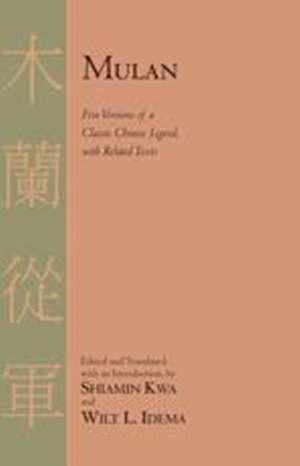
Mulan: Five Versions of a Classic Chinese Legend, with Related Texts
Traducere de Shiamin Kwa, Wilt L. Idemaen Limba Engleză Hardback – 14 sep 2010
| Toate formatele și edițiile | Preț | Express |
|---|---|---|
| Paperback (1) | 147.65 lei 3-5 săpt. | +9.18 lei 7-13 zile |
| Hackett Publishing Company – 13 sep 2010 | 147.65 lei 3-5 săpt. | +9.18 lei 7-13 zile |
| Hardback (1) | 319.29 lei 3-5 săpt. | |
| Hackett Publishing Company – 14 sep 2010 | 319.29 lei 3-5 săpt. |
Preț: 319.29 lei
Puncte Express: 479
Preț estimativ în valută:
56.52€ • 66.03$ • 49.05£
56.52€ • 66.03$ • 49.05£
Carte disponibilă
Livrare economică 04-18 februarie
Preluare comenzi: 021 569.72.76
Specificații
ISBN-13: 9781603841979
ISBN-10: 1603841970
Pagini: 170
Dimensiuni: 9 x 215 x 15 mm
Greutate: 0.33 kg
Editura: Hackett Publishing Company
Colecția Hackett Publishing Company, Inc (US)
ISBN-10: 1603841970
Pagini: 170
Dimensiuni: 9 x 215 x 15 mm
Greutate: 0.33 kg
Editura: Hackett Publishing Company
Colecția Hackett Publishing Company, Inc (US)
V-ar putea interesa
-
 Escape from Blood Pond HellBeata GrantPreț: 253.66 lei
 -
 Between Kant and Hegel: Texts in the Development of Post-Kantian IdealismGeorge di Giovanni-17%Preț: 174.43 lei210.90 lei
 -
 Kleist: Selected WritingsHeinrich von Kleist-11%Preț: 135.43 lei152.00 lei
 -
 -10%Preț: 137.62 lei153.34 lei
 -
 -17%Preț: 203.13 lei245.14 lei
 -
 Medieval DramaDavid Bevington-21%Preț: 421.59 lei532.68 lei
 -
 -9%Preț: 741.08 lei814.37 lei
 -
 Passion, Poverty and TravelWilt L. IdemaPreț: 267.39 lei
 -
 Preț: 132.68 lei
 -
 Doux Pays. 189 Dessins (Ed.1897)Forain J. L.Preț: 125.53 lei
 -
 Preț: 169.39 lei
 -
 Eloge de Voltaire, Suivi de Poesies Diverses (Ed.1783)De Cubieres Palmezeaux M.Preț: 90.17 lei
 -
 Eloge Du Sein Des Femmes: Ouvrage Curieux... (4e Ed) (Ed.1873)Mercier De Compiegne C.Preț: 111.60 lei
 -
 Preț: 124.97 lei
 -
 Preț: 97.67 lei
 -
 Preț: 131.95 lei
 -
 Etude Et Récits Sur Alfred de Musset (Éd.1891)de Choiseul Gouffier aPreț: 154.91 lei
 -
 Etude Genealogique Sur Les Bourdaloue, (Ed.1900)Tausserat J. B. E.Preț: 103.91 lei
 -
 Preț: 169.59 lei
 -
 Etudes Historiques: La Maison de Rabaine (Ed.1891)Dangibeaud C.Preț: 124.97 lei
 -
 Preț: 207.09 lei
 -
 Etudes Sur L'Histoire de Prusse (4e Tirage) (Ed.1896)Ernest LavissePreț: 176.51 lei
 -
 Etudes Sur Moliere: Le Tartuffe (Ed.1877)Louis Lacour De La PijardierePreț: 104.28 lei
 -
 Judge Bao and the Rule of LawWilt L. IdemaPreț: 230.99 lei
 -
 Generals of the Yang Family, The: Four Early PlaysWilt L. Idema-15%Preț: 544.06 lei640.06 lei
Recenzii
Idema's scholarship . . . [and his] ability to translate popular texts into comparably idiomatic English are outstanding achievements.--Hugh R. Clark, Ursinus College
The plots and the elaborations of the Mulan narratives reproduced (and summarized) here demonstrate the many ways in which the Mulan figure has spoken to succeeding generations with differing heroic characteristics and in the idiom that each audience understood; they offer excellent texts for a deep background for any consideration of Mulan in contemporary culture. For scholars of European fairy tales, the narratives offer striking points of comparison with European crossdressing heroines of the sixteenth, seventeenth, and eighteenth centuries.--Ruth B. Bottigheimer, Stony Brook University
The plots and the elaborations of the Mulan narratives reproduced (and summarized) here demonstrate the many ways in which the Mulan figure has spoken to succeeding generations with differing heroic characteristics and in the idiom that each audience understood; they offer excellent texts for a deep background for any consideration of Mulan in contemporary culture. For scholars of European fairy tales, the narratives offer striking points of comparison with European crossdressing heroines of the sixteenth, seventeenth, and eighteenth centuries.--Ruth B. Bottigheimer, Stony Brook University