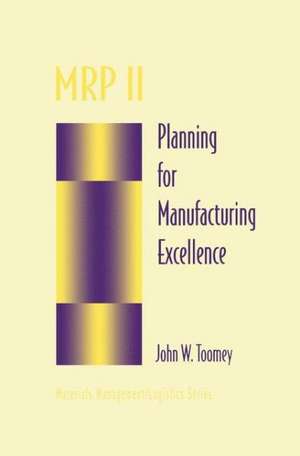
MRP II: Planning for Manufacturing Excellence: Chapman & Hall Materials Management/Logistics Series
Autor John W. Toomeyen Limba Engleză Paperback – 26 apr 2013


Preț: 906.17 lei
Preț vechi: 1105.08 lei
-18%
Carte tipărită la comandă
Livrare economică 23 noiembrie-07 decembrie
Specificații
ISBN-10: 1461368464
Pagini: 260
Ilustrații: XI, 243 p.
Dimensiuni: 155 x 235 x 14 mm
Greutate: 0.37 kg
Ediția:Softcover reprint of the original 1st ed. 1996
Editura: Springer Us
Colecția Springer
Seria Chapman & Hall Materials Management/Logistics Series
Locul publicării:New York, NY, United States
V-ar putea interesa
-
 Manufacturing Planning and Control for Supply Chain ManagementF. Robert Jacobs-26%Preț: 367.49 lei497.39 lei
 -
 Handbook of Cellular Manufacturing SystemsShahrukh A. Irani-24%Preț: 1242.68 lei1635.10 lei
 -
 Computational Intelligence in Design and ManufacturingAndrew Kusiak-14%Preț: 908.20 lei1056.05 lei
 -
 Master Planning and SchedulingJohn F Proud-23%Preț: 846.32 lei1099.12 lei
 -
 Essential Operations ManagementAlex Hill-27%Preț: 397.18 lei542.32 lei
 -
 -38%Preț: 428.57 lei693.49 lei
 -
 Operations and Supply Chain Management: The Core: 2025 Release ISEF. Robert Jacobs-4%Preț: 363.17 lei378.30 lei
 -
 Operations Management: 2025 Release ISEGerard Cachon-4%Preț: 376.39 lei392.07 lei
 -
 -8%Preț: 574.82 lei624.81 lei
 -
 Operations and Supply Chain Management: 2024 Release ISEWilliam J Stevenson-35%Preț: 405.25 lei624.01 lei
 -
 Introduction to Materials Management, Global EditionSteve Chapman-11%Preț: 655.41 lei736.42 lei
 -
 Operations and Process ManagementNigel Slack-9%Preț: 577.59 lei634.71 lei
 -
 Project ManagementHarold R. Kerzner-23%Preț: 684.74 lei889.27 lei
 -
 -15%Preț: 497.95 lei585.82 lei
 -
 -15%Preț: 411.78 lei484.45 lei
 -
 Production SchedulingPierre Lopez-14%Preț: 1212.96 lei1410.42 lei
 -
 Principles of Supply Chain Management and Their ImplicationsJack Muckstadt-11%Preț: 429.97 lei483.12 lei
 -
 Bottleneck Just-in-Time SequencingChudamani PoudyalPreț: 372.79 lei
Public țintă
ResearchCuprins
Recenzii
Descriere
MRP II explores the principles of MRP II systems, and how the manufacturer can utilize and institute them effectively for maximum profit. The book will serve as a valuable professional reference for manufacturers instituting or utilizing an MRP II scheduling system. It will also be a valuable teaching tool for the 2- and 4- year college or university programs, a reference for APICS certification review, and continuing education programs. There are examples throughout, as well as extensive end-of-chapter case studies and their solutions. A glossary of terms is also included.
Textul de pe ultima copertă
MRP II: Planning for Manufacturing Excellence, an authoritative and insightful text, explores and defines the principles of Manufacturing Resource Planning methodology. It describes how the manufacturer can utilize and institute these principles effectively for maximum profit. Written from a user's viewpoint, the author presents MRP II as a planning tool used to achieve successful execution in differing manufacturing environments. The text features extensive end-of-chapter case studies, chapter quizzes, and their solutions as well as a glossary of terms. It also includes specific goals for manufacturing environments such as short lead times, reduced work-in-process, and flexibility to demand. In addition, detailed explanations of recent approaches to both infinite and finite scheduling are examined as well as execution concepts for processes, ranging from continuous synchronized process flow to nonsynchronized interrupted flow. Designed to provide readers with the principles of MRP II as well as its application to planning and manufacturing execution, this essential guide fulfills the training needs of manufacturing personnel and community college students. It is also a useful resource for material and manufacturing practitioners who require in-depth knowledge of MRP II or those who use it as a reference book to assist in The American Production and Inventory Control Society (APICS) certification.