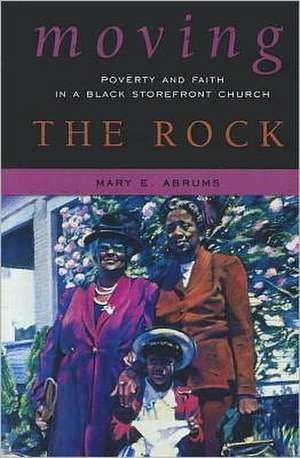
Moving the Rock: Poverty and Faith in a Black Storefront Church
Autor Mary E. Abrumsen Limba Engleză Paperback – 10 noi 2011
Preț: 211.78 lei
Preț vechi: 284.93 lei
-26%
Puncte Express: 318
Carte tipărită la comandă
Livrare economică 06-20 iunie
Specificații
ISBN-13: 9780759113206
ISBN-10: 0759113203
Pagini: 217
Dimensiuni: 154 x 231 x 15 mm
Greutate: 0.41 kg
Editura: Bloomsbury Publishing
Colecția AltaMira Press
Locul publicării:New York, United States
ISBN-10: 0759113203
Pagini: 217
Dimensiuni: 154 x 231 x 15 mm
Greutate: 0.41 kg
Editura: Bloomsbury Publishing
Colecția AltaMira Press
Locul publicării:New York, United States
V-ar putea interesa
-
 Negro with a Hat: Marcus GarveyColin Grant-30%Preț: 63.31 lei90.62 lei
 -
 Bass CultureLloyd Bradley-19%Preț: 94.99 lei117.72 lei
 -
 The Autobiography of Malcolm XAlex Haley-35%Preț: 58.55 lei90.70 lei
 -
 The Signifying Monkey: A Theory of African-American Literary CriticismHenry Louis GatesPreț: 134.49 lei
 -
 The Art of Being Black: The Creation of Black British Youth IdentitiesClaire E. Alexander-34%Preț: 677.37 lei1027.62 lei
 -
 Biko Lives!A. MngxitamaPreț: 373.12 lei
 -
 Preț: 164.60 lei
 -
 The Hemingses of MonticelloAnnette Gordon-ReedPreț: 142.73 lei
 -
 Brotherhoods of ColorEric ArnesenPreț: 238.83 lei
 -
 The Race BeatGene RobertsPreț: 103.93 lei
 -
 African American Mystery Writers: A Historical and Thematic StudyFrankie Y BaileyPreț: 298.96 lei
 -
 Indaba, My Children: African Tribal History, Legends, Customs And Religious BeliefsVusamazulu Credo MutwaPreț: 140.51 lei
 -
 The New Black HistoryE. HintonPreț: 375.41 lei
 -
 Still BraveFrances Smith FosterPreț: 146.84 lei
 -
 Preț: 103.21 lei
 -
 Business in AsiaRussell Smyth-12%Preț: 152.66 lei172.92 lei
Cuprins
Preface
Introduction: A Short History
Part I. Morning Sun Missionary Baptist Church
Chapter 1. Morning Sun Church and Its Leaders
Chapter 2. The Family
Chapter 3. Motherhood
Part II. The Women of Morning Sun Church
Chapter 4. Molly Lake Lander: "I Guess I Have to Go to Jesus"
Chapter 5. Caren Lake: "Having a Dream"
Chapter 6. Mahalia Lake: "I Don't Ask the Lord to Move the Mountain, Just Give Me the Strength to Climb It"
Chapter 7. Mable Jackson: "All I Asked the Lord for Was a Man with a Cigarette and a Job"
Chapter 8. Betty Jones: "I Like to Go!"
Chapter 9. Joann Jones Newton: "When God Comes, He's Getting Some of Every Race"
Chapter 10. Marie Jones Smith: "Getting that Made-Up Mind"
Chapter 11. Linda Wilson, Marie's Daughter: "All These Years I Have Become Stronger"
Part III. The Research Process
Chapter 12. The Research, the Women, and Me
Appendix: The Research Questions, Theories, and Methods
Introduction: A Short History
Part I. Morning Sun Missionary Baptist Church
Chapter 1. Morning Sun Church and Its Leaders
Chapter 2. The Family
Chapter 3. Motherhood
Part II. The Women of Morning Sun Church
Chapter 4. Molly Lake Lander: "I Guess I Have to Go to Jesus"
Chapter 5. Caren Lake: "Having a Dream"
Chapter 6. Mahalia Lake: "I Don't Ask the Lord to Move the Mountain, Just Give Me the Strength to Climb It"
Chapter 7. Mable Jackson: "All I Asked the Lord for Was a Man with a Cigarette and a Job"
Chapter 8. Betty Jones: "I Like to Go!"
Chapter 9. Joann Jones Newton: "When God Comes, He's Getting Some of Every Race"
Chapter 10. Marie Jones Smith: "Getting that Made-Up Mind"
Chapter 11. Linda Wilson, Marie's Daughter: "All These Years I Have Become Stronger"
Part III. The Research Process
Chapter 12. The Research, the Women, and Me
Appendix: The Research Questions, Theories, and Methods
Recenzii
Abrums, an anthropologist and registered nurse, examines the lives of African American women members of the Morning Sun Church in the Central District of Seattle. Abrums spent 18 months observing and interviewing the women of Morning Sun, and the resulting stories are deeply engaging as individual narratives and compelling when taken as a whole. The work positively sparkles with the voices of these women as they discuss their struggles, joys, beliefs, health, and families. This book is undoubtedly academic, yet there is much here for the nonacademic reader to enjoy, too. Verdict:Engaging, beautifully written, surprising, and challenging in the best way possible, this is highly recommended for its fine, compelling writing as well as for its profound subject. Scholars of women's studies, religious studies, and anthropology should take particular note of this title, but it is strongly recommended to interested general readers as well.
Mary Abrums has written an honest and sensitive portrayal of African American families rarely found in today's literature. It took me back to an earlier time and place in my own life, and I experienced a full range of emotions as I read. I rejoice in the publication of this book.
The rich detail of these women's lives is wonderfully expressed through the eyes of the narrator as she relates their life stories within the cultural context of the Seattle community in which they live. The book presents authoritative research but reads like a fascinating novel and one quickly finds oneself immersed in the lives of the eight women who shared their life histories. Abrums paints a picture so compelling that I felt I was sitting in their homes with the women and could feel their exhaustion or exhilaration. By sharing their stories, these women remind us that we have more in common as human beings than we have differences.
In Moving the Rock, Abrums eloquently unfolds the religious beliefs and practices of the women of Morning Sun Church, a group of African American women who struggle to nurture their families and community members against tremendous odds. Written in a clear and engaging style, this book provides a major contribution to scholarship in womanist/feminist literature, religious studies, and the anthropology of working-class African Americans in the urban Northwest. The author's conscientious efforts to keep the voices of these women and their narratives at the forefront of this text give the reader an insider's perspective of how religious beliefs and practices empower women living at, near, or below the official poverty line in the United States.
Mary Abrums has written an honest and sensitive portrayal of African American families rarely found in today's literature. It took me back to an earlier time and place in my own life, and I experienced a full range of emotions as I read. I rejoice in the publication of this book.
The rich detail of these women's lives is wonderfully expressed through the eyes of the narrator as she relates their life stories within the cultural context of the Seattle community in which they live. The book presents authoritative research but reads like a fascinating novel and one quickly finds oneself immersed in the lives of the eight women who shared their life histories. Abrums paints a picture so compelling that I felt I was sitting in their homes with the women and could feel their exhaustion or exhilaration. By sharing their stories, these women remind us that we have more in common as human beings than we have differences.
In Moving the Rock, Abrums eloquently unfolds the religious beliefs and practices of the women of Morning Sun Church, a group of African American women who struggle to nurture their families and community members against tremendous odds. Written in a clear and engaging style, this book provides a major contribution to scholarship in womanist/feminist literature, religious studies, and the anthropology of working-class African Americans in the urban Northwest. The author's conscientious efforts to keep the voices of these women and their narratives at the forefront of this text give the reader an insider's perspective of how religious beliefs and practices empower women living at, near, or below the official poverty line in the United States.