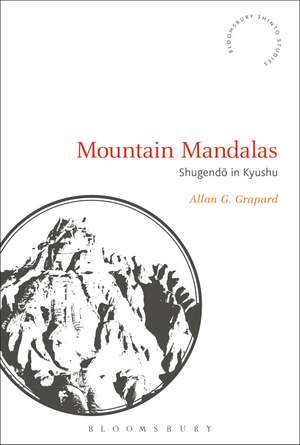
Mountain Mandalas: Shugendo in Kyushu: Bloomsbury Shinto Studies
Autor Allan G. Graparden Limba Engleză Hardback – 25 feb 2016
This book includes detailed analyses of the geography of sacred sites, translations from many original texts, and discussions on rituals and social practices. Grapard studies Mount Hiko and the Kunisaki Peninsula, which was very influential in Japanese cultural and religious history throughout the ages. We are introduced to important information on archaic social structures and their religious traditions; the development of the cult to the deity Hachiman; a history of the interactions between Buddhism and local cults in Japan; a history of the Shugendo tradition of mountain religious ascetics, and much more.
Mountain Mandalas sheds light on important aspects of Japan's religion and culture, and will be of interest to all scholars of Shinto and Japanese religion. Extensive translations of source material can be found on the book's webpage.


Preț: 851.47 lei
Preț vechi: 1264.19 lei
-33%
Puncte Express: 1277
Carte tipărită la comandă
Livrare economică 17 noiembrie-01 decembrie
Livrare prin curier în România Termenul estimat este afișat lângă disponibilitate.
Transport gratuit pentru acest produs Plată online sau ramburs, în funcție de opțiunile comenzii.
Retur gratuit în 14 zile Comandă securizată și suport în română.
Specificații
ISBN-13: 9781474249003
ISBN-10: 1474249000
Pagini: 320
Ilustrații: 10 bw illus
Dimensiuni: 156 x 234 x 23 mm
Greutate: 0.63 kg
Editura: Bloomsbury Publishing
Colecția Bloomsbury Academic
Seria Bloomsbury Shinto Studies
Locul publicării:London, United Kingdom
ISBN-10: 1474249000
Pagini: 320
Ilustrații: 10 bw illus
Dimensiuni: 156 x 234 x 23 mm
Greutate: 0.63 kg
Editura: Bloomsbury Publishing
Colecția Bloomsbury Academic
Seria Bloomsbury Shinto Studies
Locul publicării:London, United Kingdom
V-ar putea interesa
-
 The Tao of NatureChuang Tzu-31%Preț: 38.77 lei55.96 lei
 -
 Preț: 119.03 lei
 -
 Tao Te Ching (Daodejing)Lao TsePreț: 71.89 lei
 -
 Dao De Jing, or the Tao Te ChingLao Tzu LaoziPreț: 45.81 lei
 -
 The Tao of Joy Every DayDerek LinPreț: 122.67 lei
 -
 Taoist Shaman: Practices from the Wheel of LifeMantak Chia-19%Preț: 99.25 lei122.44 lei
 -
 -17%Preț: 114.91 lei139.23 lei
 -
 Greatest Kan and Li: Gathering the Cosmic LightMantak Chia-29%Preț: 145.67 lei205.66 lei
 -
 -19%Preț: 147.35 lei182.74 lei
 -
 Daoist Nei Gong: The Philosophical Art of ChangeCindy Engel-20%Preț: 133.68 lei166.49 lei
 -
 XinYi WuDao: Heart-Mind - The Dao of Martial ArtsZhao ShouRong-21%Preț: 164.08 lei207.71 lei
 -
 Clairvoyance and ConsciousnessT H MeyerPreț: 82.17 lei
 -
 HonorMiyamoto MusashiPreț: 151.33 lei
Cuprins
Illustrations
Preface
Organization of the Book
Acknowledgements
A Note on Translation and Text
1. Shugendo and the Production of Social Space
Kyushu Island: an ignored world
The Hachiman cult's nebulous origins
Usa: from prehistoric village to cultic city
Oracular pronouncements as divine directives
The early Heian period: Iwashimizu Hachiman
The Kunisaki Peninsula's links to Usa
Mount Hiko
2. Geotyped and Chronotyped Social Spaces
Hachiman's traveling icons
Mount Hiko: of swords, meteors, dragons, and goshawks
Waiting for dawn on Mount Hiko: the geotype and chronotype of heterotopia
Mount Hiko's Sacred Perimeter: four corners and three dimensions
Altitude and altered states of mind: creating a Dojo
Mandala templates: divine planning
Geotyped and chronotyped, encoded, mandalized bodies
The visionary imperative
3. Festivities and Processions: Spatialities of Power
Mount Hiko as a socio-ritualized space
Mount Hiko's conflicts with Mount Homan and the Shogo-in monzeki
Mount Hiko's ritual calendar
The New Year's shusho tsuina rite: expel and invite
The shusho goo rite: paper, pill, oath
The kissho shugi rite: sanctioning power and rank
Mountain sanctuaries awash in seawater: the shioitori rite
For the birds: the Zokei goku rite
The Matsue and Ondasai ritual festivities
Mineiri: the mandalized peregrinations
Mandalized itineraries
Practices in the mountains
The Daigyoji shrines and water
Usa Hachiman's oracular spatialities
Kunisaki: a much-disturbed heterotopia
The geognostic realm of the lotus in Kunisaki
Coursing through the peninsula
4. Shattered Bodies, Statues, and the Appeal of Truncated Memory
Mount Hiko's quasi-destruction and fall into irrelevance
Kunisaki: one breath away from the void of modernity
Hachiman's return in disguise
Afterword: From Spatialities to Dislocation
Rays of light
Glossary
Notes
Bibliography
Index
Preface
Organization of the Book
Acknowledgements
A Note on Translation and Text
1. Shugendo and the Production of Social Space
Kyushu Island: an ignored world
The Hachiman cult's nebulous origins
Usa: from prehistoric village to cultic city
Oracular pronouncements as divine directives
The early Heian period: Iwashimizu Hachiman
The Kunisaki Peninsula's links to Usa
Mount Hiko
2. Geotyped and Chronotyped Social Spaces
Hachiman's traveling icons
Mount Hiko: of swords, meteors, dragons, and goshawks
Waiting for dawn on Mount Hiko: the geotype and chronotype of heterotopia
Mount Hiko's Sacred Perimeter: four corners and three dimensions
Altitude and altered states of mind: creating a Dojo
Mandala templates: divine planning
Geotyped and chronotyped, encoded, mandalized bodies
The visionary imperative
3. Festivities and Processions: Spatialities of Power
Mount Hiko as a socio-ritualized space
Mount Hiko's conflicts with Mount Homan and the Shogo-in monzeki
Mount Hiko's ritual calendar
The New Year's shusho tsuina rite: expel and invite
The shusho goo rite: paper, pill, oath
The kissho shugi rite: sanctioning power and rank
Mountain sanctuaries awash in seawater: the shioitori rite
For the birds: the Zokei goku rite
The Matsue and Ondasai ritual festivities
Mineiri: the mandalized peregrinations
Mandalized itineraries
Practices in the mountains
The Daigyoji shrines and water
Usa Hachiman's oracular spatialities
Kunisaki: a much-disturbed heterotopia
The geognostic realm of the lotus in Kunisaki
Coursing through the peninsula
4. Shattered Bodies, Statues, and the Appeal of Truncated Memory
Mount Hiko's quasi-destruction and fall into irrelevance
Kunisaki: one breath away from the void of modernity
Hachiman's return in disguise
Afterword: From Spatialities to Dislocation
Rays of light
Glossary
Notes
Bibliography
Index
Recenzii
Rich in details and thought-provoking as it provides an approach to aspects of Japanese religiosity through a focus on "spaciality" which is the guideline throughout this volume . extremely important and useful . a major contribution on this topic with interesting cross-references .
Mountain Mandalas is thought provoking and Grapard's prose, ever inventive and sometimes even amazing, makes it a fun read . It is a rich and rewarding book for specialists in Japanese religious history and should provoke a range of discussions and further research for years to come.
Mountain Mandalas marks the culmination of many years of research by a scholar of great erudition. The author's pioneering insights and lengthy translations of primary sources-most (all?) presented for the first time in English-deserve thankful praise.
In Mountain Mandalas Allan Grapard writes with the confidence and clarity of a seasoned scholar to provide an illuminating and thought-provoking history of the Japanese Shugendo tradition in Kyushu. His study of Mount Hiko, Usa-Hachiman, and the Kunisaki Peninsula is a methodologically sophisticated work that effectively draws from the disciplines of geography, history, anthropology, sociology, and humanistic geography. Grapard has a singularly masterful command of the long sweep of Japanese religious history and the broad reach of Japanese religious geography. Mountain Mandalas makes for fascinating reading by anyone interested in how complex Buddhist doctrinal ideas were mapped onto striking topographic arrangements through the process of "mandalization" and the way that the landscape of premodern Japan was shaped as much by sophisticated minds as it was by their skillful hands. Readers will be delighted by Grapard's extremely interesting forays into Hiko's "nocturnal architecture," the lore and symbolism surrounding swords, institutional history, ritual analysis, visualization, and the labyrinthine symbolism of Esoteric Buddhism. Grapard's book provides a compelling model for the way other religious sites might best be studied from a geographical and historical perspective.
Allan Grapard's book is a rich, brilliant and thought-provoking exploration of Shugendo (Japanese mountain cults). Focusing on three adjacents regions in the northeastern part of Kyushu island (Mount Hiko, Usa, and the Kunisaki Peninsula), it combines a broad interdisciplinary approach, a deep knowledge of the textual tradition, and an imaginative interpretation. It will be a landmark in the study of Japanese religion.
Mountain Mandalas is the marvellous outcome of many years of work, and a profoundly insightful analysis of historical sources. Mountain Mandalas enhances our knowledge of Hachiman.
Mountain Mandalas is thought provoking and Grapard's prose, ever inventive and sometimes even amazing, makes it a fun read . It is a rich and rewarding book for specialists in Japanese religious history and should provoke a range of discussions and further research for years to come.
Mountain Mandalas marks the culmination of many years of research by a scholar of great erudition. The author's pioneering insights and lengthy translations of primary sources-most (all?) presented for the first time in English-deserve thankful praise.
In Mountain Mandalas Allan Grapard writes with the confidence and clarity of a seasoned scholar to provide an illuminating and thought-provoking history of the Japanese Shugendo tradition in Kyushu. His study of Mount Hiko, Usa-Hachiman, and the Kunisaki Peninsula is a methodologically sophisticated work that effectively draws from the disciplines of geography, history, anthropology, sociology, and humanistic geography. Grapard has a singularly masterful command of the long sweep of Japanese religious history and the broad reach of Japanese religious geography. Mountain Mandalas makes for fascinating reading by anyone interested in how complex Buddhist doctrinal ideas were mapped onto striking topographic arrangements through the process of "mandalization" and the way that the landscape of premodern Japan was shaped as much by sophisticated minds as it was by their skillful hands. Readers will be delighted by Grapard's extremely interesting forays into Hiko's "nocturnal architecture," the lore and symbolism surrounding swords, institutional history, ritual analysis, visualization, and the labyrinthine symbolism of Esoteric Buddhism. Grapard's book provides a compelling model for the way other religious sites might best be studied from a geographical and historical perspective.
Allan Grapard's book is a rich, brilliant and thought-provoking exploration of Shugendo (Japanese mountain cults). Focusing on three adjacents regions in the northeastern part of Kyushu island (Mount Hiko, Usa, and the Kunisaki Peninsula), it combines a broad interdisciplinary approach, a deep knowledge of the textual tradition, and an imaginative interpretation. It will be a landmark in the study of Japanese religion.
Mountain Mandalas is the marvellous outcome of many years of work, and a profoundly insightful analysis of historical sources. Mountain Mandalas enhances our knowledge of Hachiman.
Notă biografică
Allan G. Grapard is Professor Emeritus at the University of California, Santa Barbara, USA.