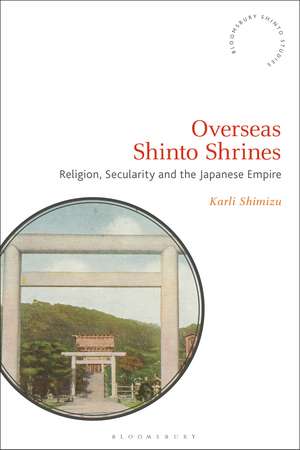
Overseas Shinto Shrines: Religion, Secularity and the Japanese Empire: Bloomsbury Shinto Studies
Autor Karli Shimizuen Limba Engleză Paperback – 18 apr 2024
Shinto shrines became one of the most visible symbols of Japanese imperialism in the early 20th century. From 1868 to 1945, shrines were constructed by both the government and Japanese migrants across the Asia-Pacific region, from Sakhalin to Taiwan, and from China to the Americas. Drawing on theories about the constructed nature of the modern categories of 'religion' and the 'secular', this book argues that modern Shinto shrines were largely conceived and treated as secular sites within a newly invented Japanese secularism, and that they played an important role in communicating changed conceptions of space, time and ethics in imperial subjects.
Providing an example of the invention of a non-Western secularity, this book contributes to our understanding of the relationship between religion, secularism and the construction of the modern state.


Preț: 208.30 lei
Preț vechi: 279.42 lei
-25%
Puncte Express: 312
Carte tipărită la comandă
Livrare economică 08-22 decembrie
Livrare prin curier în România Termenul estimat este afișat lângă disponibilitate.
Transport gratuit de la 400.00 lei Plată online sau ramburs, în funcție de opțiunile comenzii.
Retur gratuit în 14 zile Comandă securizată și suport în română.
Specificații
ISBN-13: 9781350234994
ISBN-10: 1350234990
Pagini: 296
Ilustrații: 10 bw illus
Dimensiuni: 154 x 232 x 18 mm
Greutate: 0.41 kg
Editura: Bloomsbury Publishing
Colecția Bloomsbury Academic
Seria Bloomsbury Shinto Studies
Locul publicării:London, United Kingdom
ISBN-10: 1350234990
Pagini: 296
Ilustrații: 10 bw illus
Dimensiuni: 154 x 232 x 18 mm
Greutate: 0.41 kg
Editura: Bloomsbury Publishing
Colecția Bloomsbury Academic
Seria Bloomsbury Shinto Studies
Locul publicării:London, United Kingdom
Cuprins
Introduction: Religion, Secularism, and Japan
1. The Birthplace of Japan: Kashihara Jingu and the Home Islands
2. The Northern Capital: Hokkaido and Karafuto in the Near Periphery
3. A Model Colony: Taiwan at the Far Periphery
4. Of the Same Lineage: Korea as Annexed Territory
5. A Multiethnic Empire: Manchuria and Asia outside of Japan
6. A Distant Land: Hawai?i on the East-West Border
7. Conclusion
Bibliography
Index
1. The Birthplace of Japan: Kashihara Jingu and the Home Islands
2. The Northern Capital: Hokkaido and Karafuto in the Near Periphery
3. A Model Colony: Taiwan at the Far Periphery
4. Of the Same Lineage: Korea as Annexed Territory
5. A Multiethnic Empire: Manchuria and Asia outside of Japan
6. A Distant Land: Hawai?i on the East-West Border
7. Conclusion
Bibliography
Index
Recenzii
Engaging with wider debates on the difficult divide between secular patriotic ritual and religious ritual, this monograph presents the first full-length study of Shinto shrines established in the ever-expanding Japanese sphere of influence between the late 19th and mid-20th centuries. Through her well-researched study, Shimizu discusses how Japan attempted to construct a multiethnic Shinto-based secularity and used the overseas Shinto shrines to instill new senses of time, space and morality in their newly acquired territories.
Overseas Shinto Shrines presents a significant and much-needed contribution to not only Shinto studies but also Asian studies, religious studies, and modern history more broadly. The book is a great resource for courses on religion, law, and politics, as well as colonialism, migration, and globalization. ... The historical narratives are engaging, and the contents are clear, comprehensive, and accessible for students and non-specialists. I strongly recommend Overseas Shinto Shrines and hope that it inspires further interest in Shinto research abroad.
Shimizu skilfully demonstrates how a detailed and comprehensive understanding of the developments during the imperial period and the role of Shinto in Japanese colonialism is conducive to gaining a more nuanced understanding surrounding the public role of Shinto in Japanese society today.
Overseas Shinto Shrines presents a significant and much-needed contribution to not only Shinto studies but also Asian studies, religious studies, and modern history more broadly. The book is a great resource for courses on religion, law, and politics, as well as colonialism, migration, and globalization. ... The historical narratives are engaging, and the contents are clear, comprehensive, and accessible for students and non-specialists. I strongly recommend Overseas Shinto Shrines and hope that it inspires further interest in Shinto research abroad.
Shimizu skilfully demonstrates how a detailed and comprehensive understanding of the developments during the imperial period and the role of Shinto in Japanese colonialism is conducive to gaining a more nuanced understanding surrounding the public role of Shinto in Japanese society today.