
Morpho
Autor Michel Lauricellaen Limba Engleză Paperback – 14 mai 2026
The Morpho collection of anatomy drawing books has sold over 800,000 copies worldwide, as it has helped amateur, student, and professional artists alike propel their imaginative drawing and observational skills forward. Collectively, they have become today's go-to resource for artistic anatomy drawing.
This beautiful, large-format book brings together three key volumes from the Morpho collection. The shapes of the human body are explored from depth to surface, as the bone, muscle, and fat systems are covered. The book's beautiful layout and presentation make it a perfect gift for any artist.
This book includes these three volumes:
- - Morpho: Skeleton and Bone Reference Points
- - Morpho: Joint Forms and Muscular Functions
- - Morpho: Fat and Skin Folds.
Preț: 310.58 lei
Carte disponibilă
Livrare economică 16-30 noiembrie
Livrare express 30 octombrie-05 noiembrie pentru 101.62 lei
Specificații
Pagini: 400
Dimensiuni: 219 x 279 x 31 mm
Greutate: 1.72 kg
Editura: Rocky Nook, Inc.
V-ar putea interesa
-
 Yotsuba&!: Vol 7Kiyohiko Azuma-31%Preț: 58.37 lei84.43 lei
 -
 Foster, W.: German All-in-One For DummiesWendy FosterPreț: 233.78 lei
 -
 English Grammar for DummiesGeraldine WoodsPreț: 116.41 lei
 -
 Framed Ink 2Marcos Mateu-Mestre-44%Preț: 145.85 lei258.73 lei
 -
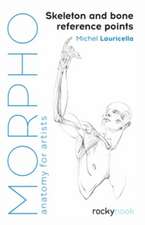 Skeleton and Bone Reference PointsMichel Lauricella-20%Preț: 73.83 lei92.17 lei
 -
 Morpho: Hands and FeetMichele Lauricella-19%Preț: 74.17 lei91.94 lei
Notă biografică
Descriere
This small, portable book presents a unique perspective on the human body for artists to study and implement in their drawing work. In this book, artist and teacher Michel Lauricella simplifies the human body into basic, synthetic shapes and forms, offering profound insight for artists of all kinds, sparking the imagination and improving one's observational abilities. Rather than going the traditional route of memorizing a repertoire of poses, Lauricella instead stresses learning this small collection of forms, which can then be combined and shaped into the more complex and varied forms and postures we see in the living body.
(Publisher's Note: This book features an "exposed" binding style. This is intentional, as it is designed to help the book lay flat as you draw.)
Table of Contents
- Foreword
- Introduction
- Head and Neck
- Torso and Shoulders
- Upper Limbs
- Lower Limbs
- Resources