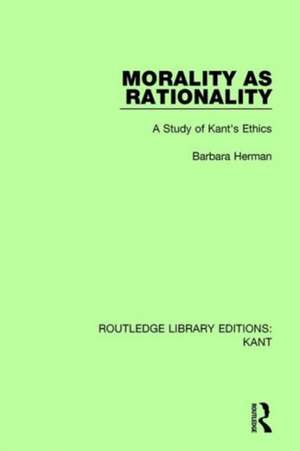
Morality as Rationality: A Study of Kant's Ethics: Routledge Library Editions: Kant
Autor Barbara Hermanen Limba Engleză Hardback – 19 apr 2016
| Toate formatele și edițiile | Preț | Express |
|---|---|---|
| Paperback (1) | 400.58 lei 43-57 zile | |
| Taylor & Francis – 17 oct 2017 | 400.58 lei 43-57 zile | |
| Hardback (1) | 846.63 lei 43-57 zile | |
| Taylor & Francis – 19 apr 2016 | 846.63 lei 43-57 zile |
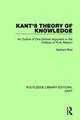
Preț: 846.63 lei
Preț vechi: 1388.81 lei
-39% Nou
Puncte Express: 1270
Preț estimativ în valută:
149.82€ • 175.68$ • 131.57£
149.82€ • 175.68$ • 131.57£
Carte tipărită la comandă
Livrare economică 09-23 februarie 26
Preluare comenzi: 021 569.72.76
Specificații
ISBN-13: 9781138650725
ISBN-10: 1138650722
Pagini: 326
Dimensiuni: 156 x 234 mm
Greutate: 0.59 kg
Ediția:1
Editura: Taylor & Francis
Colecția Routledge
Seria Routledge Library Editions: Kant
Locul publicării:Oxford, United Kingdom
ISBN-10: 1138650722
Pagini: 326
Dimensiuni: 156 x 234 mm
Greutate: 0.59 kg
Ediția:1
Editura: Taylor & Francis
Colecția Routledge
Seria Routledge Library Editions: Kant
Locul publicării:Oxford, United Kingdom
V-ar putea interesa
-
 Either/OrVictor EremitaPreț: 90.93 lei
 -
 The Architecture of Matter: Galileo to KantThomas Holden-14%Preț: 320.47 lei370.65 lei
 -
 Hume's ReasonDavid Owen-15%Preț: 299.16 lei351.10 lei
 -
 Preț: 308.62 lei
 -
 Themes in Hume: The Self, the Will, ReligionTerence Penelhum-28%Preț: 354.45 lei492.04 lei
 -
 Oxford Studies in Early Modern Philosophy Volume 1Daniel Garber-15%Preț: 351.74 lei412.54 lei
 -
 -24%Preț: 388.63 lei511.39 lei
 -
 -24%Preț: 364.95 lei477.06 lei
 -
 Descartes's Theory of MindDesmond Clarke-14%Preț: 318.23 lei369.47 lei
 -
 Schiller as Philosopher: A Re-ExaminationFrederick BeiserPreț: 361.94 lei
 -
 Preț: 294.23 lei
 -
 SchopenhauerJulian YoungPreț: 195.63 lei
 -
![British Empirical Philosophers (Routledge Revivals): Locke, Berkeley, Hume, Reid and J. S. Mill. [An anthology]](https://i4.books-express.ro/bt/9780415537742/british-empirical-philosophers-routledge-revivals.jpg) -31%Preț: 1087.12 lei1569.13 lei
-31%Preț: 1087.12 lei1569.13 lei -
 The Cambridge Companion to KantPaul GuyerPreț: 268.71 lei
 -
 Kant: A BiographyManfred KuehnPreț: 260.42 lei
 -
 Leibniz: New Essays on Human UnderstandingG. W. LeibnizPreț: 414.11 lei
 -
 German Philosophy 1760-1860Terry PinkardPreț: 354.65 lei
 -
 Kant: Anthropology from a Pragmatic Point of ViewRobert B. LoudenPreț: 263.20 lei
Public țintă
General, Postgraduate, and UndergraduateCuprins
Preface; 1. Introduction 2. Maxims 3. The Hypothetical Imperative 4. The Categorical Imperative (The Formula of Universal Law) 5. The Categorical Imperative (The Formula of the Law of Nature) 6. The Categorical Imperative – Remaining Considerations; Bibliography
Descriere
First published in 1990. The aim of this thesis is to show that the way to understand the central claims of Kant’s ethics is to accept the idea that morality is a distinctive form of rationality; that the moral "ought" belongs to a system of imperatives based in practical reason; and that moral judgment, therefore, is a species of rational assessment of agents’ actions. It argues, in effect, that you cannot understand Kant’s views about morality if you read him with Humean assumptions about rationality. This title will be of interest to students of philosophy.