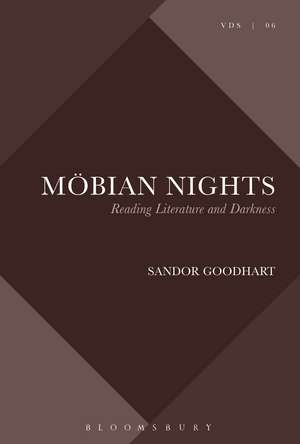
Möbian Nights: Reading Literature and Darkness: Violence, Desire, and the Sacred
Autor Professor Sandor Goodharten Limba Engleză Paperback – 21 feb 2019
Challenging customary "aesthetic" assumptions that we write in order not to die, Sandor Goodhart suggests (with Kafka) we write to die. Drawing upon analyses developed by Girard, Foucault, Blanchot, and Levinas (along with examples from Homer to Beckett), Möbian Nights proposes that all literature works "autobiographically", which is to say, in the wake of disaster; with the credo "I died; therefore, I am"; and for which the language of topology (for example, the "Möbius strip") offers a vocabulary for naming the "deep structure" of such literary, critical, and scriptural sacrificial and anti-sacrificial dynamics.




Preț: 273.25 lei
Preț vechi: 361.33 lei
-24%
Puncte Express: 410
Carte tipărită la comandă
Livrare economică 08-22 decembrie
Livrare prin curier în România Termenul estimat este afișat lângă disponibilitate.
Transport gratuit de la 400.00 lei Plată online sau ramburs, în funcție de opțiunile comenzii.
Retur gratuit în 14 zile Comandă securizată și suport în română.
Specificații
ISBN-13: 9781501350818
ISBN-10: 1501350811
Pagini: 352
Dimensiuni: 150 x 226 x 22 mm
Greutate: 0.46 kg
Editura: Bloomsbury Publishing
Colecția Bloomsbury Academic
Seria Violence, Desire, and the Sacred
Locul publicării:New York, United States
ISBN-10: 1501350811
Pagini: 352
Dimensiuni: 150 x 226 x 22 mm
Greutate: 0.46 kg
Editura: Bloomsbury Publishing
Colecția Bloomsbury Academic
Seria Violence, Desire, and the Sacred
Locul publicării:New York, United States
V-ar putea interesa
-
 -30%Preț: 681.90 lei976.30 lei
 -
 Reason, Morality, and Law: The Philosophy of John FinnisJohn Keown DCL-30%Preț: 943.93 lei1339.93 lei
 -
 Divine Teaching and the Way of the World: A Defense of Revealed ReligionSamuel Fleischacker-19%Preț: 366.18 lei452.08 lei
 -
 Kant's Elliptical PathKarl Ameriks-20%Preț: 368.74 lei458.24 lei
 -
 Spirituality: What It Is and Why It MattersRoger S. Gottlieb-10%Preț: 346.95 lei386.27 lei
 -
 -25%Preț: 1169.06 lei1550.90 lei
 -
 Religion Without GodRonald DworkinPreț: 264.71 lei
 -
 Imagining the KingdomJames K. A. SmithPreț: 149.47 lei
 -
 The Highest Poverty: Monastic Rules and Form-of-LifeGiorgio AgambenPreț: 138.02 lei
 -
 Theology in the Age of Global AIDS & HIVC. TrentazPreț: 383.15 lei
 -
 Understanding Jacques EllulJeffrey P. GreenmanPreț: 131.63 lei
 -
 The Evolving God: Charles Darwin on the Naturalness of ReligionProfessor J. David PleinsPreț: 205.33 lei
 -
 God's Final Victory: A Comparative Philosophical Case for UniversalismProfessor John Kronen-25%Preț: 278.18 lei369.61 lei
 -
 CS Lewis vs the New AtheistsPeter S. WilliamsPreț: 140.63 lei
Cuprins
Preface and Acknowledgments
Introduction: Möbian Turns: Difference as Continuity
1. After The Tragic Vision: Krieger and Criticism, Lentricchia and Crisis
2. Disfiguring de Man: Literature, History, and Collaboration
3. Witnessing the Impossible: Laub, Felman, and the Trauma of Testimony
4. Documenting Fiction: Kolitz, van Beeck, Levinas, and Holocaust Witness
5. "And Darkness Upon the Face of the Deep": Counter-Redemptive Hermeneutics in Wiesel, Mauriac, Cayrol, Blanchot, Levinas, and Genesis 1
6. Criticism, Literature, and the Möbian
7. Literarary Reading, the Möbian, and the Posthumous
Conclusion: Versions of Night: Reading Literature and Darkness
Bibliography
Index
Introduction: Möbian Turns: Difference as Continuity
1. After The Tragic Vision: Krieger and Criticism, Lentricchia and Crisis
2. Disfiguring de Man: Literature, History, and Collaboration
3. Witnessing the Impossible: Laub, Felman, and the Trauma of Testimony
4. Documenting Fiction: Kolitz, van Beeck, Levinas, and Holocaust Witness
5. "And Darkness Upon the Face of the Deep": Counter-Redemptive Hermeneutics in Wiesel, Mauriac, Cayrol, Blanchot, Levinas, and Genesis 1
6. Criticism, Literature, and the Möbian
7. Literarary Reading, the Möbian, and the Posthumous
Conclusion: Versions of Night: Reading Literature and Darkness
Bibliography
Index
Recenzii
In this beautifully written and strikingly original contribution to post-Holocaust literature, Sandor Goodhart locates in the Möbian structure first described by 19th-century mathematician August Ferdinand Möbius a model for difference or otherness that, in fact, attests to continuity and sameness. Tracing in Möbian fashion an autobiographical line extending from Homer to Beckett, Goodhart shows that we never stand outside the drama the literary presents to us. Suggesting that Möbian logic is endemic to all literary critical discourse, Goodhart, at once an astute philosopher and consummate Jewish storyteller, attests to the 'doubling back of language on itself' in a dark night that makes all writing 'the story of my death.'
Möbian Nights presents a sensitive and novel reading of the Möbian as a theoretical and structural frame of interpreting literature. Here the Möbian, not unlike chiastic structures of language and thought, speaks to the interconnected relationship between past and present, difference and continuity, self and other, silence and bearing witness. Through a variety of challenging perspectives, this deeply engaging book gets at the heart of what it means to tell a story. Set against a post-Holocaust landscape and the legacy of night, Goodhart reflects upon a cautionary and discerning way of approaching the world in which we live.
In this extraordinarily rich and thought-provoking follow-up to his earlier Sacrificing Commentary, Sandor Goodhart offers us a new, 'Möbian' basis for a general theory of the literary, which encompasses an impressively wide range of texts and authors, from Homeric epic to Derridean deconstruction. The intellectual tour de force does not for a moment, however, lose sight of the real historical crisis of our time; for over it all hovers the shadow of Auschwitz. Möbian Nights will prove necessary reading for anyone seriously interested in literature and literary criticism, and their relation to each other, as well as to philosophy, Biblical religion, and ethics.
Möbian Nights presents a sensitive and novel reading of the Möbian as a theoretical and structural frame of interpreting literature. Here the Möbian, not unlike chiastic structures of language and thought, speaks to the interconnected relationship between past and present, difference and continuity, self and other, silence and bearing witness. Through a variety of challenging perspectives, this deeply engaging book gets at the heart of what it means to tell a story. Set against a post-Holocaust landscape and the legacy of night, Goodhart reflects upon a cautionary and discerning way of approaching the world in which we live.
In this extraordinarily rich and thought-provoking follow-up to his earlier Sacrificing Commentary, Sandor Goodhart offers us a new, 'Möbian' basis for a general theory of the literary, which encompasses an impressively wide range of texts and authors, from Homeric epic to Derridean deconstruction. The intellectual tour de force does not for a moment, however, lose sight of the real historical crisis of our time; for over it all hovers the shadow of Auschwitz. Möbian Nights will prove necessary reading for anyone seriously interested in literature and literary criticism, and their relation to each other, as well as to philosophy, Biblical religion, and ethics.