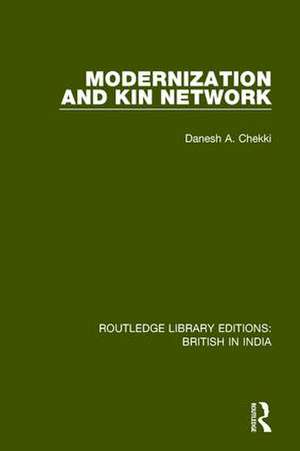
Modernization and Kin Network: Routledge Library Editions: British in India
Autor Danesh A. Chekkien Limba Engleză Paperback – 14 aug 2018
| Toate formatele și edițiile | Preț | Express |
|---|---|---|
| Paperback (1) | 336.53 lei 6-8 săpt. | |
| Taylor & Francis – 14 aug 2018 | 336.53 lei 6-8 săpt. | |
| Hardback (1) | 700.84 lei 6-8 săpt. | |
| Taylor & Francis – 27 mar 2017 | 700.84 lei 6-8 săpt. |
Din seria Routledge Library Editions: British in India
-
 Preț: 338.36 lei
 -
 Preț: 208.70 lei
 -
 Preț: 309.32 lei
 -
 Preț: 371.57 lei
 -
 Preț: 305.63 lei
 - 15%
 Preț: 518.46 lei
 -
 Preț: 347.61 lei
 -
 Preț: 312.31 lei
 -
 Preț: 313.04 lei
 -
 Preț: 313.94 lei
 - 39%
 Preț: 844.11 lei
 -
 Preț: 311.73 lei
 -
 Preț: 343.17 lei
 -
 Preț: 466.79 lei
 -
 Preț: 345.42 lei
 - 15%
 Preț: 519.86 lei
 -
 Preț: 215.02 lei
 -
 Preț: 315.25 lei
 -
 Preț: 112.84 lei
 - 40%
 Preț: 643.50 lei
 - 39%
 Preț: 10614.50 lei
 -
 Preț: 355.57 lei
 -
 Preț: 342.24 lei
 - 18%
 Preț: 913.37 lei
 -
 Preț: 305.25 lei
 -
 Preț: 201.80 lei
Preț: 336.53 lei
Nou
Puncte Express: 505
Preț estimativ în valută:
59.55€ • 69.83$ • 52.30£
59.55€ • 69.83$ • 52.30£
Carte tipărită la comandă
Livrare economică 13-27 februarie
Preluare comenzi: 021 569.72.76
Specificații
ISBN-13: 9781138705104
ISBN-10: 1138705101
Pagini: 204
Dimensiuni: 156 x 234 x 11 mm
Greutate: 0.3 kg
Ediția:1
Editura: Taylor & Francis
Colecția Routledge
Seria Routledge Library Editions: British in India
Locul publicării:Oxford, United Kingdom
ISBN-10: 1138705101
Pagini: 204
Dimensiuni: 156 x 234 x 11 mm
Greutate: 0.3 kg
Ediția:1
Editura: Taylor & Francis
Colecția Routledge
Seria Routledge Library Editions: British in India
Locul publicării:Oxford, United Kingdom
Public țintă
Postgraduate and UndergraduateCuprins
1. Problem and Theory 2. The Milieu 3. Structure of Kin Knowledge 4. Patterns of Interaction 5. Bonds of Marriage 6. Class and Community 7. Legislation and Welfare 8. Modernization and Kin Network
Descriere
This book, first published in 1974, seeks to answer the questions whether the nuclear family tends to be an isolated unit relatively cut off from its extended kin network; whether the patterns and effects of urbanization in the developing nations follow exactly the same lines as in the industrialised nations; and whether the transition from pre-urban to urban living necessarily involves stresses and strains, conflict and sociocultural maladjustments. It illuminates the specific case of a middle-sized city in India on the basis of empirical research carried out with the cross-cultural comparative approach and at the same time contributes to the understanding of the global problems of modernisation.