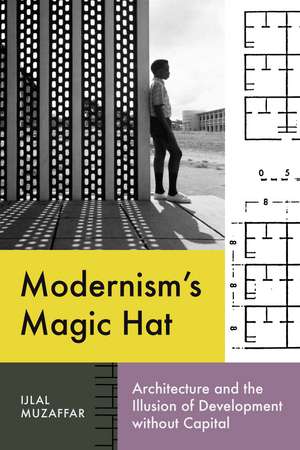
Modernism’s Magic Hat: Architecture and the Illusion of Development without Capital: Lateral Exchanges: Architecture, Urban Development, and Transnational Practices
Autor Ijlal Muzaffaren Limba Engleză Paperback – 16 iul 2024
In Modernism’s Magic Hat, Ijlal Muzaffar examines how modern architects and planners help resolve one of the central dilemmas of the mid-twentieth-century world order: how to make decolonization plausible without accounting for centuries of capital drain under colonial rule. In the years after World War II, architects and planners found extensive opportunities in new international institutions—such as the World Bank, the UN, and the Ford Foundation—and helped shape new models of global intervention that displaced the burden of change onto the inhabitants. Muzaffar argues that architecture in this domain didn’t just symbolically represent power, but formed the material domain through which new modes of power acquired sense. Looking at a series of architectural projects across the world, from housing in Ghana to village planning in Nigeria and urban planning in Venezuela and Pakistan, Muzaffar explores how architects and planners shaped new ideas of time, land, climate, and the decolonizing body, making them appear as sources of untapped value. What resulted, Muzaffar argues, is a widespread belief in spontaneous Third World “development” without capital, which continues to foreclose any global discussion of colonial theft.


Preț: 267.87 lei
Puncte Express: 402
Carte disponibilă
Livrare economică 16-30 noiembrie
Livrare express 30 octombrie-05 noiembrie pentru 35.16 lei
Livrare prin curier în România Termenul estimat este afișat lângă disponibilitate.
Transport gratuit de la 400.00 lei Plată online sau ramburs, în funcție de opțiunile comenzii.
Retur gratuit în 14 zile Comandă securizată și suport în română.
Specificații
ISBN-13: 9781477329665
ISBN-10: 1477329668
Pagini: 312
Dimensiuni: 152 x 229 x 30 mm
Greutate: 0.51 kg
Editura: University of Texas Press
Colecția University of Texas Press
Seria Lateral Exchanges: Architecture, Urban Development, and Transnational Practices
ISBN-10: 1477329668
Pagini: 312
Dimensiuni: 152 x 229 x 30 mm
Greutate: 0.51 kg
Editura: University of Texas Press
Colecția University of Texas Press
Seria Lateral Exchanges: Architecture, Urban Development, and Transnational Practices
Notă biografică
Ijlal Muzaffar is a professor of modern architectural history at the Rhode Island School of Design and is the coeditor of Architecture in Development: Systems and the Emergence of the Global South.
Cuprins
- Introduction. Soft Bricks, Hard Mortar of Immanence: Thinking through Other Figurations of Architecture in Development
- Part I: Risk/Belief
- Chapter 1. House without a Core: Capturing Intent in Ghana
- Chapter 2. God’s Gamble: Self-Help Architecture and the Housing of Risk
- Part II: Borders/Open-Endedness
- Chapter 3. Boundary Games: Military Rule, International Experts, and the Aesthetics of Incompletion in Pakistan
- Chapter 4. “Settlers Welcome”: Designing the Infinite Present, from Pakistan to the Philippines
- Chapter 5 Fuzzy Planning: MIT, Harvard, and the Image of Planning in Venezuela
- Part III: Materiality/Depth
- Chapter 6. Landing Architecture: Bodies and Land in Transition in the Gold Coast
- Chapter 7. Tropics of Shame: Fry, Drew, and the Designing of Depth
- Chapter 8. Counting Quality: Locating Patterns of Change, from Geddes to Koolhaas
- Acknowledgments
- Notes
- Index
Recenzii
Modernism’s Magic Hat is a provocative and necessary book that challenges dominant narratives about architecture’s role in development...Muzaffar’s work is essential reading for anyone interested in architectural history, postcolonial studies, and the intersections of design and global inequality. By shifting our focus from the buildings to the economic and political conditions that produce them, Muzaffar offers a critical perspective on how architecture has been used not just to design spaces, but to design power itself.
Muzaffar turns a penetrating lens on development discourses to reveal their relationship to, and origins in, systems theories and cybernetics, Kantian and Weberian modes of thought and Christian theological epistemes...in this lyrically written account.
A seriously clever book, it deserves to be widely read.
A remarkable book...[that is] profound and provocative, based on impressive scholarship.
Descriere
Examines the role of architecture in the history of global development and decolonization.