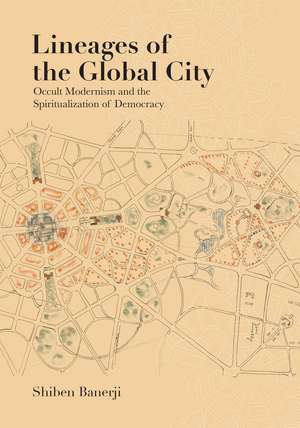
Lineages of the Global City: Occult Modernism and the Spiritualization of Democracy: Lateral Exchanges: Architecture, Urban Development, and Transnational Practices
Autor Shiben Banerjien Limba Engleză Hardback – 8 iul 2025
War, revolution, genocide, rebellion, slump. The economic and political turmoil of the early twentieth century seemed destined to rip asunder the ties that bound colonizers and the colonized to one another. The upheaval represented an opportunity, and not just to nationalists who imagined new homelands or to socialists who dreamed of international brotherhood. For modernists in the orbit of various occultisms, the crisis of empire also represented an opportunity to reveal humanity’s fundamental unity and common fate.
Lineages of the Global City recounts a continuous, if also contentious, transnational exchange among modernists and occultists across the Americas, Europe, South Asia, and Australia between 1905 and 1949. At stake were the feelings and affect of a new global subject who would perceive themselves as belonging to humanity as a unified whole, and the urban environment that would foster their subjectivity. The interventions in this debate, which drew in the period’s most renowned modernists, took the form of a succession of plans for cities, suburbs, and communes, as well as experiments in building, drawing, printmaking, filmmaking, and writing. Weaving together postcolonial, feminist, and Marxist insight on subject formation, Shiben Banerji advances a new way of understanding modernist urban space as the design of subjective effects.
Din seria Lateral Exchanges: Architecture, Urban Development, and Transnational Practices
-
 Preț: 226.45 lei
 -
 Preț: 289.98 lei
 -
 Preț: 281.82 lei
 -
 Preț: 293.26 lei
 - 23%
 Preț: 509.80 lei
 -
 Preț: 226.12 lei
Preț: 343.37 lei
Nou
Puncte Express: 515
Preț estimativ în valută:
60.77€ • 71.27$ • 53.28£
60.77€ • 71.27$ • 53.28£
Carte disponibilă
Livrare economică 05-19 ianuarie 26
Livrare express 19-25 decembrie pentru 61.52 lei
Preluare comenzi: 021 569.72.76
Specificații
ISBN-13: 9781477331408
ISBN-10: 1477331409
Pagini: 336
Ilustrații: 88 b&w photos, 12 color photos
Dimensiuni: 178 x 254 x 36 mm
Greutate: 0.85 kg
Editura: University of Texas Press
Colecția University of Texas Press
Seria Lateral Exchanges: Architecture, Urban Development, and Transnational Practices
ISBN-10: 1477331409
Pagini: 336
Ilustrații: 88 b&w photos, 12 color photos
Dimensiuni: 178 x 254 x 36 mm
Greutate: 0.85 kg
Editura: University of Texas Press
Colecția University of Texas Press
Seria Lateral Exchanges: Architecture, Urban Development, and Transnational Practices
Notă biografică
Shiben Banerji is an associate professor in the Department of Art History, Theory, and Criticism at the School of the Art Institute of Chicago.
Cuprins
- Prologue
- Chapter 1. Summoning Global Subjects: A Methodological Note
- Chapter 2. Unifying Science, 1905–1913: De Bazel’s World Capital and Andersen’s World-Centre
- Chapter 3. Financializing Debt, 1927–1933: Otlet and Le Corbusier’s Cité Mondiale
- Chapter 4. Saving Empire, 1924–1933: Besant’s World-Empire
- Chapter 5. Conserving Nature, 1920–1935: Griffin’s Castlecrag
- Chapter 6. Globalizing Democracy, 1938–1949: Mahony’s Magic of America
- Epilogue
- Acknowledgments
- Notes
- Index
Recenzii
This is a beautifully researched and realized work of scholarship, which unveils a remarkable archive of urban images that connect occultism, modernism, globality, and architecture. It will be of great value to historians, architects, planners, and scholars of cultural modernity due to its powerful argument for the cosmological underpinnings of modern urban thought.
In the contemporary era of climate crisis, growing concerns about the exploitation of nature, resurgent nationalism, and what is looking to be a new global political and economic order that will impact not just nations but also cities, this provocative book will spark considerable debate about what kinds of urban habitats we want to build and whether historical models relegated to the dustbin of twentieth-century architectural history can indeed offer new food for thought in these turbulent times.
Descriere
The forgotten history of the occult foundations of the early twentieth-century global city.