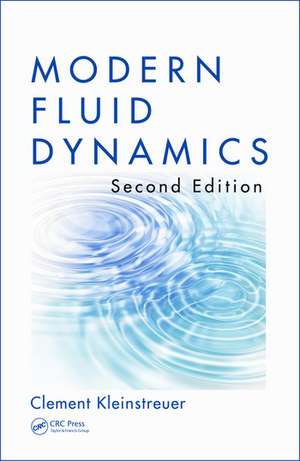
Modern Fluid Dynamics
Autor Clement Kleinstreueren Limba Engleză Hardback – 25 apr 2018
Preț: 1378.44 lei
Preț vechi: 1816.88 lei
-24%
Carte indisponibilă temporar
Specificații
ISBN-10: 1138198102
Pagini: 459
Ilustrații: 657
Dimensiuni: 178 x 254 x 36 mm
Greutate: 1.01 kg
Ediția:2
Editura: CRC Press
Colecția CRC Press
V-ar putea interesa
-
 Unit Operations of Chemical Engineering (Int'l Ed)Warren McCabe-25%Preț: 395.05 lei526.87 lei
 -
 Fluid MechanicsPijush K. Kundu-32%Preț: 668.54 lei980.75 lei
 -
 Bioprocess Engineering PrinciplesRoss Carlson-32%Preț: 598.85 lei881.03 lei
 -
 Introduction to Computational Fluid Dynamics, AnH. Versteeg-9%Preț: 614.29 lei675.04 lei
 -
 -15%Preț: 1027.87 lei1209.26 lei
 -
 Introduction to MicrofluidicsPatrick Tabeling-20%Preț: 475.25 lei592.37 lei
 -
 Turbulence: An Introduction for Scientists and EngineersPeter Davidson-20%Preț: 535.93 lei670.57 lei
 -
 Incompressible Fluid DynamicsP. A. Davidson-20%Preț: 377.84 lei470.24 lei
 -
 Fluid MechanicsJ. F. Douglas-13%Preț: 607.44 lei698.20 lei
 -
 Mechanics of FluidsJohn Ward-Smith-8%Preț: 570.75 lei620.38 lei
 -
 Fluid Mechanics: Volume 4David TongPreț: 280.59 lei
 -
 Introduction to Thermal and Fluids EngineeringDeborah A Kaminski-23%Preț: 1982.30 lei2574.42 lei
 -
 Engineering Fluid Mechanics, International AdaptationBarbara A. Lebret-19%Preț: 432.82 lei534.34 lei
 -
 -24%Preț: 404.08 lei531.75 lei
 -
 Vector Mechanics for Engineers: Dynamics, SI EditionFerdinand Beer-25%Preț: 399.42 lei530.05 lei
 -
 Fluid Power, Mathematical Design of Several ComponentsJosep M Bergada-26%Preț: 1338.90 lei1818.45 lei
 -
 Thermal SciencesMerle C. Potter-18%Preț: 809.96 lei987.74 lei
 -
 MechanicsStefan Roth-11%Preț: 401.93 lei451.60 lei
 -
 A Cup of Coffee and the OceanSung Yong KimPreț: 259.26 lei
Cuprins
Author Bio
Section A Fluid Dynamics Fundamentals with Applications
1 Review of Basic Concepts
2 Conservation Laws with Illustrative Examples
3 Incompressible Viscous Fluid Flow Applications
Section B Modern Fluid Dynamics Topics
4 Mixture Flows
5 Basic Lubrication Systems
6 Fluid Spreading, Film Drawing, and Surface Coating
7 Microscale Fluid Dynamics
8 Fluid–Structure Interaction
9 Computational Fluid Dynamics Modeling and Simulation
10 Course Projects
Appendix I
Appendix II
Index
Notă biografică
Clement Kleinstreuer is a Professor in the Mechanical and Aerospace Engineering and Biomedical Engineering departments at North Carolina State University in Raleigh, NC. He received his Dip. Ing degree at the Technical University, Munich; his M.S at Stanford University; and his Ph.D. at Vanderbilt University. He also serves as an Adjunct Professor in the Department of Surgery at the University of North Carolina School of Medicine in Chapel Hill, NC. He has also served as an Assistant Professor at Rensselaer Polytechnic Institute (Troy, NY), and as an Adjunct Professor at the University of Canterbury in Christchurch, NZ. Dr. Kleinstreuer is a member of ASME, the Biomedical Engineering Society, and the American Association of Aerosol Research.
Descriere
Textul de pe ultima copertă
This work evolved primarily out of industrial demands and post-graduate expectations, because a fine knowledge base in modern fluid dynamics is important, focusing on novel application areas such as microfluidics, mixture flows, fluid-structure interaction, biofluid dynamics, thermal flows, and fluid-particle transport. Building on courses in thermodynamics, fluid mechanics and solid mechanics as prerequisites as well as on a junior-level math background, a differential approach is most insightful to teach the fundamentals in fluid mechanics, to explain traditional and modern applications on an intermediate level, and to provide sufficient physical insight to understand results, later on generated with useful CFD software.
Pedagogical elements include a consistent 50/50 physics-mathematics approach when introducing new material, illustrating concepts, showing flow visualizations, and solving problems. The problem solution format strictly follows the pattern of system sketch, assumptions, and concept/approach—before starting the solution phase which consists of symbolic math model development (Appendix A), numerical solution, graphs, and comments on "physical insight". After some illustrative examples, most solved text examples have the same level of difficulty assuggested homework, quiz, test, and/or exam problems. The ultimate goals are that the more serious student can solve basic fluid dynamics problems independently, can provide physical insight, and can suggest, via a course project, system design improvements.