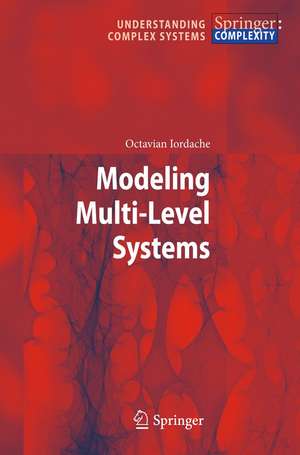
Modeling Multi-Level Systems: Understanding Complex Systems
Autor Octavian Iordacheen Limba Engleză Paperback – 11 oct 2014
Focusing on chemical engineering, pharmaceutical and environmental case studies, the chapters 5 to 8 analyze mixing, turbulent dispersion and entropy production for multi-scale systems. Taking inspiration from systems sciences, chapters 9 to 11 highlight multi-level modeling potentialities in formal concept analysis, existential graphs and evolvable designs of experiments. Case studies refer to separation flow-sheets, pharmaceutical pipeline, drug design and development, reliability management systems, security and failure analysis. Perspectives and integrative points of view are discussed in chapter 12. Autonomous and viable systems, multi-agents, organic and autonomic computing, multi-level informational systems, are revealed as promising domains for future applications.
Written for: engineers, researchers, entrepreneurs and students in chemical, pharmaceutical, environmental and systems sciences engineering, and for applied mathematicians.
Din seria Understanding Complex Systems
- 18%
 Preț: 1160.05 lei
 -
 Preț: 452.41 lei
 - 18%
 Preț: 988.65 lei
 - 15%
 Preț: 661.12 lei
 - 18%
 Preț: 1170.06 lei
 - 18%
 Preț: 911.29 lei
 - 15%
 Preț: 667.19 lei
 - 15%
 Preț: 673.77 lei
 - 15%
 Preț: 675.52 lei
 - 18%
 Preț: 955.93 lei
 - 18%
 Preț: 990.14 lei
 - 15%
 Preț: 666.14 lei
 - 15%
 Preț: 663.50 lei
 -
 Preț: 442.26 lei
 - 15%
 Preț: 661.83 lei
 - 15%
 Preț: 677.28 lei
 - 15%
 Preț: 666.40 lei
 - 20%
 Preț: 674.28 lei
 - 20%
 Preț: 677.98 lei
 - 18%
 Preț: 982.53 lei
 - 18%
 Preț: 1150.57 lei
 - 18%
 Preț: 1280.17 lei
 - 15%
 Preț: 668.60 lei
 - 18%
 Preț: 983.43 lei
 - 15%
 Preț: 669.20 lei
 - 18%
 Preț: 1440.00 lei
 - 18%
 Preț: 990.35 lei
 -
 Preț: 414.85 lei
 - 18%
 Preț: 980.03 lei
 - 18%
 Preț: 1297.31 lei
 - 15%
 Preț: 666.97 lei
 - 5%
 Preț: 1465.64 lei
 - 18%
 Preț: 984.66 lei
 - 18%
 Preț: 982.96 lei
 -
 Preț: 402.76 lei
 - 20%
 Preț: 680.46 lei
 - 18%
 Preț: 1047.87 lei
Preț: 1067.14 lei
Preț vechi: 1301.40 lei
-18%
Puncte Express: 1601
Carte tipărită la comandă
Livrare economică 30 noiembrie-14 decembrie
Livrare prin curier în România Termenul estimat este afișat lângă disponibilitate.
Transport gratuit pentru acest produs Plată online sau ramburs, în funcție de opțiunile comenzii.
Retur gratuit în 14 zile Comandă securizată și suport în română.
Specificații
ISBN-13: 9783642423680
ISBN-10: 364242368X
Pagini: 252
Ilustrații: XV, 232 p.
Dimensiuni: 155 x 235 x 14 mm
Greutate: 0.39 kg
Ediția:2011
Editura: Springer
Colecția Understanding Complex Systems
Seria Understanding Complex Systems
Locul publicării:Berlin, Heidelberg, Germany
ISBN-10: 364242368X
Pagini: 252
Ilustrații: XV, 232 p.
Dimensiuni: 155 x 235 x 14 mm
Greutate: 0.39 kg
Ediția:2011
Editura: Springer
Colecția Understanding Complex Systems
Seria Understanding Complex Systems
Locul publicării:Berlin, Heidelberg, Germany
V-ar putea interesa
-
 The Designer's Guide to VHDLPeter J. Ashenden-34%Preț: 375.93 lei572.56 lei
 -
 Deep SimplicityJohn GribbinPreț: 92.84 lei
 -
 The Computer and the BrainJohn Von NeumannPreț: 113.01 lei
 -
 Introduction to Systems TheoryNiklas LuhmannPreț: 169.40 lei
 -
 Introduction ModelicaFritzson-8%Preț: 452.76 lei492.13 lei
 -
 Perturbation Analysis of Optimization ProblemsJ.Frederic Bonnans-18%Preț: 1341.26 lei1635.67 lei
 -
 Stochastic Networked Control SystemsSerdar Yüksel-18%Preț: 995.63 lei1214.17 lei
 -
 Stochastic Networked Control SystemsSerdar Yüksel-18%Preț: 909.87 lei1109.60 lei
 -
 -18%Preț: 918.59 lei1120.23 lei
 -
 Modeling and Control of Discrete-Event Dynamic SystemsBranislav Hrúz-15%Preț: 471.15 lei554.30 lei
 -
 Introducing ChaosIwona AbramsPreț: 64.56 lei
 -
 Model-Based Control of Networked SystemsEloy Garcia-15%Preț: 675.30 lei794.47 lei
 -
 Introduction to Time-Delay Systems: Analysis and ControlEmilia Fridman-46%Preț: 513.77 lei945.44 lei
Public țintă
ResearchCuprins
Introduction.- Methodological Resources.- Conventional PSM frames.- New PSM frames.-Mixing in chemical reactors.- Compartmental systems.- Turbulent mixing.- Entropy.- Formal concept analysis.- Existential graphs.- Evolvable designs of experiments.- Autonomous systems perspective.
Textul de pe ultima copertă
This book is devoted to modeling of multi-level complex systems, a challenging domain for engineers, researchers and entrepreneurs, confronted with the transition from learning and adaptability to evolvability and autonomy for technologies, devices and problem solving methods. Chapter 1 introduces the multi-scale and multi-level systems and highlights their presence in different domains of science and technology. Methodologies as, random systems, non-Archimedean analysis, category theory and specific techniques as model categorification and integrative closure, are presented in chapter 2. Chapters 3 and 4 describe polystochastic models, PSM, and their developments. Categorical formulation of integrative closure offers the general PSM framework which serves as a flexible guideline for a large variety of multi-level modeling problems.
Focusing on chemical engineering, pharmaceutical and environmental case studies, the chapters 5 to 8 analyze mixing, turbulent dispersion and entropy production for multi-scale systems. Taking inspiration from systems sciences, chapters 9 to 11 highlight multi-level modeling potentialities in formal concept analysis, existential graphs and evolvable designs of experiments. Case studies refer to separation flow-sheets, pharmaceutical pipeline, drug design and development, reliability management systems, security and failure analysis. Perspectives and integrative points of view are discussed in chapter 12. Autonomous and viable systems, multi-agents, organic and autonomic computing, multi-level informational systems, are revealed as promising domains for future applications.
Written for: engineers, researchers, entrepreneurs and students in chemical, pharmaceutical, environmental and systems sciences engineering, and for applied mathematicians.
Focusing on chemical engineering, pharmaceutical and environmental case studies, the chapters 5 to 8 analyze mixing, turbulent dispersion and entropy production for multi-scale systems. Taking inspiration from systems sciences, chapters 9 to 11 highlight multi-level modeling potentialities in formal concept analysis, existential graphs and evolvable designs of experiments. Case studies refer to separation flow-sheets, pharmaceutical pipeline, drug design and development, reliability management systems, security and failure analysis. Perspectives and integrative points of view are discussed in chapter 12. Autonomous and viable systems, multi-agents, organic and autonomic computing, multi-level informational systems, are revealed as promising domains for future applications.
Written for: engineers, researchers, entrepreneurs and students in chemical, pharmaceutical, environmental and systems sciences engineering, and for applied mathematicians.
Caracteristici
Overviews the modeling of multi-level complex systems Demonstrates the emerging interdisciplinary importance of modeling multi-level complex systems with major practical interest Written by a leading expert in the field