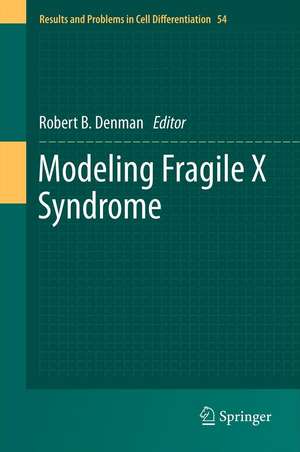
Modeling Fragile X Syndrome: Results and Problems in Cell Differentiation, cartea 54
Editat de Robert B. Denmanen Limba Engleză Paperback – 29 noi 2013
Din seria Results and Problems in Cell Differentiation
- 18%
 Preț: 1625.69 lei
 - 15%
 Preț: 574.16 lei
 -
 Preț: 390.81 lei
 - 5%
 Preț: 376.39 lei
 -
 Preț: 370.13 lei
 -
 Preț: 373.12 lei
 - 15%
 Preț: 648.56 lei
 - 15%
 Preț: 609.53 lei
 -
 Preț: 375.34 lei
 -
 Preț: 375.86 lei
 - 15%
 Preț: 646.90 lei
 -
 Preț: 367.70 lei
 -
 Preț: 398.17 lei
 -
 Preț: 393.10 lei
 -
 Preț: 383.79 lei
 -
 Preț: 388.00 lei
 -
 Preț: 388.00 lei
 -
 Preț: 394.22 lei
 - 18%
 Preț: 1274.11 lei
 - 20%
 Preț: 634.31 lei
 - 5%
 Preț: 1462.39 lei
 -
 Preț: 375.65 lei
 -
 Preț: 379.92 lei
 -
 Preț: 382.25 lei
 -
 Preț: 381.16 lei
 - 18%
 Preț: 1427.05 lei
 - 15%
 Preț: 642.38 lei
 - 18%
 Preț: 1259.18 lei
 - 15%
 Preț: 617.72 lei
 - 15%
 Preț: 626.56 lei
 - 18%
 Preț: 1260.63 lei
 - 18%
 Preț: 976.11 lei
 -
 Preț: 390.25 lei
 - 18%
 Preț: 1272.43 lei
 - 15%
 Preț: 662.13 lei
 - 18%
 Preț: 1717.95 lei
 - 18%
 Preț: 1268.99 lei
Preț: 1194.42 lei
Preț vechi: 1456.61 lei
-18%
Puncte Express: 1792
Carte tipărită la comandă
Livrare economică 09-23 decembrie
Livrare prin curier în România Termenul estimat este afișat lângă disponibilitate.
Transport gratuit pentru acest produs Plată online sau ramburs, în funcție de opțiunile comenzii.
Retur gratuit în 14 zile Comandă securizată și suport în română.
Specificații
ISBN-13: 9783642270109
ISBN-10: 3642270107
Pagini: 404
Ilustrații: XII, 392 p.
Dimensiuni: 155 x 235 x 22 mm
Greutate: 0.61 kg
Ediția:2012
Editura: Springer
Colecția Results and Problems in Cell Differentiation
Seria Results and Problems in Cell Differentiation
Locul publicării:Berlin, Heidelberg, Germany
ISBN-10: 3642270107
Pagini: 404
Ilustrații: XII, 392 p.
Dimensiuni: 155 x 235 x 22 mm
Greutate: 0.61 kg
Ediția:2012
Editura: Springer
Colecția Results and Problems in Cell Differentiation
Seria Results and Problems in Cell Differentiation
Locul publicării:Berlin, Heidelberg, Germany
V-ar putea interesa
-
 -29%Preț: 497.41 lei695.98 lei
 -
 A Survival Guide for Health Research MethodsTracy Ross-33%Preț: 150.09 lei222.48 lei
 -
 The Frailty ModelLuc Duchateau-15%Preț: 671.62 lei790.14 lei
 -
 Bioconductor Case StudiesFlorian Hahne-15%Preț: 702.45 lei826.42 lei
 -
 Tarascon Pediatric Emergency PocketbookSteven G. Rothrock-5%Preț: 130.94 lei137.83 lei
 -
 The Laboratory Xenopus sp.Sherril L. Green-15%Preț: 525.92 lei618.73 lei
 -
 The Laboratory ZebrafishClaudia Harper-8%Preț: 459.02 lei498.93 lei
 -
 Bone-Implant Interface in Orthopedic SurgeryTheofilos Karachalios-5%Preț: 1151.17 lei1211.75 lei
 -
 Preț: 361.70 lei
 -
 Pharmacological Basis of Acute CareYoo Kuen Chan-5%Preț: 813.09 lei855.88 lei
 -
 -5%Preț: 848.73 lei893.39 lei
 -
 -5%Preț: 1146.56 lei1206.90 lei
Public țintă
ResearchCuprins
Introduction: Reminiscing on Models and Modeling.- Probing Astrocyte Function in Fragile X Syndrome.- Neural Stem Cells.- Fragile X Mental Retardation Protein (FMRP) and the Spinal Sensory System.- The role of the postsynaptic density in the pathology of the fragile X syndrome.- Behavior in a Drosophila model of Fragile X.- Molecular and Genetic Analysis of the Drosophila Model of Fragile X Syndrome.- Fragile X Mental Retardation Protein and Stem Cells.- Manipulating the Fragile Mental Retardation Proteins in the frog.- Exploring the zebra finch Taeniopygia guttata as a novel animal model for the speech-language deficit of fragile X syndrome.- Neuroendocrine alterations in the fragile X mouse.- Taking STEPs forward to understanding Fragile X Syndrome.- Fmr-1 as an offspring genetic and a maternal environmental factor in neurodevelopmental disease.- Mouse Models of the Fragile X Premutation and the Fragile X Associated Tremor/Ataxia Syndrome.- Clinical Aspects of the Fragile X Syndrome.- Fragile X Syndrome: A Psychiatric Perspective.- Fragile X Syndrome and Targeted Treatment Trials.- The Fragile X-associated Tremor Ataxia Syndrome.- Vignettes: Models in Absentia.
Textul de pe ultima copertă
The present book is an in-depth synopsis of recent advances in the fragile X field. The fragile X syndrome (FXS) is the most common form of inherited mental retardation, and the molecular-genetic basis of this syndrome has been the subject of extensive experimental scrutiny over the last two decades. This book covers the spectrum of current FXS research, ranging from Drosophila model systems via mouse models to clinical and psychiatric aspects. The volume also provides updates on FXS-related diseases such as the fragile X-associated tremor/ataxia syndrome. Significant progress in recent years, as highlighted here by some of the most eminent researchers in the field, are grounds for optimism that successful therapeutical approaches may be feasible in the not too distant future.
Caracteristici
Comprehensive overview on the molecular basis of fragile X syndrome First book to cover all models used to investigate fragile X syndrome Includes state-of-of the art approaches like epigenetics Includes supplementary material: sn.pub/extras