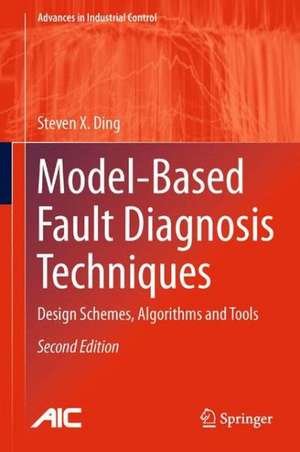
Model-Based Fault Diagnosis Techniques: Advances in Industrial Control
Autor Steven X. Dingen Limba Engleză Hardback – 2 ian 2013
This second edition of Model-Based Fault Diagnosis Techniques contains:
• new material on fault isolation and identification and alarm management;
• extended and revised treatment of systematic threshold determination for systems with both deterministic unknown inputs and stochastic noises;
• addition of the continuously-stirred tank heater as a representative process-industrial benchmark; and
• enhanced discussion of residual evaluation which now deals with stochastic processes.
Model-based Fault Diagnosis Techniques will interest academic researchers working in fault identification and diagnosis and as a text it is suitable for graduate students in a formal university-based course or as a self-study aid for practising engineers working with automatic control or mechatronic systems from backgrounds as diverse as chemical process and power engineering.
Din seria Advances in Industrial Control
- 15%
 Preț: 670.62 lei
 - 18%
 Preț: 986.31 lei
 - 18%
 Preț: 812.62 lei
 - 18%
 Preț: 1155.07 lei
 - 18%
 Preț: 996.30 lei
 - 18%
 Preț: 931.50 lei
 - 18%
 Preț: 932.22 lei
 - 18%
 Preț: 790.01 lei
 - 18%
 Preț: 755.41 lei
 - 18%
 Preț: 1458.15 lei
 - 18%
 Preț: 758.73 lei
 - 15%
 Preț: 663.00 lei
 - 15%
 Preț: 663.48 lei
 - 15%
 Preț: 664.95 lei
 - 18%
 Preț: 925.33 lei
 - 18%
 Preț: 775.66 lei
 - 18%
 Preț: 951.24 lei
 - 18%
 Preț: 987.51 lei
 - 15%
 Preț: 666.44 lei
 - 15%
 Preț: 664.72 lei
 - 18%
 Preț: 983.57 lei
 - 15%
 Preț: 663.58 lei
 - 18%
 Preț: 1436.95 lei
 - 18%
 Preț: 980.03 lei
 - 18%
 Preț: 984.66 lei
 - 18%
 Preț: 982.24 lei
 - 18%
 Preț: 985.21 lei
 - 18%
 Preț: 1148.21 lei
 - 15%
 Preț: 669.91 lei
 - 15%
 Preț: 663.58 lei
 - 18%
 Preț: 979.63 lei
 - 18%
 Preț: 982.74 lei
 - 18%
 Preț: 1153.23 lei
 - 15%
 Preț: 664.01 lei
 - 18%
 Preț: 982.58 lei
 - 18%
 Preț: 980.78 lei
 - 15%
 Preț: 660.75 lei
 - 15%
 Preț: 663.58 lei
 - 20%
 Preț: 669.73 lei
 - 18%
 Preț: 1148.59 lei
 - 20%
 Preț: 1029.39 lei
 - 15%
 Preț: 667.27 lei
 - 24%
 Preț: 1082.44 lei
 - 18%
 Preț: 978.15 lei
 - 18%
 Preț: 1342.56 lei
 - 15%
 Preț: 676.08 lei
 - 15%
 Preț: 666.52 lei
 - 20%
 Preț: 620.99 lei
 - 18%
 Preț: 1080.75 lei
Preț: 1279.34 lei
Preț vechi: 1560.17 lei
-18%
Puncte Express: 1919
Carte tipărită la comandă
Livrare economică 27 noiembrie-11 decembrie
Livrare prin curier în România Termenul estimat este afișat lângă disponibilitate.
Transport gratuit pentru acest produs Plată online sau ramburs, în funcție de opțiunile comenzii.
Retur gratuit în 14 zile Comandă securizată și suport în română.
Specificații
ISBN-13: 9781447147985
ISBN-10: 1447147987
Pagini: 524
Ilustrații: XX, 504 p.
Dimensiuni: 160 x 241 x 33 mm
Greutate: 0.89 kg
Ediția:2nd edition 2013
Editura: Springer
Colecția Advances in Industrial Control
Seria Advances in Industrial Control
Locul publicării:London, United Kingdom
ISBN-10: 1447147987
Pagini: 524
Ilustrații: XX, 504 p.
Dimensiuni: 160 x 241 x 33 mm
Greutate: 0.89 kg
Ediția:2nd edition 2013
Editura: Springer
Colecția Advances in Industrial Control
Seria Advances in Industrial Control
Locul publicării:London, United Kingdom
V-ar putea interesa
-
 Industrial Automation: Hands OnFrank Lamb-32%Preț: 372.33 lei547.27 lei
 -
 Arduino Projects for Amateur RadioJack Purdum-40%Preț: 189.12 lei314.42 lei
 -
 The Technological SingularityMurray Shanahan-21%Preț: 97.48 lei122.92 lei
 -
 Integrated Vehicle Dynamics and ControlWuwei Chen-23%Preț: 750.29 lei974.40 lei
 -
 Arduino SketchesJames A Langbridge-20%Preț: 211.27 lei264.08 lei
 -
 Practical Field RoboticsSturges-8%Preț: 636.53 lei691.87 lei
 -
 Adventures in ArduinoBecky StewartPreț: 111.83 lei
 -
 Identification and Control Using Volterra ModelsF. J. Iii Doyle-18%Preț: 1342.96 lei1637.75 lei
 -
 Reset Control SystemsAlfonso Baños-15%Preț: 620.55 lei730.06 lei
 -
 Optimization and Dynamical SystemsUwe Helmke-18%Preț: 741.79 lei904.63 lei
 -
 An Introduction to Hybrid Dynamical SystemsArjan J. Van Der SchaftPreț: 370.05 lei
 -
 Finite-Time Stability and ControlFrancesco AmatoPreț: 383.79 lei
 -
 Discrete Control SystemsYoshifumi Okuyama-15%Preț: 667.86 lei785.72 lei
 -
 Process Control for Sheet-Metal StampingYongseob Lim-15%Preț: 661.73 lei778.50 lei
 -
 Preț: 316.32 lei
 -
 Preț: 365.94 lei
Public țintă
ResearchCuprins
Basic Ideas, Major Issues, and Tools in the Observer-Based FDI Framework.- Modelling of Technical Systems.- Structural Fault Detectability, Isolability and Identifiability.- Basic Residual Generation Methods.- Perfect Unknown Input Decoupling.- Residual Generation with Enhanced Robustness against Unknown Inputs.- Residual Generation with Enhanced Robustness against Model Uncertainties.- Norm-Based Residual Evaluation and Threshold Computation.- Statistical-Methods-Based Residual Evaluation and Threshold Setting.- Integration of Norm-Based and Statistical Methods.- Integrated Design of Fault Detection Systems.- Fault Isolation Schemes.
Notă biografică
Maiying Zhong received the Ph.D. degree in control theory and control engineering from the Northeastern University, Shenyang, China, in 1999. From 2000 to 2001, she was Visiting Scholar with the University of Applied Sciences Lausitz, Germany. From 2002 to July 2008, she was Professor with the School of Control Science and Engineering at Shandong University. From 2006 to 2007, she was Postdoctoral Researcher Fellow with the Central Queensland University, Australia. From 2009 to 2016, she was Professor with the School of Instrument Science and Opto-Electronics Engineering, Beihang University. In March 2016, she joined Shandong University of Science and Technology, Qingdao, China, where she is currently Professor with the College of Electrical Engineering and Automation. Her research interests are fault diagnosis, fault-tolerant control, and their applications.
Ting Xue received the M.S. degree in Instrumentation Science and Technology from Beihang University, Beijing, China, in 2016, and Ph.D. degree in Electrical Engineering and Information Technology from the University of Duisburg-Essen, Duisburg, Germany, in 2020. She is currently a post-doctoral with Shandong University of Science and Technology, Shandong, China. Her research interests include fault diagnosis and fault-tolerant control and their applications.
Steven X. Ding received Ph.D. degree in electrical engineering from the GerhardMercator University of Duisburg, Germany, in 1992. From 1992 to 1994, he was a R&D engineer at Rheinmetall GmbH. From 1995 to 2001, he was a professor of control engineering at the University of Applied Science Lausitz in Senftenberg, Germany, and served as a vice-president of this university during 1998-2000. He is currently a full professor of control engineering and the head of the Institute for Automatic Control and Complex Systems (AKS) at the University of Duisburg-Essen, Germany. His research interests are model-based and data-driven fault diagnosis, fault-tolerant systems, real-time control, and their application in industry with a focus on automotive systems and chemical processes.
Donghua Zhou received the B.Eng., M.Sci., and Ph.D. degrees in electrical engineering from Shanghai Jiaotong University, Shanghai, China, in 1985, 1988, and 1990, respectively. He was an Alexander von Humboldt Research Fellow with the University of Duisburg, Germany, from 1995 to 1996, and Visiting Scholar with the Yale University, New Haven, CT, USA, from 2001 to 2002. He joined Tsinghua University, Beijing, China, in 1996, and was promoted as Full Professor in 1997; he was the head of the department of automation, Tsinghua University, Beijing, China, during 2008 and 2015. He is now a Vice-President, Shandong University of Science and Technology, Qingdao, China, and a Joint Professor with Tsinghua University. He has authored and coauthored over 210 peer-reviewed international journal papers and seven monographs in the areas of fault diagnosis, fault-tolerant control, reliability prediction, and optimal maintenance. Dr. Zhou is Fellow of IEEE/IET/CAA, Member of IFAC TC on SAFEPROCESS, Associate Editor of the Journal of Process Control, Vice-Chairman of Chinese Association of Automation (CAA), and the TC Chair of the SAFEPROCESS committee, CAA. He was also the NOC Chair of the 6th IFAC Symposium on SAFEPROCESS 2006.
Textul de pe ultima copertă
Guaranteeing a high system performance over a wide operating range is an important issue surrounding the design of automatic control systems with successively increasing complexity. As a key technology in the search for a solution, advanced fault detection and identification (FDI) is receiving considerable attention. This book introduces basic model-based FDI schemes, advanced analysis and design algorithms, and mathematical and control-theoretic tools.
This second edition of Model-Based Fault Diagnosis Techniques contains:
· new material on fault isolation and identification, and fault detection in feedback control loops;
· extended and revised treatment of systematic threshold determination for systems with both deterministic unknown inputs and stochastic noises;
Model-based Fault Diagnosis Techniqueswill interest academic researchers working in fault detection and diagnosis and as a textbook it is suitable for graduate students in a formal university-based course or as a self-study aid for practicing engineers working with automatic control or mechatronic systems from backgrounds as diverse as chemical process and power engineering.
Advances in Industrial Control aims to report and encourage the transfer of technology in control engineering. The rapid development of control technology has an impact on all areas of the control discipline. The series offers an opportunity for researchers to present an extended exposition of new work in all aspects of industrial control.
This second edition of Model-Based Fault Diagnosis Techniques contains:
· new material on fault isolation and identification, and fault detection in feedback control loops;
· extended and revised treatment of systematic threshold determination for systems with both deterministic unknown inputs and stochastic noises;
- addition of the continuously-stirred tank heater as a representative process-industrial benchmark; and · enhanced discussion of residual evaluation in stochastic processes.
Model-based Fault Diagnosis Techniques will interest academic researchers working in fault detection and diagnosis and as a textbook it is suitable for graduate students in a formal university-based course or as a self-study aid for practicing engineers working with automatic control or mechatronic systems from backgrounds as diverse as chemical process and power engineering.
Model-based Fault Diagnosis Techniques will interest academic researchers working in fault detection and diagnosis and as a textbook it is suitable for graduate students in a formal university-based course or as a self-study aid for practicing engineers working with automatic control or mechatronic systems from backgrounds as diverse as chemical process and power engineering.
Model-based Fault Diagnosis Techniqueswill interest academic researchers working in fault detection and diagnosis and as a textbook it is suitable for graduate students in a formal university-based course or as a self-study aid for practicing engineers working with automatic control or mechatronic systems from backgrounds as diverse as chemical process and power engineering.
Advances in Industrial Control aims to report and encourage the transfer of technology in control engineering. The rapid development of control technology has an impact on all areas of the control discipline. The series offers an opportunity for researchers to present an extended exposition of new work in all aspects of industrial control.
Caracteristici
Gives readers a framework of model-based FDI techniques, helping them to become familiar with the basic ideas and schemes in a systematic way Design algorithms and mathematical and control engineering tools encourage the translation of the ideas of the book to readers’ own systems Examples and benchmarks provide a means of practising the ideas and judging the methods described Classroom tested in the author’s teaching of graduate students Includes supplementary material: sn.pub/extras