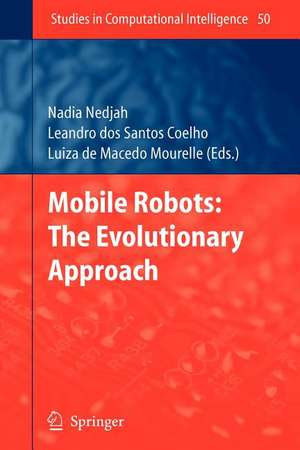
Mobile Robots: The Evolutionary Approach: Studies in Computational Intelligence, cartea 50
Editat de Leandro Dos Santos Coelhoen Limba Engleză Paperback – 22 noi 2010
Din seria Studies in Computational Intelligence
- 18%
 Preț: 924.22 lei
 - 20%
 Preț: 1229.71 lei
 - 5%
 Preț: 1058.46 lei
 - 20%
 Preț: 1030.18 lei
 - 18%
 Preț: 849.88 lei
 - 20%
 Preț: 1230.68 lei
 - 24%
 Preț: 1123.28 lei
 - 15%
 Preț: 626.20 lei
 - 20%
 Preț: 562.99 lei
 - 20%
 Preț: 317.05 lei
 - 20%
 Preț: 1105.37 lei
 - 24%
 Preț: 891.41 lei
 - 20%
 Preț: 671.27 lei
 - 18%
 Preț: 980.46 lei
 - 18%
 Preț: 980.87 lei
 - 15%
 Preț: 665.10 lei
 - 18%
 Preț: 982.36 lei
 - 20%
 Preț: 1090.62 lei
 - 20%
 Preț: 1395.65 lei
 - 20%
 Preț: 1244.59 lei
 - 15%
 Preț: 661.64 lei
 - 15%
 Preț: 658.54 lei
 - 15%
 Preț: 655.95 lei
 - 15%
 Preț: 664.69 lei
 - 18%
 Preț: 975.20 lei
 - 20%
 Preț: 1014.94 lei
 - 20%
 Preț: 1066.64 lei
 - 18%
 Preț: 1280.90 lei
 - 18%
 Preț: 950.43 lei
 - 15%
 Preț: 663.45 lei
 - 18%
 Preț: 1381.17 lei
 - 15%
 Preț: 656.62 lei
 - 18%
 Preț: 979.20 lei
Preț: 641.11 lei
Preț vechi: 754.26 lei
-15%
Puncte Express: 962
Carte tipărită la comandă
Livrare economică 30 noiembrie-14 decembrie
Livrare prin curier în România Termenul estimat este afișat lângă disponibilitate.
Transport gratuit pentru acest produs Plată online sau ramburs, în funcție de opțiunile comenzii.
Retur gratuit în 14 zile Comandă securizată și suport în română.
Specificații
ISBN-13: 9783642080630
ISBN-10: 3642080634
Pagini: 248
Ilustrații: XXI, 223 p.
Dimensiuni: 155 x 235 x 14 mm
Greutate: 0.38 kg
Ediția:Softcover reprint of hardcover 1st edition 2007
Editura: Springer
Colecția Studies in Computational Intelligence
Seria Studies in Computational Intelligence
Locul publicării:Berlin, Heidelberg, Germany
ISBN-10: 3642080634
Pagini: 248
Ilustrații: XXI, 223 p.
Dimensiuni: 155 x 235 x 14 mm
Greutate: 0.38 kg
Ediția:Softcover reprint of hardcover 1st edition 2007
Editura: Springer
Colecția Studies in Computational Intelligence
Seria Studies in Computational Intelligence
Locul publicării:Berlin, Heidelberg, Germany
V-ar putea interesa
-
 Introduction to Autonomous Mobile Robots, second editionDavide Scaramuzza-14%Preț: 587.96 lei683.67 lei
 -
 NeuroroboticsJeffrey L. Krichmar-14%Preț: 547.34 lei636.44 lei
 -
 Biological Intelligence for Biomimetic RobotsJoseph Ayers-14%Preț: 523.91 lei609.19 lei
 -
 Evolutionary Computing in Advanced ManufacturingManoj Tiwari-5%Preț: 939.67 lei989.13 lei
 -
 Robot EcologyMagnus Egerstedt-14%Preț: 528.68 lei614.75 lei
 -
 The LEGO MINDSTORMS EV3 Discovery BookLaurens Valk-18%Preț: 216.13 lei264.86 lei
 -
 The LEGO MINDSTORMS EV3 LaboratoryDaniele Benedettelli-19%Preț: 215.56 lei264.52 lei
 -
 The Nature of Code: Simulating Natural Systems with JavaScriptDaniel Shiffman-34%Preț: 215.95 lei326.00 lei
 -
 Racing RobotsElizabeth DalePreț: 48.72 lei
 -
 -23%Preț: 806.29 lei1047.13 lei
 -
 Walking Robots into Real WorldKarsten Berns-18%Preț: 1177.33 lei1435.77 lei
 -
 Discovering Drift Phenomena in Evolving LandscapesMarco Piangerelli-20%Preț: 316.06 lei395.07 lei
 -
 Nature-Inspired Computation in EngineeringXin She Yang-20%Preț: 510.13 lei637.67 lei
 -
 Robotics Goes MOOCBruno SicilianoPreț: 404.01 lei
 -
 -20%Preț: 1210.01 lei1512.52 lei
Public țintă
ResearchCuprins
Evolutionary Mobile Robots.- Differential Evolution Approach Using Chaotic Sequences Applied to Planning of Mobile Robot in a Static Environment with Obstacles.- Evolving Modular Robots for Rough Terrain Exploration.- Evolutionary Navigation of Autonomous Robots Under Varying Terrain Conditions.- Aggregate Selection in Evolutionary Robotics.- Evolving Fuzzy Classifier for Novelty Detection and Landmark Recognition by Mobile Robots.- Learning Mobile Robots.- Reinforcement Learning for Autonomous Robotic Fish.- Module-based Autonomous Learning for Mobile Robots.- A Hybrid Adaptive Architecture for Mobile Robots Based on Reactive Behaviours.- Collaborative Robots for Infrastructure Security Applications.- Imitation Learning: An Application in a Micro Robot Soccer Game.
Textul de pe ultima copertă
The design and control of autonomous intelligent mobile robotic systems operating in unstructured changing environments includes many objective difficulties. There are several studies about the ways in which, robots exhibiting some degree of autonomy, adapt themselves to fit in their environments. The application and use of bio-inspired and intelligent techniques such as reinforcement learning, artificial neural networks, evolutionary computation and so forth in the design and improvement of robot designs is an emergent research topic. Researchers have obtained robots that display an amazing slew of behaviours and perform a multitude of tasks. These include perception of environment, planning and navigation in rough terrain, pushing boxes, negotiating an obstacle course, etc.
In this context, mobile robots designed using evolutionary computation approaches, usually known as Mobile Evolutionary Robotics, have experienced significant development in the last decade. The fundamental goal of mobile evolutionary robotics is to apply evolutionary computation methods to automate the production of complex behavioural robotic controllers.
This volume offers a wide spectrum of sample works developed in leading research throughout the world about evolutionary mobile robotics and demonstrates the success of the technique in evolving efficient and capable mobile robots.
In this context, mobile robots designed using evolutionary computation approaches, usually known as Mobile Evolutionary Robotics, have experienced significant development in the last decade. The fundamental goal of mobile evolutionary robotics is to apply evolutionary computation methods to automate the production of complex behavioural robotic controllers.
This volume offers a wide spectrum of sample works developed in leading research throughout the world about evolutionary mobile robotics and demonstrates the success of the technique in evolving efficient and capable mobile robots.
Caracteristici
Everything about evolutionary computation in practice Includes supplementary material: sn.pub/extras