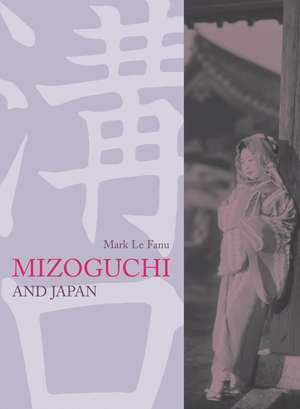
Mizoguchi and Japan
Autor Mark Le Fanuen Limba Engleză Paperback – 8 iun 2005
Imaginați-vă o sală de cinema în anii '50, unde publicul occidental este fascinat de dinamismul lui Kurosawa, în timp ce, într-o tăcere plină de semnificații, Kenji Mizoguchi perfecționa o estetică a suferinței și a frumosului pur. Descoperim aici, prin privirea criticului Mark Le Fanu, o perspectivă unică asupra unui regizor pe care revista Cahiers du Cinéma l-a numit „cel mai mare dintre toți cineaștii”. Putem afirma că lucrarea de față nu este doar o analiză tehnică, ci o incursiune în „subiectul subiectelor” pentru Mizoguchi: destinul tragic și reziliența femeilor în Japonia, de la curtezanele din casele de plăceri la figurile istorice de rang înalt.
Notăm cu interes modul în care Mark Le Fanu echilibrează rigoarea istorică cu o apreciere aproape senzorială a imaginii. Stilul său este unul analitic dar evocator, ghidând cititorul prin compozițiile picturale care au anticipat rafinamentul vizual al unor producții moderne precum cele ale lui Zhang Yimou. Pe același raft cu Kenji Mizoguchi and the Art of Japanese Cinema de Latika Padgaonkar, dar cu un accent pe contextul moral și stilistic care face legătura între tradiția japoneză și modernitatea cinematografică, această carte umple un gol de două decenii în literatura de specialitate.
În contextul operei autorului, Mizoguchi and Japan continuă explorarea sacrului și a imaginii începută în The Cinema of Andrei Tarkovsky. Dacă în Believing in Film Mark Le Fanu chestiona rolul credinței într-o lume seculară, aici el identifică o formă de spiritualitate în însăși rigoarea estetică a lui Mizoguchi. Este un studiu despre cum suferința umană poate fi transpusă în cadre de o frumusețe copleșitoare, transformând cinematografia într-un exercițiu de etică vizuală.
Preț: 259.72 lei
Preț vechi: 349.01 lei
-26%
Carte tipărită la comandă
Livrare economică 05-19 decembrie
Specificații
ISBN-10: 1844570576
Pagini: 238
Ilustrații: illustrated
Dimensiuni: 155 x 235 x 15 mm
Greutate: 0.54 kg
Ediția:2005
Editura: Bloomsbury Publishing
Colecția British Film Institute
Locul publicării:London, United Kingdom
V-ar putea interesa
-
 Easily DistractedSteve Coogan-23%Preț: 67.13 lei87.32 lei
 -
 Preț: 302.16 lei
 -
 Ayoade on AyoadeRichard AyoadePreț: 79.55 lei
 -
 -13%Preț: 176.61 lei202.51 lei
 -
 Picture ThisMolly Bang-13%Preț: 121.27 lei139.43 lei
 -
 DialogueRobert McKeePreț: 210.53 lei
 -
 Films of the New French ExtremityAlexandra WestPreț: 243.47 lei
 -
 David LynchMichel Chion-24%Preț: 243.42 lei320.25 lei
 -
 La JetéeChris Darke-41%Preț: 67.54 lei113.86 lei
 -
 Aguirre, the Wrath of GodEric Ames-42%Preț: 62.52 lei108.47 lei
 -
 Cinema Beyond the CityJudith Thissen-14%Preț: 583.84 lei678.89 lei
 -
 The Children's Film Foundation: History and LegacyRobert Shail-19%Preț: 550.65 lei679.82 lei
 -
 Doctor ZhivagoIan Christie-36%Preț: 67.58 lei105.24 lei
 -
 The Man Who Knew Too MuchProfessor Murray Pomerance-41%Preț: 66.91 lei113.86 lei
 -
 -19%Preț: 58.50 lei71.92 lei
 -
 Envisioning American UtopiasAntje DallmannPreț: 384.12 lei
 -
 The Stanley Kubrick ArchivesAlison CastlePreț: 192.65 lei
De ce să citești această carte
Recomandăm această carte oricărui cinefil care dorește să depășească orizontul cunoscut al lui Kurosawa pentru a înțelege profunzimea cinematografiei nipone. Cititorul câștigă o înțelegere nuanțată a modului în care arta vizuală poate servi drept critică socială, explorând teme precum opresiunea de gen și onoarea. Este o lectură esențială pentru a descoperi de ce Mizoguchi rămâne un reper estetic fundamental în istoria filmului mondial.
Despre autor
Mark Le Fanu este un reputat istoric de film, în prezent director al departamentului de istoria filmului la European Film College din Danemarca. Expertiza sa se întinde pe spații culturale vaste, fiind autorul unor studii de pionierat despre regizorul rus Andrei Tarkovski, lucrare publicată tot sub egida British Film Institute. Colaborator constant al unor publicații prestigioase precum Sight & Sound și Positif, Le Fanu aduce în scrierile sale o sensibilitate europeană aplicată asupra marilor maeștri ai cinematografiei mondiale, analizând intersecția dintre estetică, moralitate și context istoric.
Descriere
As a storyteller, Mizoguchi was drawn to the plight and oppression of women throughout the ages - it was, for him, the 'subject of subjects'. So in addition to the movies just mentioned, he is remembered for a string of masterly contemporary films that examined, with unprecedented candour and ferocity, the conditions of life in Japanese brothels and geisha houses. Yet, as well as being a moralist. Mizoguchi was a stylist. His films are considered by critics to be among the most beautiful ever made, from a purely pictorial point of view. Filmgoers who have responded enthusiastically in recent years to Chinese classics like Farewell My Concubine or to the colourful works of Zhang Yimou will be delighted to discover 'pre-echoes' of this cinema in such late films by this Japanese master as The Empress Yang Kwei Fei and Tales of the Taira Clan (both released in 1955) works in which colour, costume and decor are deployed with compelling refinement.
Despite his extraordinary qualities as a film-maker, Mizoguchi and Japan is the first full -length study in English for over 20 years of a director whose work is as vibrant now as it ever was in its heyday, and whom the French film review Cahiers du Cinema recently hailed 'the greatest of all cineastes.'
Mark Le Fanu's preface to the new ebook edition - https://media.bloomsbury.com/rep/files/revised-mizoguchi-and-japan-preface.docx
A Retrospective to the 2008 edition - https://media.bloomsbury.com/rep/files/mizoguchi-and-japan-retrospect.doc
Recenzii
Le Fanu is a refreshing anomaly in contemporary academic film criticism.
I offer Le Fanu the highest compliment that can be paid a critic: his book made me want to rush out and screen every Mizoguchi film I could lay my hands on.
Like all critics worthy of the name, Le Fanu goes to great pains to retrace the spiritual path of the artist he is writing about, sharing with us his intellectual curiosity and in doing so displaying a profound knowledge of the arts and the history, the literature and the customs of Japan . Le Fanu here makes a major contribution to our knowledge of this great Japanese master.
As the title indicates, the author sets Mizoguchi's films within the wider context of Japanese history, culture and society, of which he has acquired an astonishing knowledge . [Le Fanu] wrote an earlier book on Tarkovsky, and this new work is even more impressive in its scholarship and attention to detail.
If you want to know more about Mizoguchi, I can make no higher recommendation than Mark Le Fanu's Mizoguchi and Japan. Le Fanu's writing is beautifully structured: he moves logically from topic to topic. He is logical because, after all, in film writing, to talk about one thing is usually to talk about everything. Mizoguchi and Japan, then, ends up inevitably casting its net wider, making it surely one of the best film books of the year.
We have waited twenty years for a decent new book on the subject. We are fortunate to have got one as good as this.