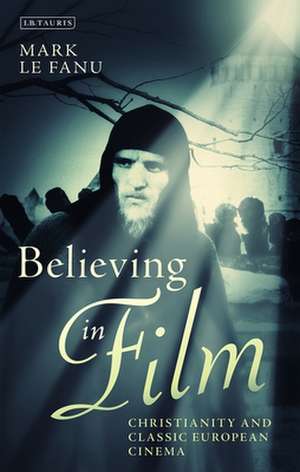
Believing in Film: Christianity and Classic European Cinema: Cinema and Society
Autor Mark Le Fanuen Limba Engleză Paperback – 19 mar 2020
Din seria Cinema and Society
- 20%
 Preț: 204.25 lei
 - 15%
 Preț: 185.15 lei
 -
 Preț: 170.14 lei
 - 13%
 Preț: 151.86 lei
 - 21%
 Preț: 191.04 lei
 - 25%
 Preț: 174.27 lei
 - 25%
 Preț: 174.05 lei
 - 23%
 Preț: 240.77 lei
 - 24%
 Preț: 234.55 lei
 - 24%
 Preț: 233.22 lei
 - 30%
 Preț: 219.30 lei
 - 38%
 Preț: 784.80 lei
 -
 Preț: 449.96 lei
 - 27%
 Preț: 235.79 lei
 - 26%
 Preț: 218.44 lei
 - 20%
 Preț: 167.58 lei
 -
 Preț: 399.68 lei
 - 21%
 Preț: 189.00 lei
 -
 Preț: 395.42 lei
 - 28%
 Preț: 857.00 lei
 - 20%
 Preț: 146.09 lei
 - 24%
 Preț: 193.31 lei
 - 25%
 Preț: 241.33 lei
 - 20%
 Preț: 171.51 lei
 - 23%
 Preț: 238.27 lei
 - 36%
 Preț: 866.65 lei
 -
 Preț: 403.94 lei
 - 21%
 Preț: 165.37 lei
 - 20%
 Preț: 197.69 lei
 - 26%
 Preț: 173.00 lei
 - 28%
 Preț: 734.62 lei
 - 25%
 Preț: 180.63 lei
 - 18%
 Preț: 185.98 lei
 - 20%
 Preț: 180.35 lei
Preț: 188.73 lei
Preț vechi: 235.30 lei
-20%
Puncte Express: 283
Carte disponibilă
Livrare economică 14-28 noiembrie
Livrare express 03-07 noiembrie pentru 72.51 lei
Livrare prin curier în România Termenul estimat este afișat lângă disponibilitate.
Transport gratuit de la 400.00 lei Plată online sau ramburs, în funcție de opțiunile comenzii.
Retur gratuit în 14 zile Comandă securizată și suport în română.
Specificații
ISBN-13: 9781350160491
ISBN-10: 1350160490
Pagini: 288
Ilustrații: 40 b&w
Dimensiuni: 128 x 198 x 22 mm
Greutate: 0.32 kg
Editura: Bloomsbury Publishing
Colecția Bloomsbury Academic
Seria Cinema and Society
Locul publicării:London, United Kingdom
ISBN-10: 1350160490
Pagini: 288
Ilustrații: 40 b&w
Dimensiuni: 128 x 198 x 22 mm
Greutate: 0.32 kg
Editura: Bloomsbury Publishing
Colecția Bloomsbury Academic
Seria Cinema and Society
Locul publicării:London, United Kingdom
V-ar putea interesa
-
 Listening to the Artifacts: Music Culture in Ancient PalestineTheodore W. Burgh-16%Preț: 291.31 lei345.88 lei
 -
 Systematic Theology Vol 3Wolfhart Pannenberg-14%Preț: 589.32 lei685.26 lei
 -
 Systematic Theology Vol 2Wolfhart Pannenberg-14%Preț: 710.94 lei826.67 lei
 -
 The Evolution of Christianity: Twelve Crises that Shaped the ChurchMarshall D. Johnson-21%Preț: 374.69 lei475.45 lei
 -
 To Our Bodies Turn We Then: Body as Word and Sacrament in the Works of John DonneFelecia Wright McDuffie-25%Preț: 277.29 lei369.13 lei
 -
 An Introduction to Religion and LiteratureDr Mark Knight-24%Preț: 240.63 lei315.80 lei
 -
 The History of the Sacred PassionLuis De La PalmaPreț: 115.25 lei
 -
 DODGING MINES IN THE MINEFIELD OF LIFEJim HoffinePreț: 104.06 lei
 -
 Fire and a HammerWarlene SmithPreț: 177.67 lei
 -
 Newman's Unquiet Grave: The Reluctant SaintDr John Cornwell-39%Preț: 68.98 lei112.47 lei
 -
 Glory to the Three EternalMichael A. G. HaykinPreț: 263.82 lei
 -
 Romans UnpluggedLes BrightonPreț: 321.51 lei
 -
 His Hidden GloryDavid Puffer Th. D.Preț: 82.60 lei
 -
 Global Pentecostalism: Encounters with Other Religious TraditionsDavid Westerlund-32%Preț: 858.42 lei1266.11 lei
 -
 -32%Preț: 564.24 lei830.56 lei
 -
 GOD Speaks to Man on The InternetAnthony A EddyPreț: 128.72 lei
 -
 Jesus unser Schicksal - ungekürztes HörbuchWilhelm BuschPreț: 60.41 lei
Cuprins
General Editor's Introduction
Introduction
CHAPTER 1: Russia: Tarkovsky, Eisenstein and Christianity
CHAPTER 2: Poland: A Trio of Catholics
CHAPTER 3: France: The Apostasy of Robert Bresson
CHAPTER 4: Italy: Christianity and Neo-Realism
CHAPTER 5: Scandinavia: Lutheran Interludes
CHAPTER 6: Spain: The Heresies of Don Luis
CHAPTER 7: Russia Again: Millennial Faith and Nihilism
Afterword
Acknowledgements
List of Illustrations
Bibliography
Index
Introduction
CHAPTER 1: Russia: Tarkovsky, Eisenstein and Christianity
CHAPTER 2: Poland: A Trio of Catholics
CHAPTER 3: France: The Apostasy of Robert Bresson
CHAPTER 4: Italy: Christianity and Neo-Realism
CHAPTER 5: Scandinavia: Lutheran Interludes
CHAPTER 6: Spain: The Heresies of Don Luis
CHAPTER 7: Russia Again: Millennial Faith and Nihilism
Afterword
Acknowledgements
List of Illustrations
Bibliography
Index
Recenzii
The impact of Le Fanu's work is palpable; whether conscious of religion's influence or not, European directors consistently dealt with questions of faith and belief. The awareness of religion's influence, and the breadth of its reaches are impressively conveyed throughout the book.
Style is one of the remarkable aspects of Dr Le Fanu's book. It is beautifully free from useless technicalities and the clotted syntax that afflicts many academic writers . [he has] an ability to convey the thrust of a film that the reader might not have seen, and an openness to directors' ideas that might be uncongenial to the author ... gripping.
In this superb cultural history, Mark Le Fanu considers the religious impulse that distinguishes so much European cinema in its golden age from the second world war up to the 1980s . Le Fanu's wonderful survey, with its aphoristic grace and erudition lightly worn, is from start to finish a delight to read.
[There is] much of fascination here for a general reader . [This book] has not only stimulated and educated, but led to my seeking out copies of four films that Le Fanu makes seem especially fascinating: Bergman's Winter Light, Buñuel's Simon of the Desert, Zanussi's Spirala and Dreyer's Day of Wrath. These purchases prove this deeply-felt treatise also to be a work of evangelism.
Clearly and thoughtfully written, with thankfully no film studies jargon, this book is one to be truly grateful for.
The substance of Believing in Film is an auteurist, country-by-country survey of the place of the Christian religion among the output of European directors during the golden age of art cinema from the time of World War II up to the end of the 1980s. The author's criterion for inclusion is not that a film should exhibit, or that a director should possess, faith, but only that the film should evidence a sympathy for Christianity, even when criticising its pretensions. One of the pleasures of tourism for the thinking traveller is the appreciation of different European countries' attitudes to what remains of their religion, and that pleasure is replicated and enhanced in this book by the author's understated and sensitive discussion of favourite films, based on a life-time of critical discernment. For Le Fanu is one of those nuanced and thoughtful people who, while rejecting extremes, is not embarrassed to confess that he remains open to the 'still-living truths of Christianity'.
Are we all still Christian? Or at least unwilling to stop framing the world in a Christian narrative? Mark Le Fanu's compelling and courageous account of European cinema is an invitation to think of films in a different light, and to explore a marvellous repertoire of films everyone ought to know better. From Pavel Lungin's The Island to Ermanno Olmi's The Fiancés, Andrzej Wajda's Ashes and Diamonds to Bunuel's Nazarin, Le Fanu ably shows how saturated our Western imagination is in such notions as sin and sacrifice, predestination and redemption, how frequently, even in the work of atheists and agnostics, epiphanies, miracles and resurrections occur. Proceeding from one engaging account to another, Believing in Film is a timely reminder of the resilience and narrative fertility of our Christian tradition.
Mark Le Fanu, who "endured a Catholic upbringing during the 1950s in the north of Scotland", has written a lucid and highly readable study of the role of religion - and specifically, the Christian religion - in classic European cinema. His thesis, unfashionable in certain quarters but cogently argued, that religion and culture are inseparable, takes in not only expected figures like Bresson and Tarkovsky, but also such avowed atheists as the Spanish director Luis Buñuel. Altogether this book offers many penetrating insights, such as will rivet the attention - and challenge the assumptions - of even the most irreligious reader.
Style is one of the remarkable aspects of Dr Le Fanu's book. It is beautifully free from useless technicalities and the clotted syntax that afflicts many academic writers . [he has] an ability to convey the thrust of a film that the reader might not have seen, and an openness to directors' ideas that might be uncongenial to the author ... gripping.
In this superb cultural history, Mark Le Fanu considers the religious impulse that distinguishes so much European cinema in its golden age from the second world war up to the 1980s . Le Fanu's wonderful survey, with its aphoristic grace and erudition lightly worn, is from start to finish a delight to read.
[There is] much of fascination here for a general reader . [This book] has not only stimulated and educated, but led to my seeking out copies of four films that Le Fanu makes seem especially fascinating: Bergman's Winter Light, Buñuel's Simon of the Desert, Zanussi's Spirala and Dreyer's Day of Wrath. These purchases prove this deeply-felt treatise also to be a work of evangelism.
Clearly and thoughtfully written, with thankfully no film studies jargon, this book is one to be truly grateful for.
The substance of Believing in Film is an auteurist, country-by-country survey of the place of the Christian religion among the output of European directors during the golden age of art cinema from the time of World War II up to the end of the 1980s. The author's criterion for inclusion is not that a film should exhibit, or that a director should possess, faith, but only that the film should evidence a sympathy for Christianity, even when criticising its pretensions. One of the pleasures of tourism for the thinking traveller is the appreciation of different European countries' attitudes to what remains of their religion, and that pleasure is replicated and enhanced in this book by the author's understated and sensitive discussion of favourite films, based on a life-time of critical discernment. For Le Fanu is one of those nuanced and thoughtful people who, while rejecting extremes, is not embarrassed to confess that he remains open to the 'still-living truths of Christianity'.
Are we all still Christian? Or at least unwilling to stop framing the world in a Christian narrative? Mark Le Fanu's compelling and courageous account of European cinema is an invitation to think of films in a different light, and to explore a marvellous repertoire of films everyone ought to know better. From Pavel Lungin's The Island to Ermanno Olmi's The Fiancés, Andrzej Wajda's Ashes and Diamonds to Bunuel's Nazarin, Le Fanu ably shows how saturated our Western imagination is in such notions as sin and sacrifice, predestination and redemption, how frequently, even in the work of atheists and agnostics, epiphanies, miracles and resurrections occur. Proceeding from one engaging account to another, Believing in Film is a timely reminder of the resilience and narrative fertility of our Christian tradition.
Mark Le Fanu, who "endured a Catholic upbringing during the 1950s in the north of Scotland", has written a lucid and highly readable study of the role of religion - and specifically, the Christian religion - in classic European cinema. His thesis, unfashionable in certain quarters but cogently argued, that religion and culture are inseparable, takes in not only expected figures like Bresson and Tarkovsky, but also such avowed atheists as the Spanish director Luis Buñuel. Altogether this book offers many penetrating insights, such as will rivet the attention - and challenge the assumptions - of even the most irreligious reader.