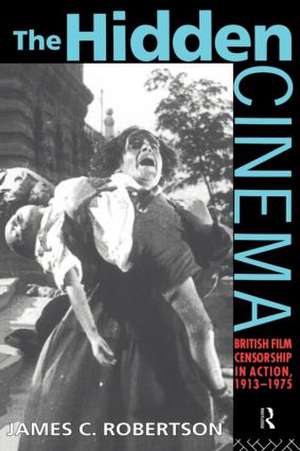
The Hidden Cinema: British Film Censorship in Action 1913-1972: Cinema and Society
Autor Dr James C Robertsonen Limba Engleză Paperback – 6 mai 1993
Din seria Cinema and Society
- 20%
 Preț: 204.25 lei
 - 15%
 Preț: 185.15 lei
 -
 Preț: 170.14 lei
 - 12%
 Preț: 154.66 lei
 - 21%
 Preț: 191.04 lei
 - 25%
 Preț: 174.27 lei
 - 25%
 Preț: 174.05 lei
 - 23%
 Preț: 240.77 lei
 - 24%
 Preț: 234.55 lei
 - 23%
 Preț: 241.36 lei
 - 30%
 Preț: 219.30 lei
 - 38%
 Preț: 784.80 lei
 -
 Preț: 449.96 lei
 - 27%
 Preț: 235.79 lei
 - 26%
 Preț: 218.44 lei
 - 20%
 Preț: 167.58 lei
 -
 Preț: 399.68 lei
 - 21%
 Preț: 189.00 lei
 - 20%
 Preț: 188.73 lei
 - 28%
 Preț: 857.00 lei
 - 20%
 Preț: 146.09 lei
 - 24%
 Preț: 193.31 lei
 - 25%
 Preț: 241.33 lei
 - 20%
 Preț: 171.51 lei
 - 23%
 Preț: 238.27 lei
 - 36%
 Preț: 866.65 lei
 -
 Preț: 403.94 lei
 - 21%
 Preț: 165.37 lei
 - 20%
 Preț: 197.69 lei
 - 26%
 Preț: 173.00 lei
 - 28%
 Preț: 734.62 lei
 - 25%
 Preț: 180.63 lei
 - 18%
 Preț: 185.98 lei
 - 20%
 Preț: 180.35 lei
Preț: 395.42 lei
Puncte Express: 593
Carte tipărită la comandă
Livrare economică 08-22 decembrie
Livrare prin curier în România Termenul estimat este afișat lângă disponibilitate.
Transport gratuit de la 400.00 lei Plată online sau ramburs, în funcție de opțiunile comenzii.
Retur gratuit în 14 zile Comandă securizată și suport în română.
Specificații
ISBN-13: 9780415090346
ISBN-10: 0415090342
Pagini: 216
Ilustrații: 1
Dimensiuni: 152 x 229 x 12 mm
Greutate: 0.4 kg
Ediția:Revised
Editura: Taylor & Francis
Colecția Routledge
Seria Cinema and Society
Locul publicării:Oxford, United Kingdom
ISBN-10: 0415090342
Pagini: 216
Ilustrații: 1
Dimensiuni: 152 x 229 x 12 mm
Greutate: 0.4 kg
Ediția:Revised
Editura: Taylor & Francis
Colecția Routledge
Seria Cinema and Society
Locul publicării:Oxford, United Kingdom
V-ar putea interesa
-
 Power and Politics After Financial CrisesJ. RobertsonPreț: 404.69 lei
 -
 Crime and Punishment in Eighteenth Century EnglandFrank McLynn-18%Preț: 1130.52 lei1378.69 lei
 -
 The Media in FranceRaymond KuhnPreț: 177.12 lei
 -
 -18%Preț: 1468.22 lei1790.51 lei
 -
 Power and the Professions in Britain 1700-1850Penelope J Corfield-18%Preț: 1119.60 lei1365.37 lei
 -
 New Heritage: New Media and Cultural HeritageYehuda KalayPreț: 478.45 lei
 -
 -18%Preț: 1612.13 lei1966.01 lei
 -
 Censorship in Theatre and CinemaAnthony Aldgate-17%Preț: 228.46 lei276.12 lei
 -
 -18%Preț: 1003.26 lei1223.49 lei
 -
 Work in France – Representations, Meaning, Organization, and PracticeSteven Laurence Kaplan-23%Preț: 665.64 lei864.48 lei
 -
 Preț: 285.13 lei
 -
 Such As UsTom E. TerrillPreț: 323.51 lei
 -
 Expanding the PastPeter N. StearnsPreț: 286.40 lei
 -
 Hooded AmericanismDavid J ChalmersPreț: 260.48 lei
 -
 Preț: 220.06 lei
 -
 FalfurriasDale LasaterPreț: 165.99 lei
 -
 Preț: 397.08 lei
 -
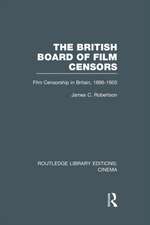 The British Board of Film Censors: Film Censorship in Britain, 1896-1950James C. RobertsonPreț: 311.10 lei
 -
 With the Cameliers in PalestineJ. RobertsonPreț: 237.71 lei
 -
 The Teacher's Voice: A Social History Of Teaching In 20th Century AmericaRichard AltenbaughPreț: 279.80 lei
 -
 Preț: 449.96 lei
Recenzii
`This volume in the excellent `Cinema and Society' series edited by Jeffrey Richards ... is interesting throughout [and] thoroughly researched.' - Film Review
`... immensely entertaining, eye opening social history, achieving a nice balance between the prudish and the prurient.' - Philip French, The Observer
`... immensely entertaining, eye opening social history, achieving a nice balance between the prudish and the prurient.' - Philip French, The Observer
Cuprins
Introduction 1 The silents, 1913–1929 2 The early talkies, 1930–1939 3 The Second World War and its aftermath, 1940–1950 4 The later talkies, 1950–1975 5 Conclusion
Descriere
How does film censorship work in Britain? Robertson examines the history of the British Board of Film Censors and shows that censorship has had a greater influence on film history than is often assumed.