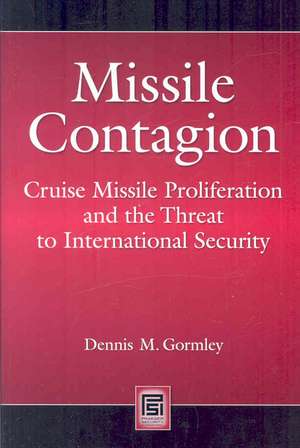
Missile Contagion: Cruise Missile Proliferation and the Threat to International Security: Praeger Security International
Autor Dennis M. Gormleyen Limba Engleză Hardback – 30 mai 2008
Signs of missile contagion abound. In this study, Gormley argues that a series of rapid and surprising developments since 2005 suggest that the proliferation of missiles capable of delivering either weapons of mass destruction or highly accurate conventional payloads is approaching a critical threshold. The surprising fact is that land-attack cruise missiles, not ballistic missiles, constitute the primary problem. Flying under the radar, both literally and figuratively, land-attack cruise missiles add a dangerous new dimension to protecting U.S. security interests and preventing regional military instability. Gormley asserts that cruise missiles are not destined to supplant ballistic missiles; rather, they are likely to join them, because when both are employed together, they could severely test even the best missile defenses. Worse yet, Gormley argues, land-attack cruise missiles are increasingly being linked to preemptive strike doctrines, which are fueling regional arms races and crisis instability. This work explains why an epidemic of cruise missile proliferation, long forecasted by analysts, has only recently begun to occur. After first assessing the state of ballistic missile proliferation, Gormley explores the role of three factors in shaping the spread of cruise missiles. These include specialized knowledge needed for missile development; narrative messages about reasons for acquiring cruise missiles; and norms of state behavior about missile nonproliferation policy and defense doctrine. This book then addresses the policy adjustments needed to stanch the spread of cruise missiles in the first place, or, barring that, cope militarily with a more demanding missile threat consisting of both cruise and ballistic missiles.
Din seria Praeger Security International
-
 Preț: 199.18 lei
 - 48%
 Preț: 455.90 lei
 - 13%
 Preț: 344.23 lei
 -
 Preț: 199.74 lei
 - 33%
 Preț: 246.45 lei
 - 38%
 Preț: 383.55 lei
 - 12%
 Preț: 312.42 lei
 -
 Preț: 197.57 lei
 -
 Preț: 194.35 lei
 - 34%
 Preț: 554.09 lei
 - 22%
 Preț: 343.02 lei
 - 37%
 Preț: 384.65 lei
 - 23%
 Preț: 423.75 lei
 - 23%
 Preț: 348.18 lei
 - 22%
 Preț: 344.85 lei
 - 22%
 Preț: 330.28 lei
 - 22%
 Preț: 344.85 lei
 - 30%
 Preț: 394.63 lei
 - 22%
 Preț: 329.07 lei
 - 31%
 Preț: 387.28 lei
 - 31%
 Preț: 387.03 lei
 - 22%
 Preț: 329.07 lei
 - 22%
 Preț: 329.67 lei
 - 28%
 Preț: 431.58 lei
 - 18%
 Preț: 344.85 lei
 - 38%
 Preț: 280.45 lei
 - 22%
 Preț: 331.50 lei
 - 22%
 Preț: 259.96 lei
 - 43%
 Preț: 586.51 lei
 - 19%
 Preț: 342.40 lei
 - 22%
 Preț: 309.58 lei
 - 23%
 Preț: 362.14 lei
 - 30%
 Preț: 397.87 lei
 - 22%
 Preț: 310.59 lei
 - 19%
 Preț: 343.02 lei
 - 22%
 Preț: 334.55 lei
 - 28%
 Preț: 347.66 lei
 - 38%
 Preț: 425.65 lei
 - 22%
 Preț: 363.95 lei
 - 23%
 Preț: 363.33 lei
 - 33%
 Preț: 261.15 lei
 - 22%
 Preț: 364.55 lei
 - 22%
 Preț: 327.86 lei
 - 22%
 Preț: 343.02 lei
 - 35%
 Preț: 363.95 lei
 - 22%
 Preț: 343.02 lei
 - 18%
 Preț: 310.59 lei
 - 19%
 Preț: 343.63 lei
 - 41%
 Preț: 416.65 lei
Preț: 331.36 lei
Preț vechi: 424.61 lei
-22%
Puncte Express: 497
Preț estimativ în valută:
58.64€ • 68.54$ • 50.91£
58.64€ • 68.54$ • 50.91£
Carte tipărită la comandă
Livrare economică 20 februarie-06 martie
Preluare comenzi: 021 569.72.76
Specificații
ISBN-13: 9780275998363
ISBN-10: 0275998363
Pagini: 272
Dimensiuni: 155 x 234 x 20 mm
Greutate: 0.56 kg
Editura: Bloomsbury Publishing
Colecția Praeger
Seria Praeger Security International
Locul publicării:New York, United States
ISBN-10: 0275998363
Pagini: 272
Dimensiuni: 155 x 234 x 20 mm
Greutate: 0.56 kg
Editura: Bloomsbury Publishing
Colecția Praeger
Seria Praeger Security International
Locul publicării:New York, United States
Cuprins
Glossary
Preface and Acknowledgments
PART ONE The Proliferation Context
Chapter 1 Introduction
Chapter 2 The Ballistic Missile Context
Chapter 3 Ballistic Missiles and Regional Competitions
Chapter 4 Land-Attack Cruise Missiles Signs of Contagion
Chapter 5 Regional Signs of Contagion
PART TWO Proliferation Instrumentalities
Chapter 6 Knowledge
Chapter 7 Narrative
Chapter 8 Norms
PART THREE Policy Responses
Chapter 9 Nonproliferation and Defense Policy Responses
Appendix Selected Missile Programs
Notes
Select Bibliography
Preface and Acknowledgments
PART ONE The Proliferation Context
Chapter 1 Introduction
Chapter 2 The Ballistic Missile Context
Chapter 3 Ballistic Missiles and Regional Competitions
Chapter 4 Land-Attack Cruise Missiles Signs of Contagion
Chapter 5 Regional Signs of Contagion
PART TWO Proliferation Instrumentalities
Chapter 6 Knowledge
Chapter 7 Narrative
Chapter 8 Norms
PART THREE Policy Responses
Chapter 9 Nonproliferation and Defense Policy Responses
Appendix Selected Missile Programs
Notes
Select Bibliography
Recenzii
Gormley (Univ. of Pittsburgh) systematically and effectively lays out the often underestimated threat of cruise missile proliferation. . . . Recommended. Upper-division undergraduates and above.
The strength of Gormley's approach is that Missile Contagion is structured to address issues of interest to multiple audiences-international security analysts, academics, and policymakers. Failing to heed his unambiguous warnings will increase the likelihood that the missile contagion will spread unchecked, and the United States, along with its allies and friends, will confront a world unnecessarily more dangerous.'
For all those who want to understand this threat and what can and must be done about it, Gormley's book is an indispensable guide.
[Gormley's] exhaustive treatment of missile proliferation makes Missile Contagion an important analysis of nonproliferation regimes, the subtle interrelation of cruise and ballistic missiles, and the strategic import of defenses against them.
The strength of Gormley's approach is that Missile Contagion is structured to address issues of interest to multiple audiences-international security analysts, academics, and policymakers. Failing to heed his unambiguous warnings will increase the likelihood that the missile contagion will spread unchecked, and the United States, along with its allies and friends, will confront a world unnecessarily more dangerous.'
For all those who want to understand this threat and what can and must be done about it, Gormley's book is an indispensable guide.
[Gormley's] exhaustive treatment of missile proliferation makes Missile Contagion an important analysis of nonproliferation regimes, the subtle interrelation of cruise and ballistic missiles, and the strategic import of defenses against them.