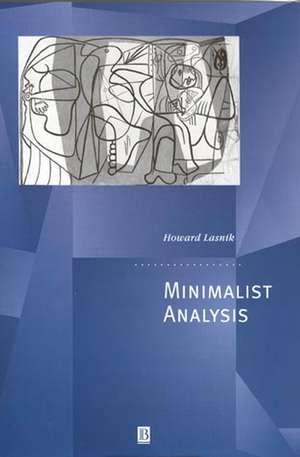
Minimalist Analysis
Autor Lasniken Limba Engleză Hardback – 2 ian 1999
Preț: 843.54 lei
Preț vechi: 1155.54 lei
-27%
Puncte Express: 1265
Carte tipărită la comandă
Livrare economică 27 noiembrie-11 decembrie
Livrare prin curier în România Termenul estimat este afișat lângă disponibilitate.
Transport gratuit pentru acest produs Plată online sau ramburs, în funcție de opțiunile comenzii.
Retur gratuit în 14 zile Comandă securizată și suport în română.
Specificații
ISBN-13: 9780631210931
ISBN-10: 0631210938
Pagini: 224
Dimensiuni: 175 x 250 x 17 mm
Greutate: 0.58 kg
Editura: Wiley
Locul publicării:Chichester, United Kingdom
ISBN-10: 0631210938
Pagini: 224
Dimensiuni: 175 x 250 x 17 mm
Greutate: 0.58 kg
Editura: Wiley
Locul publicării:Chichester, United Kingdom
V-ar putea interesa
-
 A Latin GrammarJamesFellow MorwoodPreț: 68.14 lei
 -
 Latin: A Linguistic IntroductionRenato Oniga-12%Preț: 324.04 lei367.18 lei
 -
 Case in AfricaChrista König-33%Preț: 1299.17 lei1932.81 lei
 -
 -21%Preț: 421.88 lei534.37 lei
 -
 Case and Aspect in SlavicKylie R. Richardson-31%Preț: 603.21 lei873.48 lei
 -
 The Grammar of RomanianGabriela Panã Dindelegan-35%Preț: 1035.23 lei1588.49 lei
 -
 Rhetorical Style: The Uses of Language in PersuasionJeanne Fahnestock-21%Preț: 468.63 lei593.85 lei
 -
 Preț: 284.89 lei
 -
 Minimalist Investigations in Linguistic TheoryHoward Lasnik-15%Preț: 420.28 lei494.45 lei
 -
 Syntactic IslandsCedric Boeckx-20%Preț: 198.38 lei247.31 lei
 -
 Analysing English GrammarLise FontainePreț: 371.28 lei
 -
 SyntaxRobert FreidinPreț: 351.09 lei
 -
 Modern SyntaxAndrew CarniePreț: 416.68 lei
 -
 The Cambridge Handbook of Generative SyntaxMarcel Den Dikken-23%Preț: 1278.55 lei1660.46 lei
 -
 Course in Minimalist SyntaxLasnikPreț: 476.83 lei
 -
 Understanding English Grammar 2eWardhaugh-23%Preț: 481.07 lei624.77 lei
 -
 -9%Preț: 864.16 lei949.63 lei
 -
 Preț: 507.40 lei
 -
 An Annotated Syntax ReaderRichard S. Kayne-15%Preț: 474.98 lei558.80 lei
 -
 The Syntax Workbook: A Companion to Carnie′s SyntaxAndrew CarniePreț: 321.42 lei
 -
 The Bloomsbury Companion to SyntaxSilvia Luraghi-19%Preț: 287.21 lei354.50 lei
Public țintă
upper level students of syntaxNotă biografică
Howard Lasnik is Professor of Linguistics at the University of Connecticut. He has played a prominent role in syntactic theorizing from the extended Standard Theory, through Government-Binding Theory, to Minimalism. He is the author of Move Alpha: Conditions on Its Application and Output (with Mamoru Saito), 1992; An Invitation to Cognitive Science, Vol. 1, Language (with Daniel Osherson), 1990; Essays on Restrictiveness and Learnability, 1990; Essays on Anaphora, 1989; and A Course in GB Syntax: Lectures on Binding and Empty categories (with Juan Uriagereka), 1988. He is also editor, with Daniel Osherson, of An Invitation to Cognitive Science, Vol. 1, Language (1990).
Cuprins
Preface. Original Publication Details.
Part I: Introduction.
Part II: On the Subject of Infinitives (with Mamoru Saito):.
1. Introduction.
2. Evidence for Raising.
3. When Does Raising Take Place?.
4. Postal's B-Verbs vs. W-Verbs: Raising Questions.
Part III: Lectures on Minimalist Syntax:.
5. Introduction.
6. Levels of Representation: Case Considerations.
7. The "Extended Projection Principle".
8. Case and Expletives.
9. [Spec, Agr]: Further Arguments.
10. The Problem of Apparent S-structure Requirements.
11. Antecedent Contained Deletion.
12. More on Reconstruction.
13. The PRO Theorem Reconsidered.
14. Some Remaining Issues.
Part IV: Case and Expletives Revisited: On Greed and Other Human Failings:.
15. Introduction.
16. Greed.
17. An Alternative to Greed: Enlightened Self Interest.
18. The Nature of "Partitive" Case.
19. The Structure of Inherent Case.
20. Conclusion.
Part V: Verbal Morphology: Syntactic Structures Meets the Minimalist Program:.
21. Introduction.
22. French vs. English.
23. An Economy Approach.
24. A Minimalist-Lexicalist Approach.
25. A Hybrid Approach.
26. Further Evidence from VP Ellipsis.
27. Conclusion.
Appendix.
Part VI: Last Resort:.
28. The Driving Force for A-Movement.
29. Greed.
30. Existential Constructions.
31. Enlightened Self-Interest.
32. LF Feature Movement.
33. Raising to [Spec, Agr]: Covert or Overt?.
34. Conclusion.
Part VII: A Note on Pseudogapping:.
35. Introduction.
36. Pseudogapping as Remnant Raising Plus BP Ellipsis.
37. Strong Features and PF Deletion.
38. PPs as Remnants.
39. Multiple Complements.
40. (Some Instances of) Pseudogapping as Parallel to Pseudogapping.
41. Conclusion.
Part VIII: On Certain Structural Aspects of Anaphora:.
42. Introduction.
43. Where Do the Binding Conditions Apply?.
44. Feature Movement and (Lack of) Binding.
45. Overt Raising to [Spec, Agr].
46. Feature Movement and Control?.
47. Inherent Case as "Structural"?.
48. A Puzzling Divorce of Binding and Scope.
Bibliography.
Index.
Part I: Introduction.
Part II: On the Subject of Infinitives (with Mamoru Saito):.
1. Introduction.
2. Evidence for Raising.
3. When Does Raising Take Place?.
4. Postal's B-Verbs vs. W-Verbs: Raising Questions.
Part III: Lectures on Minimalist Syntax:.
5. Introduction.
6. Levels of Representation: Case Considerations.
7. The "Extended Projection Principle".
8. Case and Expletives.
9. [Spec, Agr]: Further Arguments.
10. The Problem of Apparent S-structure Requirements.
11. Antecedent Contained Deletion.
12. More on Reconstruction.
13. The PRO Theorem Reconsidered.
14. Some Remaining Issues.
Part IV: Case and Expletives Revisited: On Greed and Other Human Failings:.
15. Introduction.
16. Greed.
17. An Alternative to Greed: Enlightened Self Interest.
18. The Nature of "Partitive" Case.
19. The Structure of Inherent Case.
20. Conclusion.
Part V: Verbal Morphology: Syntactic Structures Meets the Minimalist Program:.
21. Introduction.
22. French vs. English.
23. An Economy Approach.
24. A Minimalist-Lexicalist Approach.
25. A Hybrid Approach.
26. Further Evidence from VP Ellipsis.
27. Conclusion.
Appendix.
Part VI: Last Resort:.
28. The Driving Force for A-Movement.
29. Greed.
30. Existential Constructions.
31. Enlightened Self-Interest.
32. LF Feature Movement.
33. Raising to [Spec, Agr]: Covert or Overt?.
34. Conclusion.
Part VII: A Note on Pseudogapping:.
35. Introduction.
36. Pseudogapping as Remnant Raising Plus BP Ellipsis.
37. Strong Features and PF Deletion.
38. PPs as Remnants.
39. Multiple Complements.
40. (Some Instances of) Pseudogapping as Parallel to Pseudogapping.
41. Conclusion.
Part VIII: On Certain Structural Aspects of Anaphora:.
42. Introduction.
43. Where Do the Binding Conditions Apply?.
44. Feature Movement and (Lack of) Binding.
45. Overt Raising to [Spec, Agr].
46. Feature Movement and Control?.
47. Inherent Case as "Structural"?.
48. A Puzzling Divorce of Binding and Scope.
Bibliography.
Index.
Descriere
This volume presents an introduction to the basic ideas and concepts of minimalism. It brings together theoretical discussion of the concepts and techniques of the minimalist approach to syntax, and empirical studies, including some on phenomena.