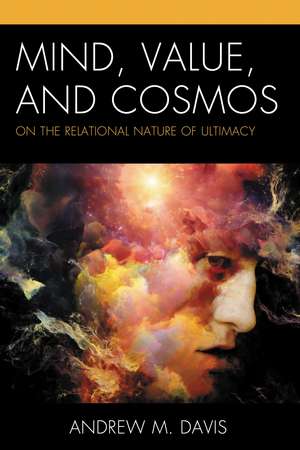
Mind, Value, and Cosmos: On the Relational Nature of Ultimacy: Contemporary Whitehead Studies
Autor Andrew M. Davisen Limba Engleză Hardback – 14 oct 2020
Din seria Contemporary Whitehead Studies
- 36%
 Preț: 730.96 lei
 - 34%
 Preț: 602.61 lei
 - 33%
 Preț: 390.72 lei
 - 34%
 Preț: 581.67 lei
 - 33%
 Preț: 549.89 lei
 - 25%
 Preț: 361.94 lei
 - 32%
 Preț: 596.67 lei
 - 26%
 Preț: 263.60 lei
 - 32%
 Preț: 598.12 lei
 - 28%
 Preț: 220.75 lei
 - 27%
 Preț: 255.41 lei
 - 33%
 Preț: 775.66 lei
 - 19%
 Preț: 224.75 lei
 - 32%
 Preț: 491.39 lei
 - 35%
 Preț: 995.31 lei
 - 27%
 Preț: 255.93 lei
 - 17%
 Preț: 266.76 lei
 - 34%
 Preț: 570.25 lei
Preț: 583.50 lei
Preț vechi: 864.14 lei
-32%
Puncte Express: 875
Carte tipărită la comandă
Livrare economică 04-18 decembrie
Livrare prin curier în România Termenul estimat este afișat lângă disponibilitate.
Transport gratuit pentru acest produs Plată online sau ramburs, în funcție de opțiunile comenzii.
Retur gratuit în 14 zile Comandă securizată și suport în română.
Specificații
ISBN-13: 9781793636393
ISBN-10: 1793636397
Pagini: 242
Dimensiuni: 161 x 228 x 24 mm
Greutate: 0.54 kg
Editura: Bloomsbury Publishing
Colecția Lexington Books
Seria Contemporary Whitehead Studies
Locul publicării:New York, United States
ISBN-10: 1793636397
Pagini: 242
Dimensiuni: 161 x 228 x 24 mm
Greutate: 0.54 kg
Editura: Bloomsbury Publishing
Colecția Lexington Books
Seria Contemporary Whitehead Studies
Locul publicării:New York, United States
Descriere
Mind, Value, and Cosmos: On the Relational Nature of Ultimacy is an investigation into the nature of ultimacy and explanation, particularly as it relates to the status of, and relationship among Mind, Value, and the Cosmos. It draws its stimulus from longstanding "axianoetic" convictions as to the ultimate status of Mind and Value in the western tradition of philosophical theology, and chiefly from the influential modern proposals of A.N. Whitehead, Keith Ward, and John Leslie. What emerges is a relational theory of ultimacy wherein Mind and Value, Possibility and Actuality, God and the World are revealed as "ultimate" only in virtue of their relationality. The ultimacy of relationality-what Whitehead calls "mutual immanence"-uniquely illuminates enduring mysteries surrounding: any and all existence, necessary divine existence, the nature of the possible, and the world as actual. As such, it casts fresh light upon the whence and why of God, the World, and their ultimate presuppositions.
Cuprins
Introduction: The Relational Nature of Ultimacy
Part I: Any and All Existence
Chapter 1: Mysteries of Existence
Chapter 2: Ways of Explaining the Mystery
Part II: Divine Necessity and the Axianoetic Tradition
Chapter 3: Axiarchism: The Creative Supremacy of Value
Chapter 4: Idealism: The Primordiality of Mind
Chapter 5: The Mutual Immanence of Mind and Value
Part III: God and the Possible
Chapter 6: Riddles of the Possible
Chapter 7: Ridding the Possible
Chapter 8: The Mutual Immanence of the Possible and the Actual
Part IV: The World and Its Actualization
Chapter 9: Mind and the Making of Actuality
Chapter 10: The Mutual Immanence of God and the World
Conclusion: The Ultimacy of Relationality
Part I: Any and All Existence
Chapter 1: Mysteries of Existence
Chapter 2: Ways of Explaining the Mystery
Part II: Divine Necessity and the Axianoetic Tradition
Chapter 3: Axiarchism: The Creative Supremacy of Value
Chapter 4: Idealism: The Primordiality of Mind
Chapter 5: The Mutual Immanence of Mind and Value
Part III: God and the Possible
Chapter 6: Riddles of the Possible
Chapter 7: Ridding the Possible
Chapter 8: The Mutual Immanence of the Possible and the Actual
Part IV: The World and Its Actualization
Chapter 9: Mind and the Making of Actuality
Chapter 10: The Mutual Immanence of God and the World
Conclusion: The Ultimacy of Relationality
Recenzii
As a work of philosophical theology and process metaphysics, Mind, Value, and Cosmos deserves serious engagement from specialists in these areas of study. Interested general readers will also find much to consider in this intellectually stimulating book.
In this book, Davis provides an excellent example of traditional metaphysics and philosophical theology. It brings intellectual rigour to key questions regarding Ultimate Reality, which according to him is relationality.. This is an outstanding book which all who are interested in questions concerning Mind, Value, Cosmos and God-world relationships should read. Also, it travels along with several thinkers through history which, besides being significant for the context of the book, also serve as a good reminder of their work and thinking. Moreover, Davis offers a fantastic presentation of Leslie´s, Ward´s and Whitehead's thinking around the questions mentioned above. I can only congratulate Andrew Davis for his outstanding piece of research.
Why is there a cosmos instead of utter emptiness? The answer could be found in connections between a divine mind, its value, the existence of everything. Expert and very readable, this book develops suggestions from Plato, Spinoza, Hegel, Whitehead, and writers of today.
An outstanding and important defense of an original Process-influenced metaphysics which positively advances philosophical thinking in this area in a very creative way. This book deserves a wide readership.
It is only rarely that one comes across a work of an author that is brilliant in its argumentation on such fragile and mysterious matters as the ultimate sources of being.The proposed solution of a mutuality of ultimate sources and their interspace of togetherness is a welcome and fresh approach worth considering.
If the mystery of existence obsesses you, if that the world works fixates you, then Mind, Value and Cosmos is for you. Davis explores why there is anything at all, why actualities seem shockingly amenable for consciousness, by triangulating John Leslie's value, Keith Ward's idealism, and Alfred North Whitehead's process philosophy-with cameo contributions from Paul Davies, Peter Forrest, Thomas Nagel, John Polkinghorne, Nicholas Rescher, Richard Swinburne, Steven Weinberg, others. The relational nature of ultimacy, subsuming Mind and Value, is a distinction. (Videos of Leslie, Ward, others on Closer To Truth.)
Since Darwin, intellectual efforts have been expended primarily in showing the primacy of matter. Many of those who have aimed at comprehensiveness, have thought they could explain a great deal, but they are left with the intractable problem of consciousness. Now attention is shifting to the alternative type of metaphysic, one that gives primacy to mental dimensions. Davis gives promise of being a leader in this much more promising effort. He builds on key contributors and writes about them generously, accurately, and clearly. For one seeking an entry point into this new, or renewed, metaphysical tradition, I recommend this book.
In Mind, Value, and Cosmos, Andrew M. Davis provides an excellent example of old-fashioned metaphysics and philosophical theology. (Calling it "old-fashioned" is not a slam, but a compliment.) Dealing with Canadian philosopher John Leslie, British philosopher-and-theologian Keith Ward, and British-American metaphysician Alfred North Whitehead, Davis illustrates three examples of what he calls an "axianoetic" approach, which regards both value and mind as ultimate in the nature of things through "mutual immanence." His thesis is that, rather than trying to determine which of these is truly ultimate, we should think in terms of the ultimacy of relationality.
This book brings intellectual rigor to key questions regarding ultimate reality. On Davis's account, it is relationality that is ultimate. His 'axianoetic' approach, which relies heavily on the work of John Leslie, Keith Ward, and especially Alfred North Whitehead, sees both mind and value spread throughout the cosmos. This book is a welcome addition to both process metaphysics and systematic theology.
Andrew M. Davis has produced an insightful and widely informed account of one of the key issues of classical metaphysics. It is bound to stimulate further interest in these ever-challenging issues.
If one wants an idealism, that is, a view that allows an ultimate plurality of related but independent things, Andrew M. Davis is the person for you. He calls this an idealism because of Keith Ward's theory according to which God is a divine mind and because of John Leslie's theory that the world consists of Platonic ideals of various grades, including an identity with the divine mind. Most of all it is an idealism because of Whitehead's cosmology of mutual immanence in which everything actual is a mind, everything in becoming is a mind, and the everlasting creative advance into novelty is mental. Analyzing Ward, Leslie, Whitehead, and many others on the problem of universal possibilities and actualization, Davis develops a wonderfully consistent cosmology. This is one of the several orthodox readings of Whitehead.
What are the ultimates required to understand all things, actual or merely possible? In this impressive work, Andrew M. Davis makes the case for axionoeticism, the thesis that mind and values are two mutually dependent ultimates. Axionoeticism has been implicit in the philosophy of many great thinkers, but Davis' contribution is to make it explicit and to defend it by critically examining three recent proponents, Alfred Whitehead, John Leslie and Keith Ward. I highly recommend this book both to philosophers and theologians.
In this book, Davis provides an excellent example of traditional metaphysics and philosophical theology. It brings intellectual rigour to key questions regarding Ultimate Reality, which according to him is relationality.. This is an outstanding book which all who are interested in questions concerning Mind, Value, Cosmos and God-world relationships should read. Also, it travels along with several thinkers through history which, besides being significant for the context of the book, also serve as a good reminder of their work and thinking. Moreover, Davis offers a fantastic presentation of Leslie´s, Ward´s and Whitehead's thinking around the questions mentioned above. I can only congratulate Andrew Davis for his outstanding piece of research.
Why is there a cosmos instead of utter emptiness? The answer could be found in connections between a divine mind, its value, the existence of everything. Expert and very readable, this book develops suggestions from Plato, Spinoza, Hegel, Whitehead, and writers of today.
An outstanding and important defense of an original Process-influenced metaphysics which positively advances philosophical thinking in this area in a very creative way. This book deserves a wide readership.
It is only rarely that one comes across a work of an author that is brilliant in its argumentation on such fragile and mysterious matters as the ultimate sources of being.The proposed solution of a mutuality of ultimate sources and their interspace of togetherness is a welcome and fresh approach worth considering.
If the mystery of existence obsesses you, if that the world works fixates you, then Mind, Value and Cosmos is for you. Davis explores why there is anything at all, why actualities seem shockingly amenable for consciousness, by triangulating John Leslie's value, Keith Ward's idealism, and Alfred North Whitehead's process philosophy-with cameo contributions from Paul Davies, Peter Forrest, Thomas Nagel, John Polkinghorne, Nicholas Rescher, Richard Swinburne, Steven Weinberg, others. The relational nature of ultimacy, subsuming Mind and Value, is a distinction. (Videos of Leslie, Ward, others on Closer To Truth.)
Since Darwin, intellectual efforts have been expended primarily in showing the primacy of matter. Many of those who have aimed at comprehensiveness, have thought they could explain a great deal, but they are left with the intractable problem of consciousness. Now attention is shifting to the alternative type of metaphysic, one that gives primacy to mental dimensions. Davis gives promise of being a leader in this much more promising effort. He builds on key contributors and writes about them generously, accurately, and clearly. For one seeking an entry point into this new, or renewed, metaphysical tradition, I recommend this book.
In Mind, Value, and Cosmos, Andrew M. Davis provides an excellent example of old-fashioned metaphysics and philosophical theology. (Calling it "old-fashioned" is not a slam, but a compliment.) Dealing with Canadian philosopher John Leslie, British philosopher-and-theologian Keith Ward, and British-American metaphysician Alfred North Whitehead, Davis illustrates three examples of what he calls an "axianoetic" approach, which regards both value and mind as ultimate in the nature of things through "mutual immanence." His thesis is that, rather than trying to determine which of these is truly ultimate, we should think in terms of the ultimacy of relationality.
This book brings intellectual rigor to key questions regarding ultimate reality. On Davis's account, it is relationality that is ultimate. His 'axianoetic' approach, which relies heavily on the work of John Leslie, Keith Ward, and especially Alfred North Whitehead, sees both mind and value spread throughout the cosmos. This book is a welcome addition to both process metaphysics and systematic theology.
Andrew M. Davis has produced an insightful and widely informed account of one of the key issues of classical metaphysics. It is bound to stimulate further interest in these ever-challenging issues.
If one wants an idealism, that is, a view that allows an ultimate plurality of related but independent things, Andrew M. Davis is the person for you. He calls this an idealism because of Keith Ward's theory according to which God is a divine mind and because of John Leslie's theory that the world consists of Platonic ideals of various grades, including an identity with the divine mind. Most of all it is an idealism because of Whitehead's cosmology of mutual immanence in which everything actual is a mind, everything in becoming is a mind, and the everlasting creative advance into novelty is mental. Analyzing Ward, Leslie, Whitehead, and many others on the problem of universal possibilities and actualization, Davis develops a wonderfully consistent cosmology. This is one of the several orthodox readings of Whitehead.
What are the ultimates required to understand all things, actual or merely possible? In this impressive work, Andrew M. Davis makes the case for axionoeticism, the thesis that mind and values are two mutually dependent ultimates. Axionoeticism has been implicit in the philosophy of many great thinkers, but Davis' contribution is to make it explicit and to defend it by critically examining three recent proponents, Alfred Whitehead, John Leslie and Keith Ward. I highly recommend this book both to philosophers and theologians.
Notă biografică
Andrew M. Davis is program director for the Center for Process Studies. He is author, editor, and coeditor of several books including Mind, Value, and Cosmos (2020) and Metaphysics of Exo-Life (2023).