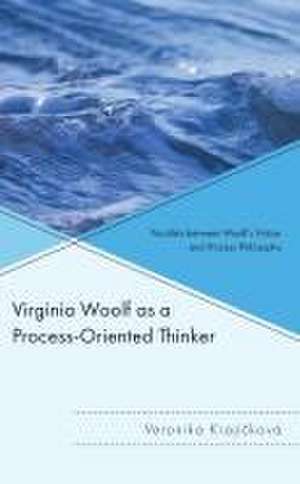
Virginia Woolf as a Process-Oriented Thinker: Parallels between Woolf’s Fiction and Process Philosophy: Contemporary Whitehead Studies
Autor Veronika Krajíckováen Limba Engleză Hardback – 10 oct 2023
Din seria Contemporary Whitehead Studies
- 36%
 Preț: 730.96 lei
 - 34%
 Preț: 602.61 lei
 - 33%
 Preț: 390.72 lei
 - 34%
 Preț: 581.67 lei
 - 33%
 Preț: 549.89 lei
 - 25%
 Preț: 361.94 lei
 - 32%
 Preț: 596.67 lei
 - 26%
 Preț: 263.60 lei
 - 32%
 Preț: 598.12 lei
 - 28%
 Preț: 220.75 lei
 - 27%
 Preț: 255.41 lei
 - 33%
 Preț: 775.66 lei
 - 19%
 Preț: 224.75 lei
 - 35%
 Preț: 995.31 lei
 - 27%
 Preț: 255.93 lei
 - 17%
 Preț: 266.76 lei
 - 34%
 Preț: 570.25 lei
Preț: 491.39 lei
Preț vechi: 721.31 lei
-32%
Puncte Express: 737
Carte tipărită la comandă
Livrare economică 03-17 decembrie
Livrare prin curier în România Termenul estimat este afișat lângă disponibilitate.
Transport gratuit pentru acest produs Plată online sau ramburs, în funcție de opțiunile comenzii.
Retur gratuit în 14 zile Comandă securizată și suport în română.
Specificații
ISBN-13: 9781666942293
ISBN-10: 1666942294
Pagini: 200
Dimensiuni: 150 x 232 x 18 mm
Greutate: 0.47 kg
Editura: Bloomsbury Publishing
Colecția Lexington Books
Seria Contemporary Whitehead Studies
Locul publicării:New York, United States
ISBN-10: 1666942294
Pagini: 200
Dimensiuni: 150 x 232 x 18 mm
Greutate: 0.47 kg
Editura: Bloomsbury Publishing
Colecția Lexington Books
Seria Contemporary Whitehead Studies
Locul publicării:New York, United States
Cuprins
Introduction: Virginia Woolf and Process-Oriented Thought
Chapter 1: Woolf's Conception of Things and the Relation Between Subject and Object
Chapter 2: Panpsychism and More-Than-Human Experience in Woolf's Fiction
Chapter 3: Woolf's Process-Oriented Identity, Intersubjective Selves, and Exploration of Community of Difference
Chapter 4: Woolf's Criticism of Anthropocentrism and Exploitation of Nature
Conclusion: Analogies Between Literature, Philosophy, and Real Life
Chapter 1: Woolf's Conception of Things and the Relation Between Subject and Object
Chapter 2: Panpsychism and More-Than-Human Experience in Woolf's Fiction
Chapter 3: Woolf's Process-Oriented Identity, Intersubjective Selves, and Exploration of Community of Difference
Chapter 4: Woolf's Criticism of Anthropocentrism and Exploitation of Nature
Conclusion: Analogies Between Literature, Philosophy, and Real Life
Recenzii
A book waiting to be written-and Veronika Krajícková does so in mindful, thorough, and always informative ways.
Veronika Krajícková's new book demonstrates that scholars studying Virginia Woolf's handling of materiality, ecology, ontology, ethics, and aesthetics (not to mention their entanglements!) ought to be in dialogue with the process philosophy of Alfred North Whitehead. While theorists like Gilles Deleuze, Donna Haraway, Jane Bennett, and Rosi Braidotti supply the conceptual architecture for much of this kind of work in Woolf studies, Krajícková shows the relevance of a philosopher who was Woolf's contemporary-a thinker whose writing not only resonates with Woolf's fiction and non-fiction but whose insistence on processual and relational models anticipates thing theory, OOO, speculative realism, and new materialism. There is much work left to do on Whitehead's place in modernist thought and culture.
Working from that sweet spot where philosophy and literature intersect, Veronika Krajícková writes about parallels between the fiction of Virginia Woolf and the speculative philosophy of Alfred North Whitehead. Though Woolf and Whitehead did not know one another well, they had an affinity through their similar reactions to the crises of early-twentieth-century modernity. They both sought to develop a richer account of the world's entanglements and interconnections than was available in the official culture of their day. Krajícková beautifully brings out the parallels between Woolf and Whitehead, and their shared search for the re-enchantment of our lives in the cosmos.
Veronika Krajícková's new book demonstrates that scholars studying Virginia Woolf's handling of materiality, ecology, ontology, ethics, and aesthetics (not to mention their entanglements!) ought to be in dialogue with the process philosophy of Alfred North Whitehead. While theorists like Gilles Deleuze, Donna Haraway, Jane Bennett, and Rosi Braidotti supply the conceptual architecture for much of this kind of work in Woolf studies, Krajícková shows the relevance of a philosopher who was Woolf's contemporary-a thinker whose writing not only resonates with Woolf's fiction and non-fiction but whose insistence on processual and relational models anticipates thing theory, OOO, speculative realism, and new materialism. There is much work left to do on Whitehead's place in modernist thought and culture.
Working from that sweet spot where philosophy and literature intersect, Veronika Krajícková writes about parallels between the fiction of Virginia Woolf and the speculative philosophy of Alfred North Whitehead. Though Woolf and Whitehead did not know one another well, they had an affinity through their similar reactions to the crises of early-twentieth-century modernity. They both sought to develop a richer account of the world's entanglements and interconnections than was available in the official culture of their day. Krajícková beautifully brings out the parallels between Woolf and Whitehead, and their shared search for the re-enchantment of our lives in the cosmos.