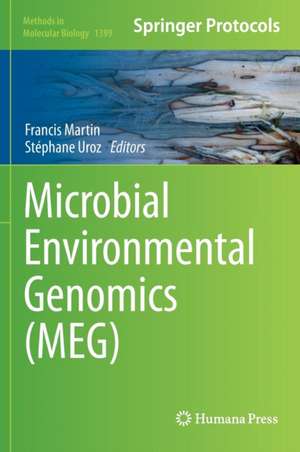
Microbial Environmental Genomics (MEG): Methods in Molecular Biology, cartea 1399
Editat de Francis Martin, Stéphane Urozen Limba Engleză Hardback – 21 ian 2016
Authoritative and practical, Microbial Environmental Genomics (MEG) will serve as a primary research reference for researchers and research managers in environmental microbiology working in the expanding field of molecular ecology and environmental genomics.
Din seria Methods in Molecular Biology
- 5%
 Preț: 752.32 lei
 - 5%
 Preț: 753.38 lei
 - 5%
 Preț: 762.24 lei
 - 5%
 Preț: 767.04 lei
 - 15%
 Preț: 682.63 lei
 - 18%
 Preț: 1056.83 lei
 - 5%
 Preț: 756.75 lei
 - 18%
 Preț: 942.11 lei
 - 15%
 Preț: 683.53 lei
 - 15%
 Preț: 673.77 lei
 - 18%
 Preț: 1459.88 lei
 - 5%
 Preț: 762.94 lei
 - 18%
 Preț: 1001.24 lei
 - 15%
 Preț: 679.26 lei
 - 5%
 Preț: 759.52 lei
 - 18%
 Preț: 1014.54 lei
 - 5%
 Preț: 755.09 lei
 - 5%
 Preț: 760.91 lei
 - 18%
 Preț: 992.42 lei
 - 15%
 Preț: 672.54 lei
 - 5%
 Preț: 1087.05 lei
 - 18%
 Preț: 972.05 lei
 - 18%
 Preț: 2199.73 lei
 - 5%
 Preț: 1345.68 lei
 - 18%
 Preț: 1435.06 lei
 - 18%
 Preț: 1446.89 lei
 - 18%
 Preț: 1171.86 lei
 - 18%
 Preț: 1461.94 lei
 - 18%
 Preț: 1166.54 lei
 - 18%
 Preț: 1001.54 lei
 - 5%
 Preț: 1347.38 lei
 - 5%
 Preț: 1150.76 lei
 - 5%
 Preț: 755.42 lei
 - 18%
 Preț: 1160.38 lei
 - 18%
 Preț: 991.80 lei
 - 18%
 Preț: 1453.36 lei
 - 5%
 Preț: 1331.69 lei
 - 18%
 Preț: 1285.76 lei
 - 18%
 Preț: 1275.27 lei
 - 5%
 Preț: 1704.75 lei
 - 5%
 Preț: 1159.98 lei
 - 5%
 Preț: 1470.11 lei
 - 18%
 Preț: 771.93 lei
 - 5%
 Preț: 1674.66 lei
 - 18%
 Preț: 749.09 lei
 - 5%
 Preț: 1142.35 lei
 - 5%
 Preț: 1355.98 lei
 - 5%
 Preț: 1679.79 lei
 - 18%
 Preț: 786.39 lei
Preț: 1149.62 lei
Preț vechi: 1210.12 lei
-5%
Puncte Express: 1724
Carte tipărită la comandă
Livrare economică 01-15 decembrie
Livrare prin curier în România Termenul estimat este afișat lângă disponibilitate.
Transport gratuit pentru acest produs Plată online sau ramburs, în funcție de opțiunile comenzii.
Retur gratuit în 14 zile Comandă securizată și suport în română.
Specificații
ISBN-13: 9781493933679
ISBN-10: 1493933671
Pagini: 336
Ilustrații: XII, 321 p. 55 illus., 34 illus. in color.
Dimensiuni: 183 x 260 x 24 mm
Greutate: 0.77 kg
Ediția:1st edition 2016
Editura: Springer
Colecția Methods in Molecular Biology
Seria Methods in Molecular Biology
Locul publicării:New York, NY, United States
ISBN-10: 1493933671
Pagini: 336
Ilustrații: XII, 321 p. 55 illus., 34 illus. in color.
Dimensiuni: 183 x 260 x 24 mm
Greutate: 0.77 kg
Ediția:1st edition 2016
Editura: Springer
Colecția Methods in Molecular Biology
Seria Methods in Molecular Biology
Locul publicării:New York, NY, United States
Public țintă
Professional/practitionerCuprins
“Dechiphering Archaeal Communities” Omics Tools in the Study of Archaeal Communities.- Investigating the Endobacteria which Thrive in Arbuscular Mycorrhizal Fungi.- Genosol Platform: A Logistic and Technical Platform for Conserving and Exploring Soil Microbial Diversity.- Sample Preparation for Fungal Community Analysis by High-Throughput Sequencing Of Barcode Amplicons.- Fungal Communities in Soils – Soil Organic Matter Degradation.- DNA-Based Characterization and Identification of Arbuscular Mycorrhizal Fungi Species.- Molecular Identification of Soil Eukaryotes and Focused Approaches Targeting Protist and Faunal Groups
Using High-Throughput Metabarcoding.- From Genome To Field: Detection Of Mating Type Genes in a Black Perigord Truffle (Tuber Melanosporum Vittad.) Orchard.- Stable Isotope Probing-RNA to Study Plant/Fungus Interactions.- Targeted Gene Capture by Hybridization to Illuminate Ecosystem Functioning.- Hybridization of Environmental Microbial Community Nucleic Acids by Geochip.- Reconstruction of Transformation Processes Catalysed by the Soil Microbiome Using Metagenomic Approaches.- MG-RAST, A Metagenomics Service for Analysis of Microbial Community Structure and Function.- Analysis of Active Methylotrophic Communities: When DNA-SIP Meets High Throughput Technologies.- Functional Metagenomics: Construction and High-Throughput Screening of Fosmid Libraries for Discovery of Novel Carbohydrate-Active Enzymes.- Metatranscriptomics of Soil Eukaryotic Communities.- Analysis of Ancient DNA in Microbial Ecology.
Using High-Throughput Metabarcoding.- From Genome To Field: Detection Of Mating Type Genes in a Black Perigord Truffle (Tuber Melanosporum Vittad.) Orchard.- Stable Isotope Probing-RNA to Study Plant/Fungus Interactions.- Targeted Gene Capture by Hybridization to Illuminate Ecosystem Functioning.- Hybridization of Environmental Microbial Community Nucleic Acids by Geochip.- Reconstruction of Transformation Processes Catalysed by the Soil Microbiome Using Metagenomic Approaches.- MG-RAST, A Metagenomics Service for Analysis of Microbial Community Structure and Function.- Analysis of Active Methylotrophic Communities: When DNA-SIP Meets High Throughput Technologies.- Functional Metagenomics: Construction and High-Throughput Screening of Fosmid Libraries for Discovery of Novel Carbohydrate-Active Enzymes.- Metatranscriptomics of Soil Eukaryotic Communities.- Analysis of Ancient DNA in Microbial Ecology.
Textul de pe ultima copertă
This volume seeks to understand how organisms and gene functions are influenced by environmental cues while accounting for variation that takes place within and among environmental populations and communities.Microbial Environmental Genomics (MEG) guides readers through methods to analyse the diversity of different organism types (archaea, bacteria, fungi, protists and microfauna), interactions between fungi and trees, and methods to identify and characterize functions and functional diversity of both pro- and eukaryotes. Written for the Methods in Molecular Biology series, chapters include introductions to their respective topics, lists of the necessary materials and reagents, step-by-step, readily reproducible laboratory protocols, and tips on troubleshooting and avoiding known pitfalls.
Authoritative and practical, Microbial Environmental Genomics (MEG) will serve as a primary research reference for researchers and research managers in environmental microbiology working in the expanding field of molecular ecology and environmental genomics.
Authoritative and practical, Microbial Environmental Genomics (MEG) will serve as a primary research reference for researchers and research managers in environmental microbiology working in the expanding field of molecular ecology and environmental genomics.
Caracteristici
Includes cutting-edge methods and protocols Provides step-by-step detail essential for reproducible results Contains key notes and implementation advice from the experts Includes supplementary material: sn.pub/extras