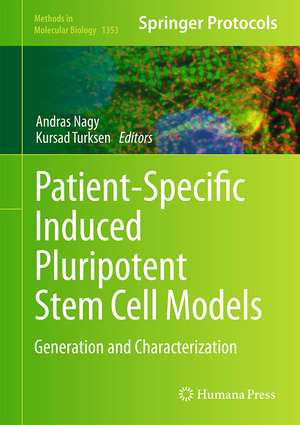
Patient-Specific Induced Pluripotent Stem Cell Models: Methods in Molecular Biology, cartea 1353
Editat de Andras Nagy, Kursad Turksenen Limba Engleză Hardback – 8 noi 2015
Sub coordonarea editorilor Andras Nagy și Kursad Turksen, acest volum din prestigioasa serie Methods in Molecular Biology consolidează progresele recente în tehnologia celulelor stem pluripotente induse (iPSC). Observăm o orientare clară către aplicabilitatea clinică, editorii reușind să reunească protocoale de laborator din centre de cercetare globale, axate pe crearea unor modele de boală fidele contextului genetic al pacientului. Această lucrare vine în completarea cercetărilor anterioare ale editorilor, precum Induced Pluripotent Stem (iPS) Cells de Andras Nagy, extinzând spectrul de la generarea de bază a celulelor spre caracterizarea lor funcțională în patologii complexe. Structura volumului este una eminamente practică, debutând cu metode non-invazive de prelevare, precum utilizarea vectorilor Sendai pe celule din sânge periferic sau biopsiile de piele. Găsim în această carte secțiuni dedicate corecției genetice prin sisteme inductibile cu doxiciclină, esențiale pentru validarea modelelor experimentale. Înaintând în cuprins, remarcăm o progresie logică de la reprogramare la diferențierea dirijată către linii celulare specifice, cum ar fi celulele cardiace sau musculare, oferind cercetătorului instrumentele necesare pentru a studia bolile cardiovasculare sau scheletice „într-o cutie Petri”. Fiecare capitol este calibrat pentru rigoarea academică, integrând liste de reactivi și sfaturi critice pentru evitarea obstacolelor tehnice frecvente. Patient-Specific Induced Pluripotent Stem Cell Models reprezintă o alternativă la Induced Pluripotent Stem Cells and Human Disease pentru cursurile de biologie celulară și medicină regenerativă, cu avantajul aducerii în prim-plan a unor tehnici specifice pentru tulburările de imprinting și mutațiile mitocondriale, oferind o perspectivă tehnică actualizată asupra modelării bolilor umane.
Din seria Methods in Molecular Biology
- 5%
 Preț: 752.32 lei
 - 5%
 Preț: 753.38 lei
 - 5%
 Preț: 762.24 lei
 - 5%
 Preț: 767.04 lei
 - 15%
 Preț: 682.63 lei
 - 18%
 Preț: 1056.83 lei
 - 5%
 Preț: 756.75 lei
 - 15%
 Preț: 683.53 lei
 - 15%
 Preț: 673.77 lei
 - 18%
 Preț: 1459.88 lei
 - 5%
 Preț: 762.94 lei
 - 18%
 Preț: 1001.24 lei
 - 15%
 Preț: 679.26 lei
 - 5%
 Preț: 759.52 lei
 - 18%
 Preț: 1014.54 lei
 - 5%
 Preț: 755.09 lei
 - 5%
 Preț: 760.91 lei
 - 18%
 Preț: 992.42 lei
 - 15%
 Preț: 672.54 lei
 - 5%
 Preț: 1087.05 lei
 - 18%
 Preț: 972.05 lei
 - 18%
 Preț: 2199.73 lei
 - 5%
 Preț: 1345.68 lei
 - 18%
 Preț: 1435.06 lei
 - 18%
 Preț: 1446.89 lei
 - 18%
 Preț: 1171.86 lei
 - 18%
 Preț: 1461.94 lei
 - 18%
 Preț: 1166.54 lei
 - 18%
 Preț: 1001.54 lei
 - 5%
 Preț: 1347.38 lei
 - 5%
 Preț: 1150.76 lei
 - 5%
 Preț: 755.42 lei
 - 18%
 Preț: 1160.38 lei
 - 18%
 Preț: 991.80 lei
 - 18%
 Preț: 1453.36 lei
 - 5%
 Preț: 1331.69 lei
 - 18%
 Preț: 1285.76 lei
 - 18%
 Preț: 1275.27 lei
 - 5%
 Preț: 1704.75 lei
 - 5%
 Preț: 1159.98 lei
 - 5%
 Preț: 1470.11 lei
 - 18%
 Preț: 771.93 lei
 - 5%
 Preț: 1674.66 lei
 - 18%
 Preț: 749.09 lei
 - 5%
 Preț: 1142.35 lei
 - 5%
 Preț: 1355.98 lei
 - 5%
 Preț: 1679.79 lei
 - 18%
 Preț: 786.39 lei
Preț: 942.11 lei
Preț vechi: 1148.92 lei
-18%
Carte disponibilă
Livrare economică 09-23 noiembrie
Specificații
ISBN-10: 1493930338
Pagini: 384
Ilustrații: XIII, 368 p.
Dimensiuni: 183 x 260 x 25 mm
Greutate: 0.94 kg
Ediția:1st edition 2016
Editura: Springer
Colecția Methods in Molecular Biology
Seria Methods in Molecular Biology
Locul publicării:New York, NY, United States
V-ar putea interesa
-
 Cell Physiology Source Book: Essentials of Membrane BiophysicsNicholas Sperelakis-24%Preț: 794.77 lei1051.23 lei
 -
 The Cell: A Very Short IntroductionTerence Allen-20%Preț: 56.65 lei70.82 lei
 -
 Stem Cells in Craniofacial Development and RegenerationGeorge T J Huang-9%Preț: 1091.25 lei1199.18 lei
 -
 AtherosclerosisHong Wang-9%Preț: 1236.92 lei1359.25 lei
 -
 Cytogenetic AbnormalitiesZneimer-9%Preț: 856.84 lei941.59 lei
 -
 Studies on Renal DisordersToshio Miyata-18%Preț: 1851.81 lei2258.31 lei
 -
 mTORThomas Weichhart-18%Preț: 1001.50 lei1221.33 lei
 -
 Osteoclasts: Cell Biology, Functions & Related DiseasesCecelia Reeves-27%Preț: 997.66 lei1361.20 lei
Public țintă
Professional/practitionerDe ce să citești această carte
Această lucrare este indispensabilă cercetătorilor și clinicienilor care doresc să implementeze protocoale de ultimă oră în modelarea bolilor specifice pacienților. Cititorul câștigă acces la metodologii reproductibile pentru transformarea celulelor somatice în modele de studiu viabile, facilitând testarea medicamentelor într-un mediu controlat. Este un ghid tehnic riguros ce elimină incertitudinile din laborator prin secțiunile sale detaliate de depanare și liste precise de materiale.
Cuprins
Textul de pe ultima copertă
Authoritative and practical, Patient-Specific Induced Pluripotent Stem Cell Models: Generation and Characterization is an ideal reference for scientists working on furthering iPS research.